

There is an old lead in your CRM right now that you wrote off six months ago. Maybe it was a quote that didn’t close, an Angi inquiry that ghosted after one text, or a homeowner who booked a consultation and then disappeared. The math behind Hatch’s pitch is that AI-driven SMS, voice, and email re-engagement can resurrect 8-12% of those dormant leads — pulling them back through the funnel without your CSR team lifting a finger. The pitch is real, the technology is real, and named operators are reporting real numbers. The question for any contractor evaluating Hatch in 2026 is whether it’s the right shape for your operation specifically — and the answer depends entirely on which CRM you run, what trade you’re in, and whether you’re prepared to sign an annual contract on demo-gated pricing.
Hatch is the AI CSR platform across SMS, voice, and email for service businesses, now operating as a wholly-owned subsidiary of Yelp following the company’s $300 million acquisition that closed February 2026. Founded in 2018 by Christopher Bache (CEO) and William Violante (President), Hatch reached approximately $25M ARR with 70% YoY growth at the point of acquisition. The product is purpose-built for home services (HVAC, plumbing, electrical, roofing) and home improvement (remodeling, windows & doors, flooring) operators, with 2,000+ customers including more than half of the top 20 QR 500 home improvement companies. ServiceTitan Gold Partner status with the only AI calendar-booking integration on the market is the deepest single integration moat, and the lead-source integration breadth (23 native sources including Angi, Thumbtack, Google LSA, Modernize, HomeBuddy, Yelp, and Facebook) is class-leading.
This review covers what Hatch actually is in May 2026 — including the Yelp acquisition implications operators should think about explicitly, the verified product architecture, the integration depth and the meaningful CRM gaps (Housecall Pro, Service Fusion, FieldEdge are NOT native), the pricing reality (operator-reported $700-$1,500/month on annual contracts with no free trial), the polarized 3.5/5 Capterra distribution and what that bimodal pattern actually means, named operator results from Pella, High Ground, and Peaden, the per-dimension scoring that lands Hatch at 3.7 on our framework, and the explicit who-is-NOT-for filter against GoHighLevel AI Employee, Avoca AI, and Viktor.
“I would never recommend anybody to use this software… Massive waste of money.” — Anonymous Owner, Construction company, Capterra 1-star review, December 18, 2025
“Hatch has been very helpful in sales, sales follow up and speed to lead inquiry’s.” — Rachel L., Inside Sales, Construction company, Capterra 5-star review, December 17, 2025
The two reviews above were posted one day apart. They’re both real, they’re both verified, and they’re both consistent with the bimodal pattern across all 40 Capterra reviews. Hatch is not a product where the average review tells you the truth — it’s a product where stack-fit determines outcomes, and matching your stack to Hatch’s native integrations is the single biggest variable in whether the platform pays for itself.
What Hatch Actually Is in 2026 (Now Owned by Yelp)
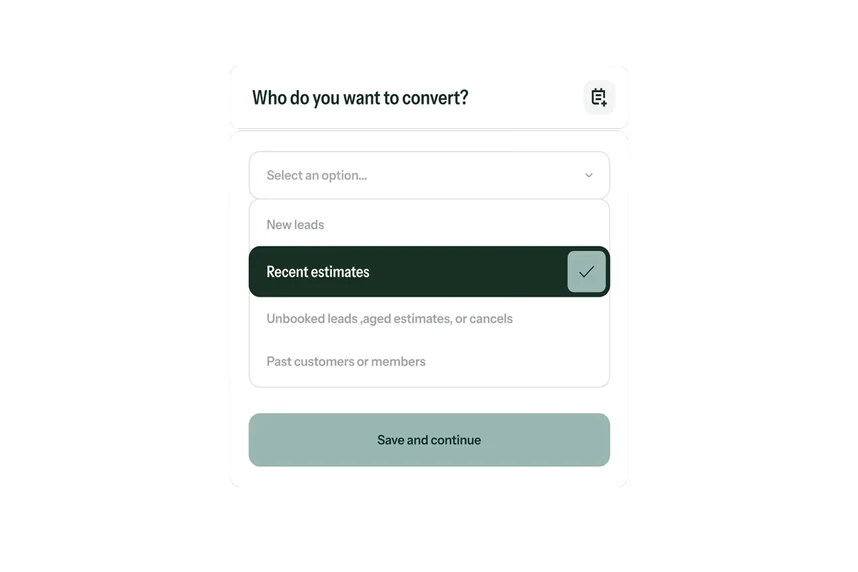
Hatch is an AI CSR platform across three communication channels — SMS (Messaging AI), voice (Voice AI, both inbound and outbound as of March 2026), and email — coordinated through a unified Command Center where operators see the conversation history per lead across all channels. The product framing post-acquisition is “the definitive AI CSR platform” with the company explicitly rejecting the “tool” framing in favor of “AI infrastructure embedded into the way your business operates.”
The architectural model is CRM-anchored autonomous engagement. Hatch sits between your lead sources (Angi, Thumbtack, Google LSA, Modernize, your website forms, Yelp, Facebook, and 16 more) and your CRM (ServiceTitan, HubSpot, AccuLynx, JobNimbus, Jobber, Salesforce, Microsoft Dynamics, and 5 more). When a lead arrives — whether new from a lead source or dormant from your CRM — Hatch’s AI runs autonomous multi-channel sequences (SMS, then voice, then email; or any combination) to qualify, nurture, and book the appointment, then writes the outcome back to your CRM as a synced record.
The seven product surfaces named on Hatch’s homepage are:
- Voice AI — autonomous inbound and outbound calls with intent detection, dialogue navigation, and human handoff on demand
- Messaging AI — autonomous SMS conversations with customizable bot personalities and directives
- Journey Builder — multi-step nurture sequence designer (operator-configurable but typically built by Hatch staff during onboarding)
- Command Center — unified workspace for monitoring conversations across all three channels
- Knowledge Engine — operator-uploaded business context (services, pricing, FAQs, brand voice) the bots reference during conversations
- Data Bridge — bidirectional CRM sync layer
- AI Embed — chat widget for operator websites
Where Hatch fits on our AI Agents hub: Tier 1 (Multi-Channel) AI CSR specifically for ServiceTitan-anchored operators. The closest analog on the hub is Avoca AI — both run autonomous Voice AI on ServiceTitan, both target home services, both score 4 on autonomy. The differentiator is that Avoca’s three-pillar model (Convert/Nurture/Coach) is specifically inbound-call-centric with a CSR-coaching layer; Hatch’s model is multi-channel-coordinated outbound-and-inbound with deeper lead-source ingestion. For operators whose top problem is lead-source conversion across many sources, Hatch is the better-shaped tool. For operators whose top problem is inbound call quality and CSR coaching, Avoca is the better-shaped tool.
The Yelp Acquisition: What It Means for Operators
This is the section most existing Hatch reviews on G2, Capterra, and SoftwareAdvice don’t cover yet — because most of those reviews predate February 2026. Treat this as the most important editorial flag in the review.
On January 21, 2026, Yelp Inc. (NYSE: YELP) announced it was acquiring Hatch in a deal that closed in early February for approximately $300 million total consideration ($270M cash plus $30M in employee retention over 2-3 years). At acquisition, Hatch had ~$25M ARR with 70% YoY growth and was modestly cash-flow negative. Yelp CEO Jeremy Stoppelman framed the deal as “an important step forward in Yelp’s AI transformation,” and Hatch CEO Chris Bache stated the company would “scale faster and help more businesses grow and succeed” as part of Yelp.
Operationally, the change is small. Hatch continues to run as a wholly-owned subsidiary with its existing leadership, brand, product, and customer relationships intact. The April 2026 Hatch Customer Advisory Summit in NYC and the March 2026 Outbound Voice AI launch both happened post-acquisition under the existing Hatch leadership.
Strategically, the change matters more than it appears. Yelp now owns both:
- Yelp (the lead source) — paid Yelp leads are one of Hatch’s 23 native lead-source integrations. Operators paying for Yelp leads have those leads route directly into Hatch’s AI sequences.
- Hatch (the AI agent that engages those leads) — the AI sequences that re-engage dormant leads, qualify new leads, and book appointments.
The structural incentive that emerges over the next 24 months is that Yelp has a financial interest in promoting Yelp leads through Hatch’s AI sequences over leads from competing sources (Angi, Thumbtack, Google LSA, Modernize, HomeBuddy, etc.). Whether that incentive manifests in product behavior — preferential routing, prioritized nurture cadence, lead-quality features that work better on Yelp leads than on competitor sources, lead-source attribution dashboards that emphasize Yelp ROI — is an open editorial question. The acquisition is too recent (3 months at publish time) for any of this to have shipped. But on a 2-3 year evaluation horizon, this is a real flag rather than a speculative one.
Operator implications:
- If you don’t pay for Yelp leads currently, Hatch’s value proposition is unchanged. You’re using Hatch to coordinate Angi, Thumbtack, Google LSA, and your other lead sources just as before.
- If you DO pay for Yelp leads, you should be aware that the platform you’re using to nurture those leads is now owned by the company selling them to you. The conflict isn’t necessarily bad — Yelp’s incentive to make Yelp leads convert better on Hatch is aligned with your incentive — but it’s not neutral.
- If you’re evaluating Hatch against Avoca AI (Series B independent), Alivo (Series A independent), or GoHighLevel AI Employee (independent platform), the lead-source neutrality of those alternatives is a genuine differentiator on this dimension.
The honest editorial position: Yelp ownership is a meaningful new flag, not a deal-breaker. Operators with diversified lead sources outside Yelp can use Hatch without the conflict materially affecting their workflow. Operators heavily dependent on Yelp leads should explicitly think about the structural alignment.
AI CSR Architecture: Voice AI, Messaging AI, Journey Builder
The autonomy level of Hatch’s AI is higher than most contractor operators expect from a “texting platform” — and meaningfully higher than the legacy positioning of competitors like Podium and Birdeye. This section covers what each AI surface actually does end-to-end.
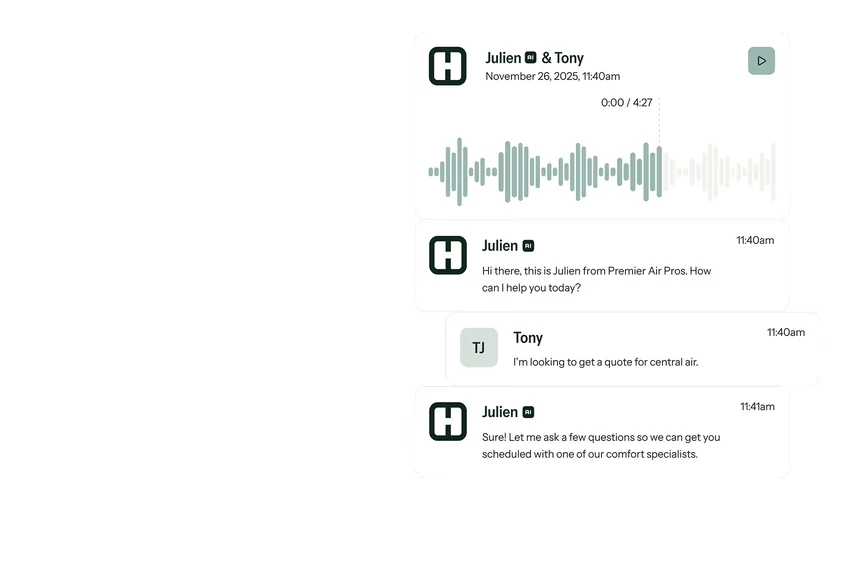
Voice AI (inbound and outbound) runs autonomous phone conversations. The bots get a name, a personality, a business profile reference, and a directive (qualify leads, book appointments, follow up on outstanding quotes), then handle the full call dialogue without human intervention. Hatch’s published documentation states the bots “don’t follow scripts — they understand intent, navigate complex dialogues, and adapt in real time.” When a customer asks for a human or the conversation hits a defined complexity threshold, the bot transfers the call to your CSR team with the conversation context attached. The March 2026 launch added autonomous outbound calls — the same agents that handle inbound now also call leads, qualify them, and book appointments on the operator’s behalf.
Messaging AI runs autonomous SMS conversations with the same architectural pattern — named bot, personality, directive, autonomous dialogue, human handoff on demand. The bots can be configured with different personas for different lead sources (a lighter conversational tone for Facebook leads, a more direct booking-focused tone for Angi, etc.). The Knowledge Engine layer feeds the bots your business-specific context (services offered, service area, pricing structure, common objections, brand voice) so responses stay accurate and on-brand.
Email AI handles email responses and outbound nurture sequences. This is the channel with the least operator-reported feedback — most published case studies emphasize voice and SMS performance, with email functioning more as a tertiary channel for confirmations and longer-form nurture content.
Journey Builder is the multi-step sequence designer where operators (or, more commonly, Hatch’s onboarding staff during your initial setup) configure the cadence, channel sequence, and trigger logic for each lead-source workflow. Example: Angi lead arrives → SMS within 60 seconds → if no response after 15 minutes, autonomous voice call → if no response after 24 hours, email follow-up → if no response after 72 hours, second SMS attempt → if engaged at any point, AI books appointment and writes back to ServiceTitan. The flexibility is genuine; the constraint is that meaningful changes typically require going back through Hatch’s onboarding team rather than self-edit in a UI.
Command Center is the unified operator workspace — every conversation across every channel for every lead, in one view. This is the operational layer most working CSRs interact with day-to-day, and the feature set most named operator testimonials cite when describing time saved.
Knowledge Engine is the layer most under-discussed in third-party reviews and most consequential for AI accuracy. The quality of Hatch’s bots depends almost entirely on the quality of the operator-provided context loaded into Knowledge Engine — service descriptions, pricing structure, service area, common objections, escalation rules, brand voice. Operators who invest in detailed Knowledge Engine setup report substantially better AI performance than those who don’t. This is the part of Hatch’s onboarding that Hatch’s staff specifically guides operators through, which is why the weekly 30-minute calls during onboarding are operationally meaningful (and frustrating to operators who wanted self-serve).
The underlying language model powering Hatch’s AI is not publicly disclosed. Whether it’s OpenAI, Anthropic, a proprietary model, or a multi-model architecture is not stated on Hatch’s website, in press releases, or in operator-facing materials. For operators who care about LLM disclosure as a procurement standard (PE-backed operations, healthcare-adjacent restoration work, operations subject to data-handling audit requirements), this opacity is worth flagging.
The ServiceTitan Gold Partner Story (And Where Hatch Falls Short)
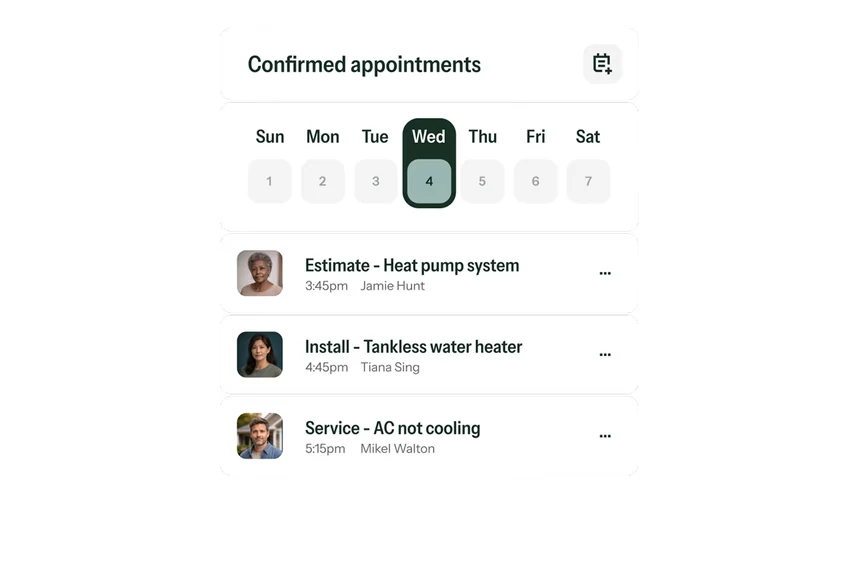
Hatch is a ServiceTitan Gold Partner with the only AI agent integration on the market that books directly into the ServiceTitan calendar without operator intervention. The bidirectional sync runs every 15 minutes, customer records flow both directions, and 1,000+ ServiceTitan operators currently use Hatch — that’s the deepest single-integration moat on our AI Agents hub. For HVAC, plumbing, and electrical operators running ServiceTitan as the system of record, this is a genuine differentiator. Avoca AI is also a ServiceTitan Gold Partner with deep integration, but only Hatch ships native calendar booking.
The full native CRM integration list (verified from Hatch’s integrations page, May 2026) is: AccuLynx, CertaOne, HubSpot, improveit 360, Jobber, JobNimbus, LeadPerfection, Leap, MarketSharp, MetricWise, Microsoft Dynamics, Salesforce, ServiceTitan. Twelve CRMs, with ServiceTitan being the deepest by a meaningful margin.
The lead-source integration list is where Hatch’s breadth is genuinely class-leading. Twenty-three native lead sources including 33 Mile Radius, Angi, Blue Fire Leads, BluePagesPro, Buyerlink, Contractor Appointments, CraftJack, EverConnect, Facebook, GlassHouse, Google LSA, HelloProject, Home Appointments, HomeBuddy, homeyou, Modernize, My Home Pros, Porch, Quinstreet, SolarReviews, Stone Canyon AI, Thumbtack, and Yelp. For home-improvement operators (windows, doors, remodelers, flooring) buying leads from multiple aggregators, this depth means the AI sequences fire reliably across every lead source without Zapier middleware introducing latency or sync failures.
The tool integration list is also substantive: 800response, ActiveProspect, Boostpoint, Caddie Services, CompanyCam, Demand IQ, Hover, Ingage, One Click Contractor, Renoworks, SalesRabbit, Siro, WinGen, WordPress, and Zapier itself.
Where Hatch falls short on integrations is the residential service CRM stack outside ServiceTitan. Housecall Pro, Service Fusion, FieldEdge, and Successware are NOT on the public native integrations list. These are dominant CRMs in residential service — Housecall Pro especially, which powers a large share of solo and small-team residential operations across HVAC, plumbing, electrical, and home improvement. Hatch’s marketing copy in some blog posts implies broader CRM compatibility, but the integrations page is the authoritative list.
For operators on those CRMs, the practical options are:
- Use Zapier middleware to bridge Hatch with your CRM. Operator-reported reliability is mixed — some workflows work cleanly, others break in ways that lose leads. Capterra reviewers specifically flag this.
- Migrate to a Hatch-supported CRM — usually not a realistic option for established operations.
- Use a different AI CSR platform. Avoca AI lists Housecall Pro support. GoHighLevel AI Employee operates inside the GHL ecosystem with its own CRM and bypasses the integration question entirely.
The honest editorial position: Hatch’s integration story is genuinely best-in-class for ServiceTitan-anchored mid-market operators, and structurally weak for everyone else. Verify your specific CRM is on the native list before any commitment.
What Hatch Actually Costs (And Why You Won’t Find a Price on Their Site)
This is the most opaque pricing in the AI Agents category, and the section where editorial honesty matters most.
Hatch does not publish pricing publicly. The pricing page lists three named tiers — Standard, Pro, Enterprise — with no associated dollar figures. The pricing model is described as “platform fee plus usage. Plans are annual, paid monthly per location.” All AI tiers include 500 conversations per month bundled in the platform fee. There is no free trial, no monthly contract option, no published setup fee, and no money-back guarantee.
Operator-reported pricing from Capterra, GetApp, SaaSWorthy, and SoftwareAdvice reviews falls in the $700-$1,500 per month range plus per-conversation usage charges:
- SaaSWorthy aggregated data: starts at approximately $600/month
- Capterra reviewer-reported range: $700-$1,500/month (most common)
- SoftwareAdvice reviewer mention: $250/month for chat-to-text only (lowest reported figure, likely a legacy tier)
- One operator reported being charged $1,500 even after written cancellation notice — implies contract minimums and difficulty cancelling
- Multiple reviewer mentions in the $900-$1,000 range
The annual contract structure is explicitly confirmed on Hatch’s pricing page. Multiple Capterra reviewers complain about annual lock-in friction and difficulty cancelling. Verify cancellation terms and contract minimums in writing before any commitment.
The cost-to-value math depends entirely on call volume and stack-fit. For operators running 20+ appointments per week (Hatch’s own stated best-fit threshold) on ServiceTitan with multiple lead sources, the math typically works — Rich Jordan at High Ground reports $300K saved annually at one operator, Reyn Rogers at Peaden reports 30% of all revenue influenced by Hatch. For solo operators or single-truck contractors running fewer than 20 appointments per week, the cost-to-value math is structurally unfavorable — the platform fee alone exceeds what most lower-volume operations save in CSR labor.
Pricing alternatives in the same category: Avoca AI is also sales-quoted but operator-reported in the $1K-$3K/month range — not transparent, but a similar order of magnitude. Alivo publishes $1,299/month directly on its website (the most transparent pricing on the AI Agents hub for vertical roofing operators). GoHighLevel AI Employee is $97/mo Unlimited as an add-on inside an existing GHL subscription — by far the cheapest path to AI CSR coverage for any contractor already running GHL. Viktor publishes $50/mo Team plan plus $100 in free credits to start with no card required — the cleanest evaluation path in the entire AI Agents category, though with a different audience focus (office-team coworker, not customer-facing CSR).
The Polarized Review Pattern: Why Hatch Works for Some Operators and Fails for Others
Capterra shows 3.5 out of 5 across 40 reviews — but the average tells you almost nothing about the product. The distribution is bimodal: 63% of reviewers rate it 4 or 5 stars, 35% rate it 1 or 2 stars, with very few ratings clustering around the average. GetApp shows the same pattern — 3.6/5 across 40 reviews with sub-scores diverging widely (Value for Money 3.3/5, Email Management 2.9/5, Performance Metrics Tracking 2.5/5, Interaction Tracking 2.3/5). G2’s listing for “Hatchify Hatch” exists but our automated review fetch returned a 403 — we’re flagging this as unverified pending manual lookup.
Read the bimodal pattern as a fit signal, not a quality signal. The dividing line between five-star reviewers and one-star reviewers, when you read the actual review text, is consistently:
- Five-star reviewers are operators on ServiceTitan, HubSpot, AccuLynx, JobNimbus, or Salesforce running 20+ appointments per week with multiple lead sources. The platform’s native integrations work cleanly for their stack, the AI sequences book appointments at meaningfully higher rates than their CSR baseline, and the cost-to-value math is favorable. Named positive examples (Pella, High Ground, Peaden, Bone Dry Roofing) all fit this profile.
- One-star reviewers are operators whose stack doesn’t match Hatch’s native integrations (Housecall Pro, Service Fusion, FieldEdge users), operators who hit cost-to-value mismatches at lower call volumes, and operators who experienced billing or cancellation friction. The complaint patterns are remarkably consistent across the negative reviews.
Real Tier-1 named customer evidence (positive):
“Hatch has been very helpful in sales, sales follow up and speed to lead inquiry’s.” — Rachel L., Inside Sales, Construction company, Capterra 5-star review, December 17, 2025
“The speed and efficiency with which Hatch has allowed us to respond to customers… grow rapidly without needing to add as many employees.” — Ray T., Contact Center Director of Operations, GetApp review
“Built in API to connect our existing CRM system to Hatch in order to build automations that start campaigns in the background automatically.” — Drew M., Controller, GetApp review
Real Tier-1 named customer evidence (negative):
“Misrepresented Product, Ignored Cancellation Request, Continued Billing During Active Dispute.” — Tom A., CEO, Construction company, Capterra 1-star review, April 28, 2026
“High pressure sales, long contracts, not honest.” — Bill B., CEO, Construction company, Capterra 1-star review, January 14, 2025
“Hatch Missed the Mark – Poor Integration and Weak Results.” — Rami O., CEO, Construction company, Capterra 2-star review, July 17, 2025
Recurring complaint themes verified across both Capterra and GetApp:
- High-pressure sales process during the demo
- Long annual contract lock-in with cancellation friction
- Continued billing during cancellation disputes (multiple separate operator reports)
- Integration syncs breaking (especially for non-native CRM combinations)
- AI hallucinating or “making things up” on edge-case lead inquiries
- Heavy onboarding cadence (multiple weekly 30-minute calls required)
- Cost-to-value mismatch for operators below 20 appointments/week
Aggregate marketing claims from Hatch’s own site (Tier 4 — treat as marketing-tier evidence): $70M client revenue influenced for Free Agency; $7M+ closed through Bone Dry Roofing’s rehash campaigns; $365K booked in 60 days for Crown Roofing; Shafer Services 80% more bookings via Voice AI with 90+ monthly appointments AI-set. These numbers are real, but the case-study format and the absence of independent verification means we weight them lower than the named Capterra reviews above.
How Hatch Stacks Up on the 7 AI Agents Dimensions
Our framework scores AI agents across seven dimensions weighted by editorial relevance to contractor operators. Hatch’s per-dimension breakdown:
-
Contractor Specificity (18% weight): 4/5 — purpose-built for home services and home improvement, 2,000+ customers in those verticals, 12 native CRM integrations skewed toward residential service. Not 5 because painting, general contractors, solar-only operators, pool service, landscaping, and pest control are not explicitly targeted. Comparable to Avoca AI at 4/5; behind Alivo at 5/5 (vertical roofing depth).
-
Autonomy Level (17% weight): 4/5 — Voice AI and Messaging AI run fully autonomous conversations with intent detection, dialogue navigation, and human handoff on demand. Outbound Voice AI shipped March 2026. Comparable to Avoca and Alivo (also 4/5); meaningfully higher than legacy texting platforms like Podium (which remain template-based for the most part).
-
Integration Depth (16% weight): 4/5 — ServiceTitan Gold Partner with the only AI calendar booking on the market, 12 native CRMs, 23 native lead sources, 16 tool integrations. Class-leading for the ServiceTitan ecosystem. Not 5 because Housecall Pro, Service Fusion, FieldEdge, and Successware are NOT native — and those are dominant CRMs for residential service operators outside the ServiceTitan ecosystem. Behind Avoca and Alivo (both 5/5 in their respective verticals).
-
Setup Complexity (15% weight): 3/5 — heavy onboarding with multiple weekly 30-minute calls, campaigns and Journey Builder workflows typically configured by Hatch staff rather than self-serve. Time to operational is measured in weeks, not days. The staff-built configuration model means meaningful changes require routing through Hatch’s team. Behind Avoca (4/5 with smoother onboarding) and well behind Viktor (5/5 with self-serve in-Slack configuration).
-
Human Oversight Required (14% weight): 4/5 — shared Command Center workspace for monitoring conversations across channels, transfer-on-demand handoff to human CSRs, configurable escalation rules. Healthy oversight available without making the AI feel handicapped. Comparable to Avoca and Alivo.
-
Cost Structure (12% weight): 2/5 — hidden pricing on the website, demo-gated evaluation, annual contracts, no free trial, no money-back guarantee, multiple operator complaints about billing during cancellation disputes. The most opaque pricing in the category. Behind Avoca (3/5, sales-quoted but with operator-published $1K-$3K range), behind Alivo (3/5 with $1,299/month published), and well behind GoHighLevel AI Employee (4/5 at $97/mo Unlimited published) and Viktor (4/5 at $50/mo Team plan published with $100 free credits).
-
Data Sovereignty (8% weight): 2/5 — cloud-only deployment, no public LLM disclosure (which model powers the AI is not stated), no published SOC 2 Type 1/2, HIPAA, or GDPR compliance posture. Operators handling sensitive customer data or operating under PE-backed procurement standards should treat this opacity as a real flag. Behind Avoca (also 2/5 but with public SOC 2 + GDPR posture per their published documentation) and well behind Viktor (2/5 but SOC 2 Type 1 + GDPR + CCPA + CASA Tier 3 disclosed) and RoofClaw (5/5 for local-hardware sovereignty).
Weighted overall: 3.45 + 0.20 calibration constant = 3.65 → displays 3.7/5.0 ★★★½☆. Hatch lands sixth on the AI Agents hub — behind Alivo (4.3), GoHighLevel AI Employee (4.2), Avoca AI (4.1), Viktor (4.1), and RoofClaw (3.8). The gap to RoofClaw (3.8) is 0.1 — both products have one big honest issue (RoofClaw’s setup-complexity 1/5 hardware delivery friction; Hatch’s cost-structure 2/5 pricing opacity), and both lose ground on data sovereignty.
Hatch vs GoHighLevel vs Podium: Picking the Right Texting Layer
This is where most contractor evaluations land — three products compete for the “we need an AI texting layer” budget line, and they’re built around fundamentally different architectures. The honest decision rule depends on what the rest of your stack looks like.
Hatch is the AI CSR platform — autonomous SMS plus Voice plus Email, ServiceTitan-anchored, $700-$1,500/mo on annual contracts, designed for mid-market home services running 20+ appointments per week. The wedge is multi-channel coordination plus deep ServiceTitan integration plus 23 native lead sources. If your operation is ServiceTitan-anchored with multiple lead sources (Angi + Thumbtack + Google LSA + Modernize + your website forms), Hatch is the right shape.
GoHighLevel is the all-in-one marketing and CRM stack — agency-style platform that includes AI Employee, AI Receptionist (Voice AI), texting, email, calendar booking, pipeline management, automation, and reputation management in a single subscription. The AI Employee add-on is $97/mo Unlimited inside an existing GHL account. The wedge is breadth at one-fifth the cost — for operators who need an AI texting layer AND a CRM AND voice AND automation AND reputation management, GHL covers all of it. The trade-off is that GHL is a generalist agency stack rather than a purpose-built home services product, and the integrations with ServiceTitan or other vertical CRMs aren’t as deep as Hatch’s. For operators who don’t already have a deeply-built CRM workflow elsewhere, GHL is genuinely the better economic choice — and the funnel many Hatch evaluators end up in once they realize how much their ServiceTitan setup is actually costing them.
Podium is the post-sale and reactive customer-engagement platform — review requests, appointment reminders, broadcast SMS to existing customer lists. The wedge is reputation management depth and lower entry price for small-to-medium local operators. Podium does NOT run autonomous AI sequences on inbound leads, does NOT have ServiceTitan calendar booking, and does NOT coordinate multi-step pre-sale nurture across SMS/Voice/Email. Hatch’s own published comparison (which is editorially fair) frames it as: “Podium is best for small and local businesses that want to improve reputation. Hatch is best for medium and large businesses that want to increase conversion.”
Practical decision rule:
- If your top problem is lead-recovery and pre-sale conversion across multiple lead sources, on ServiceTitan, Hatch is the right shape.
- If your top problem is needing a full marketing/CRM/voice/texting stack at low cost and you’re willing to build inside the GHL ecosystem, GoHighLevel covers texting plus everything else at one-fifth the cost.
- If your top problem is reputation management and review velocity for a small-to-medium local operator, Podium is the right shape.
- If your top problem is inbound call quality and CSR coaching specifically, Avoca AI is the better-shaped tool.
- If your top problem is office-team productivity (board reports, multi-tool data analysis, custom internal dashboards) rather than customer-facing engagement, Viktor is the right shape — different category entirely.
Who Hatch Is Built For
The right operator profile for Hatch is specific and narrower than the marketing implies, but genuinely real for the operators who fit:
- Mid-market home services operators on ServiceTitan running HVAC, plumbing, or electrical with 20+ appointments per week. The ServiceTitan calendar booking integration is a meaningful operational moat, the deep bidirectional sync handles the data flow without breakage, and the per-location pricing structure works for multi-location operations.
- Mid-market home improvement operators in remodeling, windows & doors, flooring, or bath remodeling. Hatch’s customer concentration in this segment (more than half of the top 20 QR 500 home improvement companies) means peer operators have already validated the product. Pella, Bone Dry Roofing, Crown Roofing, Luxury Bath, SwiftPro, and High Ground are all named users in this profile.
- Multi-lead-source operations buying leads from 5+ aggregators. The 23 native lead-source integrations (Angi, Thumbtack, Google LSA, Modernize, HomeBuddy, Porch, CraftJack, Yelp, Facebook, etc.) coordinate without Zapier middleware, which is a genuine differentiator for operators whose lead pipeline depends on aggregator diversity.
- Operators with an existing CSR team Hatch can augment rather than replace. The Command Center workspace assumes human CSRs handling escalations, complex conversations, and bot-handoff scenarios. Hatch is structurally not a “fire your CSRs” play — it’s a “make your CSRs handle 3x the volume” play, which works for operations that already have CSR labor in place.
- Operations comfortable with annual contracts and demo-gated pricing, who value vendor stability over evaluation transparency. The Yelp acquisition genuinely improves long-term roadmap predictability — for operators who want a vendor that won’t be acquired or shut down in 18 months, Hatch’s parent-company strength is real.
Who Should NOT Use Hatch
The audience-mismatch filter on Hatch is just as important as the audience-fit description. If any of the following apply, Hatch is the wrong product for your operation:
- Solo operators or single-truck contractors running fewer than 20 appointments per week. The cost-to-value math is structurally unfavorable at low volumes — $700-$1,500/month plus usage on an annual contract exceeds what most lower-volume operations save in CSR labor. For lower-volume operators who still want AI CSR coverage, Avoca AI at the lower end of its quote range is a better-shaped fit, or stay with a human CSR until volume justifies the platform investment.
- Operators on Housecall Pro, Service Fusion, FieldEdge, or Successware. Hatch does NOT natively integrate with any of these CRMs. Forcing Zapier middleware will introduce reliability issues that show up as lost leads — and Capterra reviewers consistently flag this as a friction point. Avoca AI lists Housecall Pro support; GoHighLevel AI Employee operates inside the GHL ecosystem with its own CRM.
- Operators who need a full marketing/CRM/voice/texting/automation stack rather than a specialist texting layer. GoHighLevel covers Hatch’s texting use case PLUS CRM, calendar, automation, reputation management, and AI Employee at $97/mo Unlimited inside the GHL platform — one-fifth the cost of Hatch for a meaningfully broader feature set. For operators not already deeply committed to ServiceTitan or another CRM, GHL is the better economic choice.
- Operators who need an internal office-team AI coworker (board reports, multi-tool data analysis, custom internal dashboards, recurring office automations) rather than a customer-facing CSR. Viktor is purpose-built for that use case and sits in your Slack workspace — entirely different shape, different audience, different pricing ($50/mo Team plan + $100 free credits to start). Hatch is customer-facing AI; Viktor is office-team AI.
- Roofing-vertical operators who want vertical-trained AI rather than multi-trade home-services AI. Alivo is the roofing-specific Tier 1 vertical agent on the AI Agents hub at $1,299/month with five named agents (Lilly/Evan/Alex/Jenna and the orchestration layer) trained specifically on roofing scenarios.
- Operators who require transparent pricing before commitment. Hatch’s pricing is not published and is gated behind a sales demo with annual contract terms. If you require a free trial, monthly contract option, or money-back guarantee before signing — Hatch will not accommodate that. Viktor at $50/mo with $100 free credits is the cleanest evaluation path on the AI Agents hub; GoHighLevel offers a 14-day free trial.
- Operators heavily dependent on Yelp leads who want lead-source neutrality. The Yelp acquisition creates structural alignment between Yelp (the lead source) and Hatch (the AI agent re-engaging those leads). Avoca AI, Alivo, and GoHighLevel are all independent of Yelp ownership.
- Operators handling sensitive customer data who require published SOC 2, HIPAA, or LLM disclosure. Hatch does not publicly state which language model powers their AI, has not published SOC 2 / HIPAA / GDPR compliance posture, and does not market data-sovereignty features. For PE-backed operations or work with healthcare-adjacent data handling requirements, Viktor (SOC 2 Type 1 + GDPR + CCPA + CASA Tier 3 disclosed) or RoofClaw (local-hardware deployment with 5/5 sovereignty) are better-shaped alternatives.
Hatch in the Broader Contractor AI Stack
The structural position Hatch occupies — ServiceTitan-anchored multi-channel AI CSR with deep lead-source ingestion — is a real one, and the operators who fit get genuine value. But Hatch is one piece of a contractor’s full AI stack, not the whole stack. Here’s how Hatch fits alongside the other AI tools and agents on our coverage:
Customer-facing AI agents (Hatch’s category): Avoca AI for inbound voice with CSR-coaching depth on ServiceTitan; Alivo for vertical roofing with five trained agents; GoHighLevel AI Employee for the broader GHL ecosystem at one-fifth the cost; RoofClaw for storm-restoration roofing operators who require local-hardware data sovereignty. Hatch’s specific lane within this set is multi-channel coordination + deep ServiceTitan integration + 23 lead sources — pick Hatch if those three things are your top priorities.
Office-team AI coworker (different category, complementary): Viktor sits in your Slack workspace and runs internal office workflows — board reports, marketing-spend dashboards, recurring data analyses across HubSpot + Google Ads + Stripe. For multi-location contractor operations or contractor marketing agencies, Hatch handles customer-facing engagement while Viktor handles internal office productivity. Different jobs, complementary stack positions.
AI receptionists and call answering (overlap zone): The AI receptionists on our AI Call Answering hub (Smith.ai, Rosie, AI by Ruby) handle 24/7 inbound voice answering specifically. Hatch’s Voice AI overlaps but is broader (also outbound, also SMS, also email) — for operators who only need inbound call answering and don’t want the full multi-channel platform, the dedicated receptionists are simpler and often cheaper. Hatch makes sense when the operator’s actual problem is multi-channel pre-sale conversion, not just call answering.
AI tools for office productivity (different category): The workflow and productivity tools on our AI Tools hub (Claude, ChatGPT, Zapier AI, etc.) cover non-customer-facing AI use cases — content drafting, internal data analysis, spreadsheet automation. Hatch is not in this category and does not replace these tools. Most contractor operations need both: customer-facing AI (Hatch, Avoca, Alivo, GHL) AND internal office AI (Viktor, Claude, ChatGPT) — they solve different problems on different sides of the operation.
Honest editorial close: Hatch at 3.7/5.0 is a real product solving a real problem for a specific operator profile. The audience-fit filter is genuinely tight (mid-market, ServiceTitan-anchored, 20+ appointments/week, lead-source-diverse), and operators who fit get value from named results — Pella, High Ground, Peaden, Bone Dry Roofing don’t put their names on case studies for products that don’t work. The operators outside that fit profile are better served by GoHighLevel (broader stack at lower cost), Avoca AI (Housecall Pro support and CSR coaching), Viktor (office-team AI rather than customer-facing), or Alivo (roofing-vertical depth). The Yelp acquisition is a real new flag rather than a deal-breaker, and operators with diversified lead sources outside Yelp can use Hatch without the conflict materially affecting their workflow.
For operators evaluating Hatch on a 12-month timeline: book the demo, ask explicitly about cancellation terms in writing, verify your specific CRM is on the native integration list, and run the cost-to-value math against your actual call volume before signing the annual contract. The product genuinely works for the operators who fit — and the audience-mismatch filter is just as important as the fit description.
Ready to Evaluate Hatch on Your Stack?
Hatch's pricing is demo-gated and operator-reported $700-$1,500/month on annual contracts. Verify your CRM is on the native integration list, ask about cancellation terms in writing, and run the cost-to-value math against your actual appointment volume before signing.