

The Short Version: What Contractors Need to Know About ActiveCampaign
Independent testers rank ActiveCampaign #1 for email deliverability in 2026 at 94.2% inbox placement. The platform has 185,000+ SMB customers in 170 countries, 900+ pre-built automation recipes — more than any competitor — and an AI layer (Active Intelligence) that rivals HubSpot’s Breeze at a fraction of the cost. On paper, it’s one of the strongest marketing automation platforms available to a small business.
None of that changes the fact that ActiveCampaign was not built for contractors, and contractors have to do all the wiring themselves. There are zero native integrations with JobNimbus, ServiceTitan, AccuLynx, Jobber, Housecall Pro, or CompanyCam. There are no case studies featuring roofers, HVAC techs, plumbers, or general contractors. There are no pre-built templates for the three automations every contractor actually needs: post-job follow-up drip, automated review requests, and referral program nurture.
That gap matters. When HubSpot or GoHighLevel at least attempt to speak to the contractor market through partner case studies and agency programs, ActiveCampaign mostly doesn’t. The contractors who run ActiveCampaign successfully have either a dedicated in-house marketer or a retained marketing agency. Solo operators and small crews trying to self-serve the platform usually bounce off the complexity and go back to their CRM’s built-in email tools.
Full disclosure: This is a research-based review. We have not used ActiveCampaign in our own contracting operation. Our analysis draws from ActiveCampaign’s product and pricing documentation, EmailTooltester’s independent deliverability testing (April 2026), customer reviews across G2 (4.5/5 across 14,000+ reviews), Capterra (4.6/5 across 2,546 reviews), Trustpilot (3.0/5 across 1,128 reviews), BBB records, and Reddit discussions on r/marketing, r/smallbusiness, r/emailmarketing, and r/EntrepreneurRideAlong.
What ActiveCampaign Actually Is in 2026
ActiveCampaign now positions itself as an “autonomous marketing platform” rather than pure marketing automation. The shift reflects a 2025-2026 AI push centered on “Active Intelligence” — a brand covering AI Agents, AI Prompt Block, AI Campaign Builder, and a handful of other AI-native primitives baked into the core product.
The platform has five pillars: marketing automation (the flagship), email marketing, sales CRM, content creation, and analytics. Communication happens across email, SMS, WhatsApp, landing pages, and transactional email. The visual automation builder is the feature that built the company — it’s consistently named the most powerful in the category and has 900+ pre-built recipes in the template library.
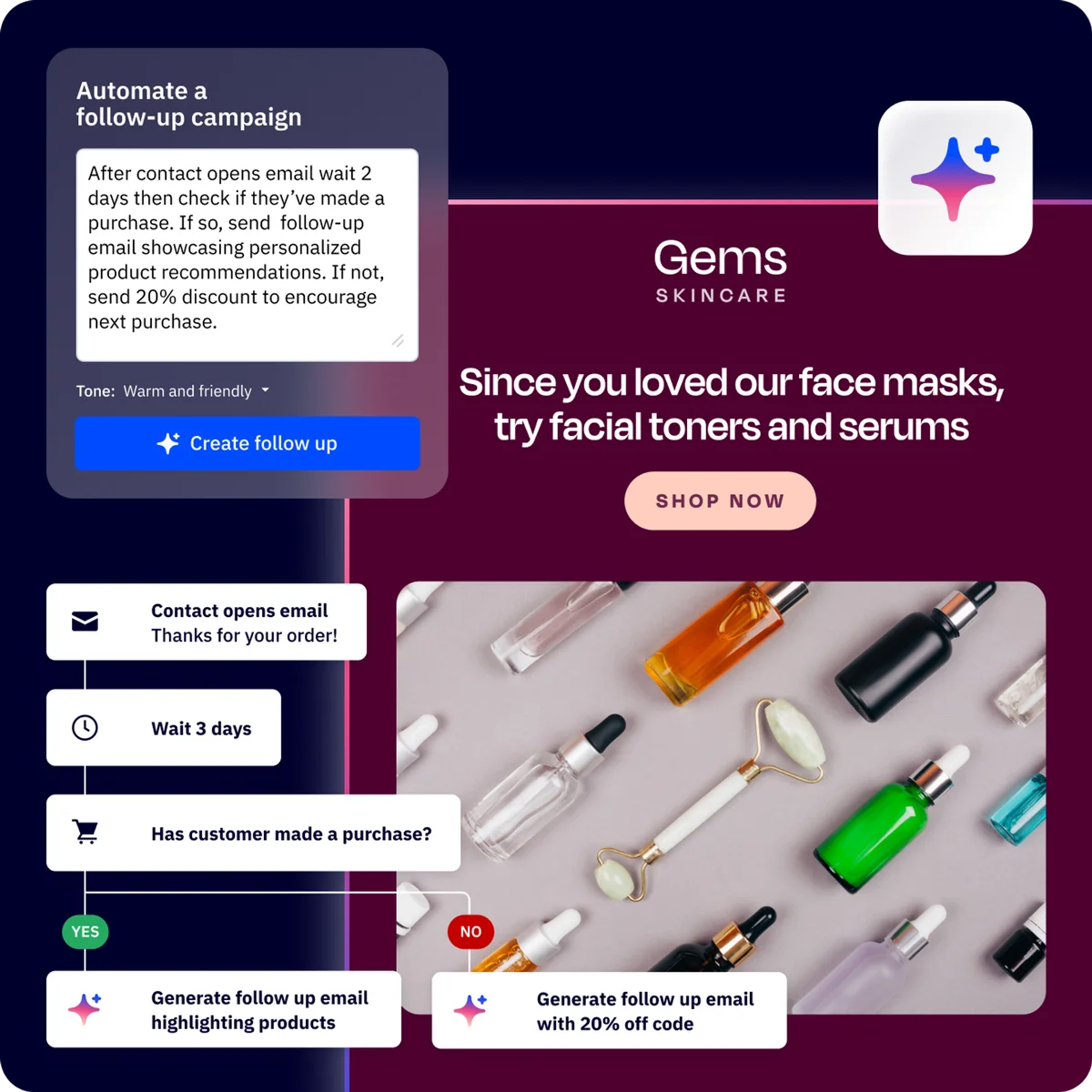
ActiveCampaign also includes a sales CRM in every paid tier — visual pipelines, deal tracking, AI-powered lead scoring, and Win Probability prediction. It’s leaner than HubSpot’s CRM (no service hub, no ticketing, no meeting scheduler natively) but meaningful enough that calling ActiveCampaign “pure-play marketing automation” undersells what you get for your money.
The company is based in Chicago with 846 employees as of February 2026, has raised $363 million in venture funding across three rounds (most recently a $240M Series C at a $3B valuation from Tiger Global), and reports $250M+ ARR. CEO Jason VandeBoom founded the company in 2003 as a consulting firm and pivoted to SaaS around 2013.
How Much Does ActiveCampaign Actually Cost in 2026?
Pricing scales with contact count, which is how most marketing automation platforms work. The confusing part is that the published tier prices only apply at the smallest contact bracket (1,000 contacts) — the moment you grow past that, the tier price itself goes up.
Here’s the 2026 pricing structure on annual billing for Plus and above (Plus is effectively the practical starting tier for any contractor who wants real automation):
| Contacts | Starter | Plus | Professional | Enterprise |
|---|---|---|---|---|
| 1,000 | $15/mo | $49/mo | $79/mo | $145/mo |
| 2,500 | $39/mo | $95/mo | $149/mo | $255/mo |
| 5,000 | $79/mo | $145/mo | $205/mo | $375/mo |
| 10,000 | $149/mo | $189/mo | $375/mo | $589/mo |
Monthly billing adds roughly 20% to these numbers. A recurring 25% promo discount on the first year is usually available on self-serve signup.
What’s Actually Different Between the Tiers
Starter ($15/mo at 1,000 contacts): 1 user, 5-action automation cap, no branching, no landing pages, no AI tools, no CRM pipelines. This tier exists to get people in the door — it’s not usable for serious contractor marketing.
Plus ($49/mo at 1,000 contacts): 3 users, unlimited automations with full branching, landing pages, retargeting, advanced segmentation, CRM pipelines with lead scoring. This is the practical starting tier. Most contractors who adopt ActiveCampaign live here.
Professional ($79/mo at 1,000 contacts): 5 users, Predictive Sending (AI-optimized send times), Win Probability, Split Automations, Site Messaging (behavioral on-site popups), advanced reporting, conditional content. The tier where AI starts delivering measurable performance gains — ActiveCampaign claims Predictive Sending alone produces 17% higher click-through rates.
Enterprise ($145+/mo at 1,000 contacts): 8 users, custom objects, custom reporting, HIPAA options, SSO, dedicated customer success manager, phone support. Only relevant at larger contractor operations with compliance requirements or multi-location reporting needs.
The November 2025 Billing Change
Something changed on November 3, 2025 that every contractor considering ActiveCampaign should understand before signing up. New accounts are now billed for every contact in the system — including unsubscribed, bounced, and unconfirmed contacts. Pre-existing accounts were grandfathered on the old active-contact-only billing model.
In practice, this raises the cost of new accounts by 10-30% depending on list hygiene. A contractor importing an old lead list with 40% invalid addresses will pay for those invalid addresses indefinitely unless they manually scrub before import. It’s also the single most common complaint in ActiveCampaign reviews published in 2026 — not because $49/month is unreasonable, but because people feel blindsided by paying for contacts they can’t actually email.
The fix if you sign up: scrub your import list aggressively before uploading. Use a deliverability validator, remove role-based addresses, and don’t import contacts older than 24 months without reconsent.
Where ActiveCampaign Is Genuinely Strong: Deliverability + Automation
The 94.2% inbox placement number matters. EmailTooltester’s April 2026 deliverability test ranked ActiveCampaign #1 of 16 major platforms — ahead of Mailchimp, Brevo, Campaign Monitor, GetResponse, and every other tool they tested. Industry benchmarks sit at 83-89% for “good” deliverability and 95%+ for “excellent,” which puts ActiveCampaign at the top of the very-good band.
For a contractor running post-job follow-up or review request sequences, deliverability is the quiet thing that makes the difference between a sequence that recovers revenue and a sequence that never reaches the inbox. A 10-percentage-point deliverability gap on a 5,000-contact list means 500 more emails landing where customers will see them every send.
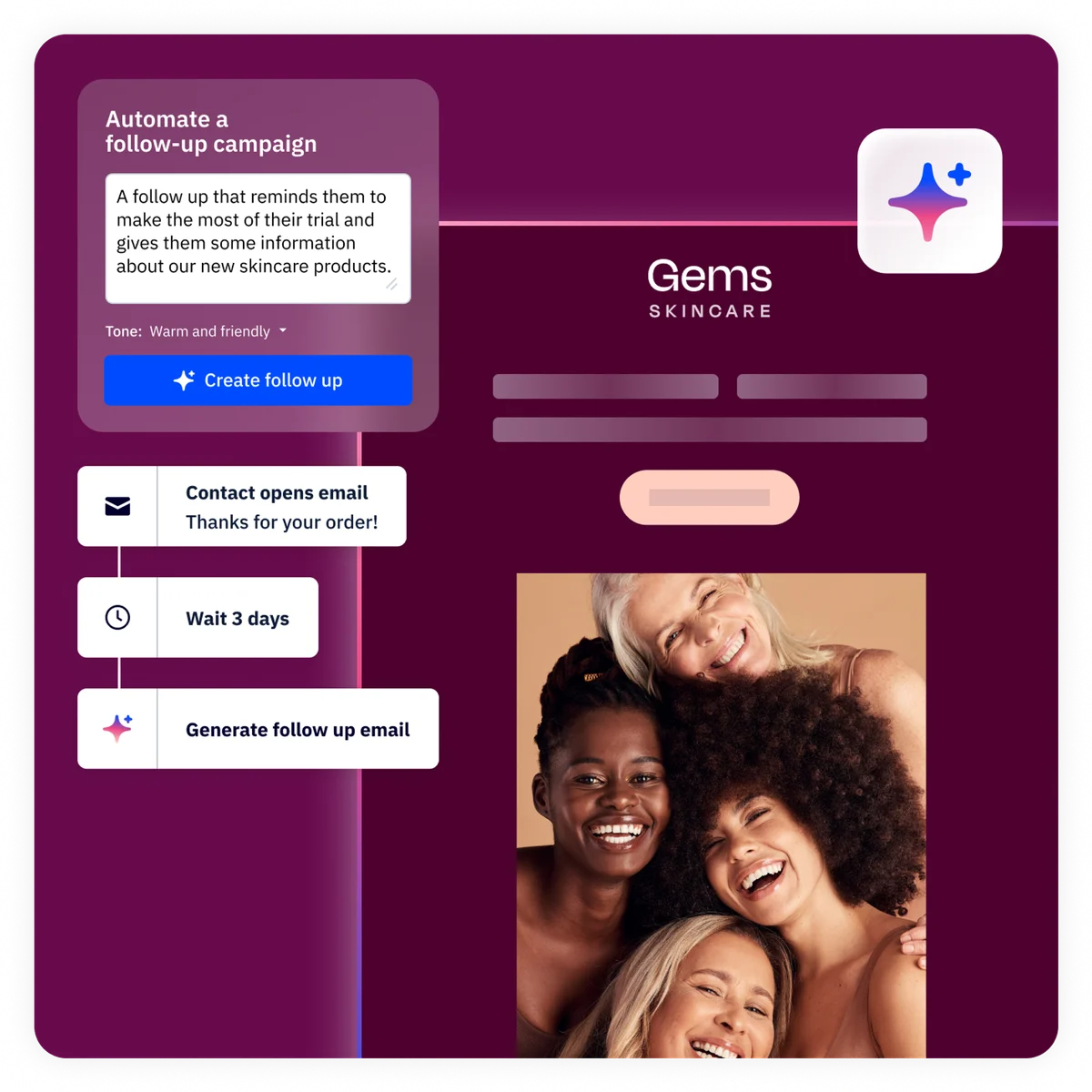
The automation builder backs up its reputation. You can build multi-branch sequences with if/then logic, goal jumps (contacts skip ahead when they hit a conversion), split tests on automation paths, and triggers based on tags, custom field changes, site visits, form submissions, SMS replies, or deal stage changes. The 900+ pre-built recipes cover everything from welcome sequences and abandoned-cart flows to re-engagement and milestone campaigns — though none of them are labeled for contractors or home services.
Segmentation is where the platform’s power compounds. Unlimited tags, unlimited custom fields, behavioral triggers tied to site and email activity, and layered segment conditions that would take hours to build in a simpler tool. A contractor running a lead list could segment by service requested, ZIP code, lead source, estimate range, job status, and referral history — and automate different sequences for each cross-section without ever manually exporting a list.
Active Intelligence: What ActiveCampaign’s AI Actually Does
ActiveCampaign spent 2025 and 2026 rebuilding around AI. The result is Active Intelligence — a layer that competes directly with HubSpot’s Breeze and does it at a fraction of the price.

The core AI features in 2026:
- AI Agents — autonomous agents that execute toward defined goals. Available across tiers with usage credit limits on Starter/Plus and higher allocations on Pro/Enterprise.
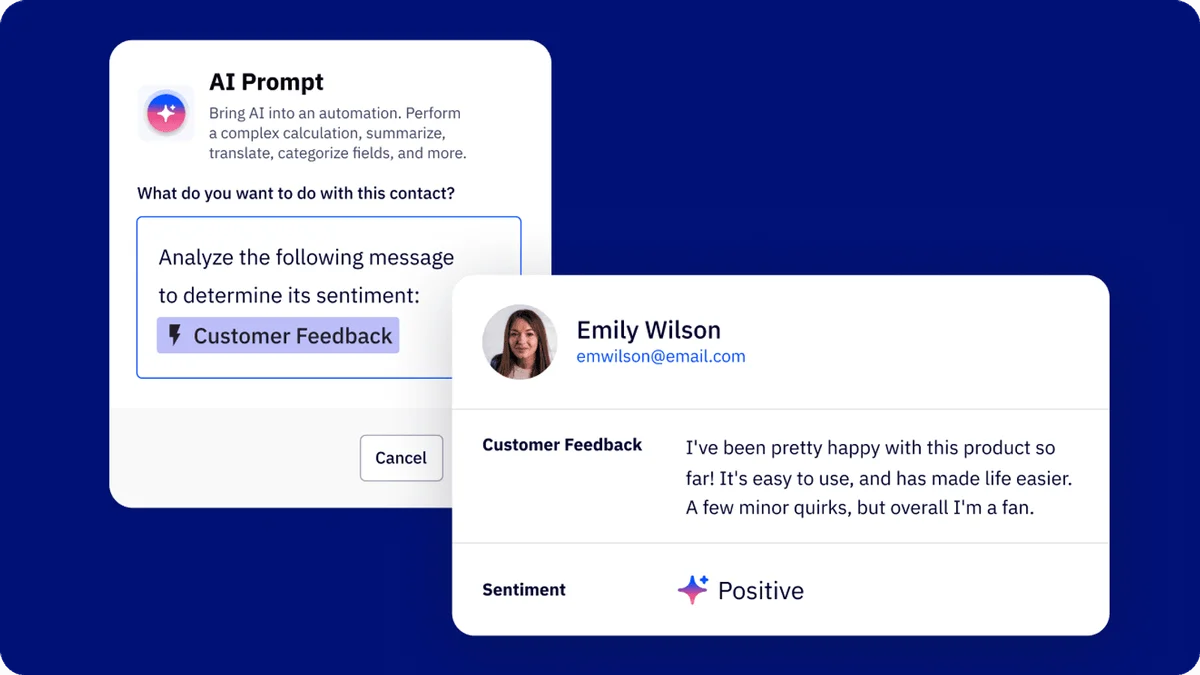
- AI Prompt Block — drop an AI step into any automation with a natural-language prompt. “Analyze this contact’s email behavior and draft a personalized follow-up” becomes a single node in your workflow.
- AI Campaign Builder — generates full campaigns (subject line, preheader, layout, images, copy, CTA) from a single prompt.
- AI Brand Kit — imports colors, fonts, and logos from your website URL and applies them to every campaign automatically.
- AI-Suggested Segments — AI identifies high-impact contact cohorts you might have missed.
- Predictive Sending (Pro+) — sends each email at the optimal time per individual recipient. ActiveCampaign cites a 17% CTR lift.
- Native Claude + ChatGPT integrations — both listed as featured apps on the integrations directory.
For a contractor who currently manually drafts every post-job email, the AI Campaign Builder and AI Prompt Block together can collapse hours of writing into minutes. For a contractor with no marketing background, Active Intelligence can draft and ship campaigns that would otherwise require an agency.
The catch is that AI doesn’t solve the core problem. AI can write a good post-job email quickly — but if that email doesn’t fire when the job closes in your CRM (because no native integration exists), it doesn’t go out.
The Integration Gap: Zero Contractor CRMs Connect Natively
ActiveCampaign lists 1,000+ native integrations on its App Marketplace. Featured apps include Salesforce, Shopify, Wix, Square, Mindbody, Calendly, WordPress, Webflow, Postmark, Claude, and ChatGPT. It’s a genuinely broad ecosystem — one of the largest in SaaS.
Here’s what it doesn’t include:
- JobNimbus — no native integration. Zapier only.
- ServiceTitan — no native integration. Zapier only.
- AccuLynx — no native integration.
- Jobber — no native integration. Zapier only.
- Housecall Pro — no native integration. Zapier only.
- CompanyCam — no native integration.
- QuickBooks — no native integration. Third-party connector or Zapier required.
Every contractor-critical tool requires Zapier or a custom API connector. That works — thousands of businesses run Zapier workflows in production every day — but it costs extra (Zapier’s paid tiers start at $19.99/month for basic triggers) and introduces fragility. Each Zap is a handoff point that can break, time out, or duplicate records. Debugging a failed automation becomes “is it ActiveCampaign, Zapier, or my CRM?” instead of “let me check the logs in one place.”
For a solo contractor or small crew, this is the friction that kills adoption. You sign up, realize every automation you actually want to build requires you to set up a Zapier account, wire three or four integrations, test each one, and pay for Zapier’s paid tier on top of ActiveCampaign — and by the time you’re done setting up the infrastructure, you’ve spent a weekend on what was supposed to save you time.
For a marketing agency configuring ActiveCampaign for a contractor client, the same integration burden is just Tuesday. Agencies set this up in their sleep. That’s the quiet reason ActiveCampaign thrives among agency-led contractor accounts and struggles among self-serve ones.
What 16,000+ Customer Reviews Actually Say
ActiveCampaign’s review data shows the same bimodal pattern that appears across most major SaaS platforms, but the split is narrower than HubSpot’s:
- G2: 4.5/5 across 14,000+ reviews. 69% 5-star, 25% 4-star. The top praise themes are automation power (787 mentions), segmentation flexibility, deliverability, integration breadth, and cross-channel journey orchestration.
- Capterra: 4.6/5 across 2,546 reviews. Themes align with G2 — automation power praised, complexity and price creep flagged.
- Trustpilot: 3.0/5 across 1,128 reviews. Billing disputes, surprise migration price hikes (20-40% reported during tier migrations), and slow customer support dominate the negative reviews. The positive reviews echo G2’s automation praise.
- BBB: A+ rating, accredited since November 2021. Complaints exist (predominantly billing-related, overcharge-after-downgrade patterns) but most show as resolved.
The gap between solicited reviews (G2, Capterra) and unfiltered reviews (Trustpilot) is real but narrower than HubSpot’s 4.4/5 G2 vs 1.7/5 Trustpilot chasm. ActiveCampaign’s product is genuinely strong and its customer support is genuinely inconsistent.
On Reddit, ActiveCampaign is the most-mentioned marketing automation platform across r/marketing, r/smallbusiness, r/emailmarketing, and r/EntrepreneurRideAlong — but contractor-specific mentions are rare. Where contractors appear in the discussion, it’s usually a marketing agency managing ActiveCampaign on behalf of a contractor client, not a contractor running the platform directly.
Who Should Use ActiveCampaign
- Contractors with a retained marketing agency — agencies configure ActiveCampaign for clients dozens of times a year; the integration burden is a known quantity to them, not a barrier
- Commercial contractors running real inbound programs — content marketing, paid ads, nurture sequences, lead scoring for long B2B sales cycles (30+ days from first contact to signed contract)
- Multi-location contractor operations with dedicated marketing staff and enough scale to justify the setup investment
- Contractors already running an e-commerce side (product sales, maintenance plans, financing referrals) where ActiveCampaign’s Shopify integration makes the stack cohesive
- Contractors who are genuinely comfortable building Zapier workflows and willing to treat the integration layer as part of the platform cost
Who Should NOT Use ActiveCampaign
- Solo contractors and small crews — use Jobber’s built-in marketing tools at $39/month, or the texting/email features bundled into Housecall Pro at $59/month. You won’t save money or time by adding a standalone marketing automation platform.
- Roofing contractors — JobNimbus includes Engage ($49-$249/month add-on) that handles texting, email, and review requests natively inside the CRM your crew already uses. Adding ActiveCampaign means maintaining two systems that don’t talk to each other.
- HVAC, plumbing, and electrical contractors — ServiceTitan includes call analytics, automated follow-ups, and service agreement marketing built into the dispatch workflow. Housecall Pro does the same at smaller scale.
- Contractors who want “set it and forget it” — ActiveCampaign is set-up-heavy by design. If you don’t have 20-40 hours to invest in configuration and automation building, the platform won’t deliver its value.
- Contractors who want contractor-specific workflows out of the box — there are none. Use GoHighLevel (which has contractor agency partners pre-configuring templates) if you want marketing automation that’s been pre-wired for the trades.
For a broader view of marketing tools that actually fit contractor operations, the upcoming Marketing Automation category roundup will put ActiveCampaign head-to-head with HubSpot, Keap, GoHighLevel, and the other viable options.
The Decision Framework: Three Questions Before You Sign Up
Instead of a bottom-line recommendation, here are the three questions that actually determine whether ActiveCampaign fits your operation. If the other option on your shortlist is GoHighLevel, the head-to-head is in GoHighLevel vs ActiveCampaign.
1. Do you have someone whose job is marketing — internal or agency? If yes, ActiveCampaign is a legitimate choice and the price point (relative to HubSpot) is attractive. If no, skip it. The platform rewards dedicated configuration time that no operator-owner has.
2. Is your CRM something other than a contractor-specific platform? If you’re running HubSpot’s free CRM, Pipedrive, Salesforce, or spreadsheets, ActiveCampaign can be your marketing layer and the integration is straightforward. If you’re on JobNimbus, ServiceTitan, AccuLynx, Jobber, or Housecall Pro, the integration burden via Zapier adds real friction — and those platforms all have built-in marketing tools that cover 70% of what ActiveCampaign does for zero additional setup.
3. Is email a meaningful marketing channel for your business, or are you mostly phone-driven? Residential roofing, HVAC service calls, and plumbing emergencies live on the phone. The email nurture game is much stronger for commercial contractors with long B2B sales cycles, solar installers running inbound lead gen, and restoration contractors working insurance lists. If your revenue comes from the phone, invest in AI call answering before you invest in email automation.
Answer yes to all three and ActiveCampaign is worth the 14-day trial. Answer no to any one of them and your marketing spend goes further somewhere else.