

Before Anything Else: Keap Was Acquired
If you’re evaluating Keap in 2026, the first thing you should know is that it isn’t an independent company anymore. Thryv Holdings acquired Keap on October 31, 2024 for $80 million in cash — less than one year of Keap’s trailing revenue. The brand is still alive, the product still ships monthly updates, and customers still log in at keap.com. But every page on keap.com now reads “Keap, A Thryv, Inc. Brand” in the footer, and the official FAQ about the acquisition uses the phrase “for now, all the Keap products and services you know and love will remain the same.”
“For now” is doing a lot of work in that sentence.
This matters because Thryv is a company you might already be skeptical of if you’ve read our Thryv review. Their BBB record shows 300+ complaints over the past 12 months. Their Trustpilot rating is 2.3 out of 5. Their DNA comes from the Yellow Pages — Dex Media and DexYP, rebranded to Thryv in 2019 and pivoted to SaaS. The sales culture that made the old Yellow Pages aggressive with local businesses is the same culture now running Keap.
That doesn’t mean Keap is a bad product. It might mean it’s the best product Thryv now owns. Keap’s 200,000+ small business customers generally like the software — Capterra gives it 4.1 out of 5 across 1,298 reviews, and the visual automation builder is widely called the crown jewel of the category. But it also means the Trustpilot horror stories (1.2 out of 5 across 480+ reviews, with cancellation complaints dominating the negative feedback) should weigh heavily on any contractor signing a 12-month contract at $299 per month.
This review walks through Keap’s features, its real 2026 pricing, how it compares to HubSpot and ActiveCampaign, and the scenarios where it makes sense or doesn’t for a contractor operation.
Full disclosure: This is a research-based review. We have not used Keap in our own contracting operation. Our analysis draws from Keap’s product documentation, Thryv’s investor disclosures, customer reviews across Capterra (4.1/5 across 1,298), G2 (3.8/5 across 13 — flagged low and possibly migrated post-acquisition), Trustpilot (1.2/5 across 480+), BBB complaint records, and industry coverage of the Thryv acquisition.
What Keap Actually Does
Keap positions itself as the “#1 HubSpot Alternative” and pitches small businesses on “putting your business growth on autopilot.” In practice, it’s an all-in-one platform covering six functional areas that a small contractor operation might otherwise buy separately:
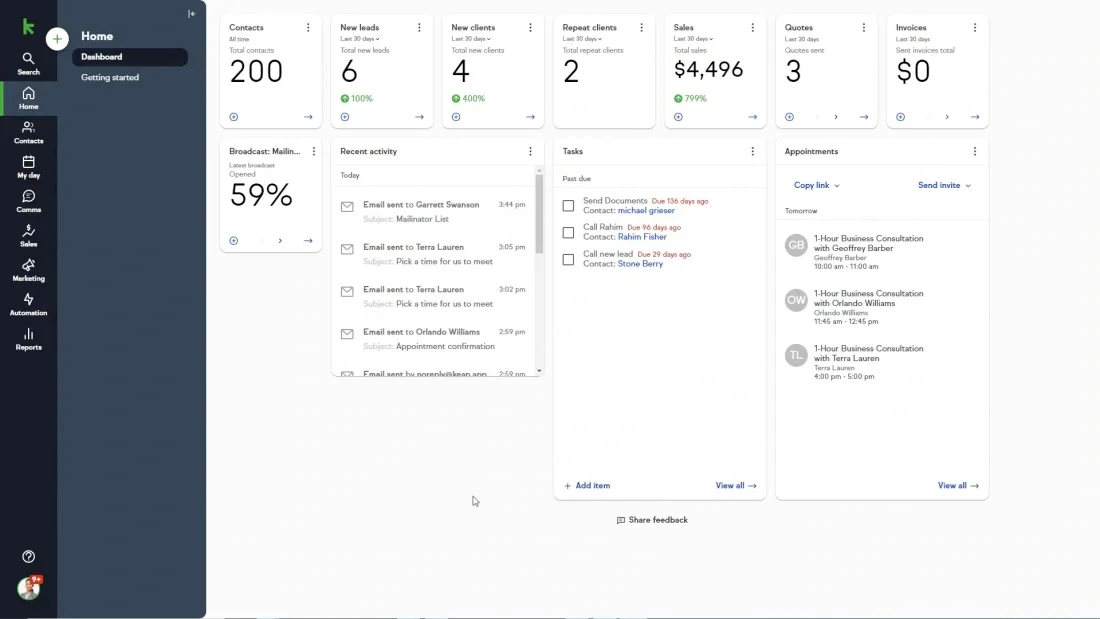
CRM: Contact management with tag-based segmentation, lists and filters, company records, custom fields, tasks, notes, lead scoring, and a customizable dashboard. The CRM is lighter than HubSpot’s full suite but meaningful — it’s not a “marketing platform with a contact list tacked on” like some MA tools.
Marketing automation: Visual campaign builder with conditional branching, 12 pre-built automation templates, lead capture forms, landing pages, and multi-page sales funnels. This is the feature Keap is most known for — the Infusionsoft legacy product that launched in 2001 was primarily an automation engine.
Email marketing: Broadcasts, one-to-one messages, newsletters, template library, AI Content Assistant, and a dedicated email deliverability health dashboard.
Text marketing (US-only): Native SMS and voice with a dedicated business phone line included at the lowest tier. Usage-based tiers scale from 500 messages/month included up to 25,000 for $279/month.
Sales and payments: Sales pipelines, appointment scheduler, quotes, invoices, checkout forms, order bumps, promo codes, and Keap Pay — a native embedded payment processor for one-time and recurring payments. Third-party processors (PayPal, Stripe, Eway) also supported.
Operations: Internal forms, native Google Reviews automation (connect your Google Business Profile, auto-trigger review requests after jobs close), employee reminders, My Day task manager, billing automation, credit card expiration reminders, pipeline automation, API with webhooks, and native Zapier.
The “all-in-one” framing is real. You don’t have to stitch together a CRM, an email tool, an SMS tool, an invoicing tool, and a Zapier account to make a basic contractor marketing operation work. Keap includes all of it in one login.
Keap’s 2026 Pricing: What You’ll Actually Pay
Keap collapsed its historical tier structure (Pro, Max, Ultimate, Lite, Grow, Scale) into a single plan sometime in 2024-2025. If you find third-party blog posts describing Keap Pro at $199/month or Keap Max at $299/month, that’s outdated — there’s one plan now, and it scales by contact count and user seats.
The One-Plan Reality
| Contacts | Annual Price | Monthly Price (~) |
|---|---|---|
| 1,500 (entry) | $299/mo | ~$359/mo |
| 2,500 | ~$329/mo | ~$389/mo |
| 5,000 | ~$369/mo | ~$449/mo |
| 10,000 | ~$441/mo | ~$539/mo |
| 25,000 | ~$625/mo | ~$749/mo |
Base plan includes: 2 users, full feature access, native QuickBooks integration, built-in SMS tier 1 (500 texts/100 voice minutes), unlimited email sending (within deliverability best practices), Keap Pay payments, mobile app, Keap Community, 24/7 chat and US-based phone support.
Extra users: $39 per user per month.
Implementation fee: $499 to $1,500 depending on the onboarding package you select. This is required — it’s not optional — and the price is quoted via phone or chat rather than published on the pricing page. Factor this into year-one cost calculations.
What It Actually Costs at Contractor Scale
- Small contractor (2 users, 1,500 contacts) on the annual plan: $299/month + $499-$1,500 one-time = $4,087-$5,088 year one. Year two drops to $3,588.
- 5-person contractor team on annual plan with 5,000 contacts: $369/month base + $117/month in extra users (3 extra × $39) + $499-$1,500 implementation = $6,333-$7,334 year one. Year two is $5,832.
- Text marketing at tier 2 (1,000 messages/month): Add $288/year.
For context, ActiveCampaign Plus at 2,500 contacts runs about $95/month ($1,140/year, no implementation fee) — a 3.5x cost difference for roughly comparable automation and email capabilities. HubSpot Marketing Hub Professional runs $800/month base plus $3,000 onboarding — about 3x Keap’s price but with more extensive features. Jobber at $39/month covers CRM, scheduling, quoting, and invoicing for any trade — 7x cheaper than Keap but without the marketing automation depth.
Keap is not competing on price. It’s competing on “everything in one place” — which is genuinely valuable for small operations that want to avoid juggling five tools, but expensive if you already run a field-service CRM for operations.
The Automation Engine: Why Keap Still Has a Following
Keap’s visual automation builder is the feature that keeps customers on the platform despite the pricing. It’s widely cited as the best in the small-business category — more capable than Mailchimp’s, smoother than HubSpot’s for non-technical users, and less complex than Salesforce Marketing Cloud.

You build automations by dragging triggers and actions onto a canvas: a contact fills out a form, gets a tag applied, enters a sequence that branches based on whether they open the first email, moves to a different sequence if they click a specific link, gets scored based on behavior, and routes to a sales rep when the score crosses a threshold. All of that without writing code or exporting data to another system.
For a contractor running post-job follow-up, this means you can build a sequence like:
- Job marked complete in the CRM
- Wait 24 hours
- Send thank-you email with photo gallery
- Wait 3 days
- Branch: if email opened, send review request with Google Business Profile link; if not opened, send a text follow-up
- Wait 14 days
- Send referral request with discount code
That sequence runs without manual intervention for every completed job. The time you save is real — Capterra reviewers consistently call out “the automation pays for itself” as the reason they stay even when they have price complaints.
The catch is setup time. Building a sequence like the one above takes 2-4 hours for someone familiar with Keap, and much longer for a first-time user. The learning curve is widely flagged across reviews — 419 G2 reviewers mention complexity on the competing HubSpot platform, and Keap has the same issue at smaller review volume.
Active AI Roadmap (Launched Under Thryv)
One thing the Thryv acquisition hasn’t killed is Keap’s AI investment. The AI suite launched in 2025 under new ownership and has received monthly feature updates:
Keap AI (umbrella brand):
- AI Automation Assistant — describe a workflow in plain English (“when a customer books an appointment, wait 24 hours, send a reminder, and tag them as ‘active lead’”), and the AI builds the campaign structure for you
- SmartSend AI — optimizes email and SMS delivery timing per recipient based on when they’ve historically opened messages
- AI Content Assistant — generates subject lines, body copy, and CTAs from prompts
- Dedicated Subject Line Generator — a standalone tool for testing subject line variants
The scope is narrower than HubSpot’s Breeze (which includes four autonomous Breeze Agents — Customer Agent, Content Agent, Prospecting Agent, Social Media Agent) or ActiveCampaign’s Active Intelligence (AI Agents, AI Prompt Block embeddable in any automation, AI Campaign Builder). For a contractor who primarily wants AI to reduce the time they spend writing marketing copy, Keap’s suite is sufficient. For a contractor who wants AI agents autonomously running chunks of their marketing operation, HubSpot or ActiveCampaign deliver more.
Native QuickBooks: The Differentiator Nobody Talks About
Here’s the feature that actually sets Keap apart from every other marketing automation platform we review: native QuickBooks Online integration.

HubSpot requires a third-party connector or Zapier for QuickBooks. ActiveCampaign doesn’t have a first-party QuickBooks integration at all. Keap is the only major MA platform with a direct, bidirectional QuickBooks Online sync built by Keap themselves — contacts flow between systems, invoices sync, payments reconcile automatically.
For a contractor doing job-costing in QuickBooks Online (which is most contractors using QuickBooks at this point), this integration eliminates double entry between your marketing CRM and your accounting system. The sync is not perfect — Capterra reviewers flag occasional reliability issues — but it exists, which is more than competitors offer natively.
QuickBooks Desktop is also supported but only for legacy Keap Ultimate (Max Classic) customers. New customers on the current single plan get QuickBooks Online only.
Integration Gap: Same Story as HubSpot and ActiveCampaign
Outside of QuickBooks, Keap’s contractor-specific integration story is the same as every other horizontal SMB marketing platform. Zero native integrations with:
- JobNimbus — Zapier only
- ServiceTitan — Zapier only
- AccuLynx — no integration
- Jobber — Zapier only
- Housecall Pro — Zapier only
- CompanyCam — no integration
- EagleView, HOVER, aerial measurement tools — none
- ABC Supply, SRS Distribution, material suppliers — none
Keap markets “5,000+ integrations” but that number counts Zapier’s full app directory, not native connections. Keap’s actual native integration library is around 29 direct connections according to Capterra reviewers — a frequent complaint theme. For a contractor running JobNimbus or ServiceTitan for operations, adopting Keap for marketing means setting up Zapier workflows for every data handoff between systems. That works, but it costs extra (Zapier paid tiers start at $19.99/month), adds fragility, and adds another invoice to your monthly software spend.
The Trustpilot vs Capterra Gap: What Two Ratings Tell You
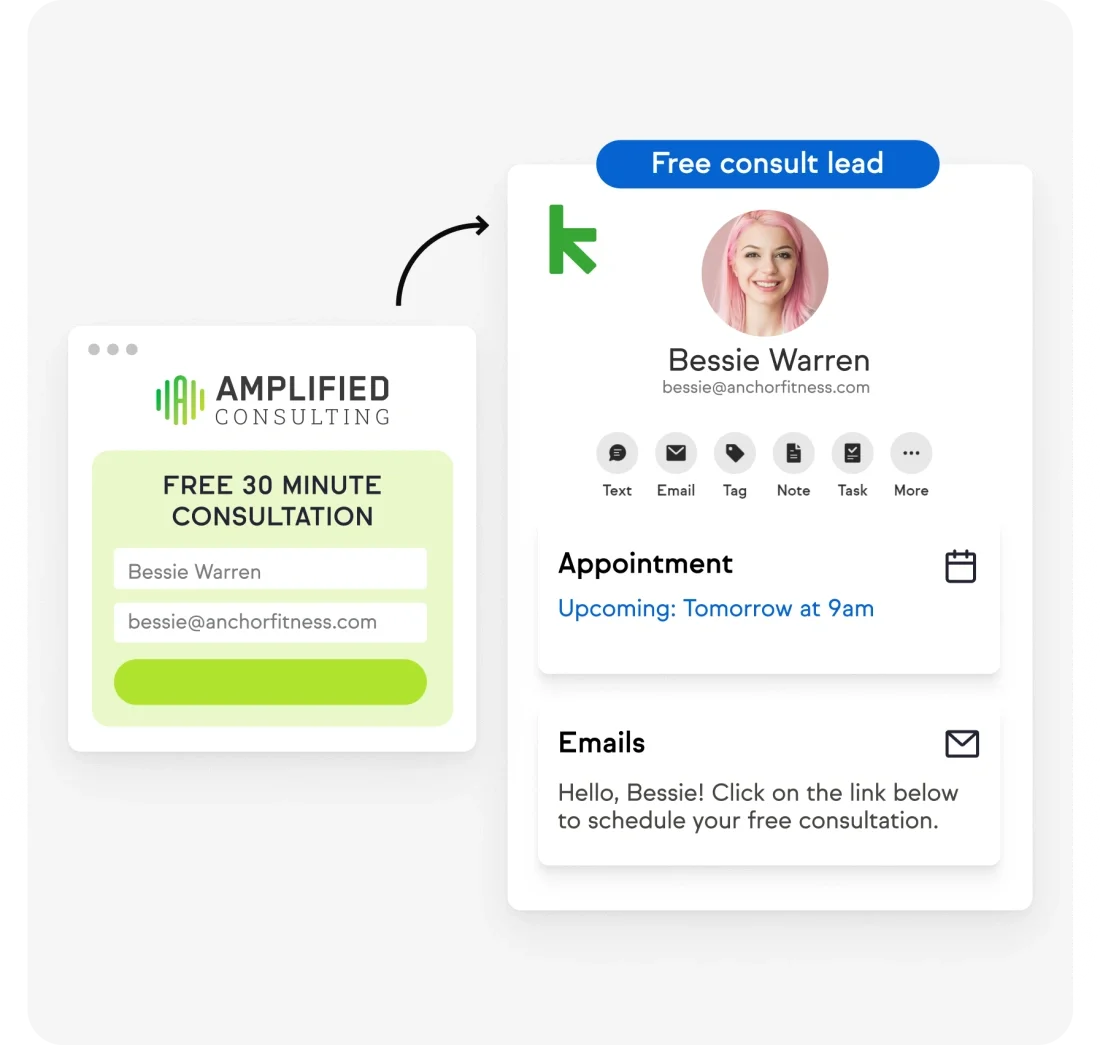
Keap has two customer review realities, and any contractor considering the platform needs to understand both.
Capterra: 4.1/5 across 1,298 reviews. People evaluating features love the automation power, the all-in-one bundling, and the support responsiveness. The top complaints are expected: learning curve, mobile stability (especially Android), and rising pricing. 56% of reviewers explicitly flag “too expensive” — but they’re still using the product, still giving it 4 stars, and still recommending it.
Trustpilot: 1.2/5 across 480+ reviews. People trying to leave Keap hate it. The themes are consistent and brutal: cancellation requires a phone call with a customer success representative (you cannot cancel in-app), early termination fees that reviewers claim were not disclosed at signup, refund refusals for customers who used the product briefly, persistent billing after cancellation attempts, and support ghosting — promises to return calls followed by silence.
Both things are true at the same time. Keap is a genuinely strong product that locks customers in with commercial practices most people would consider hostile. One Trustpilot reviewer described having to threaten legal action to escape an auto-renewed contract. Another described a $1,200 early termination fee they hadn’t known existed.
The BBB record echoes this. Keap is not BBB-accredited. Complaint themes include undisclosed fees, mandatory phone-cancellation, charging for contacts that don’t exist, and unresponsive account managers.
What this means for contractors: Read your contract terms carefully before signing. Set calendar alerts 60-120 days before your annual renewal date. Understand that if you change your mind in month 2, you may not be able to leave without paying a year’s subscription. The Capterra 4.1 tells you the product works; the Trustpilot 1.2 tells you what happens if it doesn’t work for you.
Who Should Use Keap
- Small contractor operations (3-10 employees) with follow-up-heavy sales cycles — long quote-to-close windows, multiple touchpoints, insurance-supplement work, or consultative selling
- Contractors running QuickBooks Online for accounting who want a native marketing platform sync rather than a Zapier workaround
- Commercial or B2B contractors with marketing budgets measured in thousands per month and a need for real nurture sequences, lead scoring, and sales routing
- Contractors who want all-in-one over best-in-class — one login, one vendor, one monthly bill instead of a stitched-together stack of Jobber + ActiveCampaign + QuickBooks + Google Reviews + SMS
- Contractors who plan to stay on the platform for 3+ years — the implementation cost ($499-$1,500) and learning curve only pay back over time
Who Should NOT Use Keap
- Solo contractors and small crews under 3 people — Jobber at $39/month handles CRM, scheduling, quoting, and invoicing for any trade. The marketing automation gap isn’t worth $260/month extra plus implementation.
- Roofing contractors — JobNimbus includes Engage ($49-$249/month add-on) that does texting, email, and review requests inside the CRM your crew already uses. Adding Keap means two systems that don’t talk natively.
- HVAC, plumbing, and electrical service businesses — ServiceTitan and Housecall Pro include automated follow-ups, service agreement marketing, and review requests built into the dispatch workflow. You already have what Keap sells.
- Contractors who might want to cancel within 12 months — the Trustpilot pattern is too consistent to ignore. If there’s any chance your business situation changes before your renewal date, every dollar you spend on Keap is at risk.
- Contractors who value month-to-month flexibility — Keap is an annual commitment. If pricing transparency and the ability to walk away matter, pick a platform that treats them as features.
For a look at how Keap fits alongside the other marketing automation options, the upcoming Marketing Automation category roundup will put Keap head-to-head with HubSpot, ActiveCampaign, GoHighLevel, and more — with real pricing, contractor fit, and editorial picks by use case.
The Bottom Line
Keap has served 200,000+ small businesses since 2001 and the product reflects two and a half decades of iteration. The automation engine is genuinely excellent. The native QuickBooks integration is a real differentiator nobody else in the category offers. The AI roadmap is active under Thryv ownership and the platform is being invested in, not quietly killed.
All of that is also true of Keap’s commercial practices. The $299/month floor, the mandatory implementation fee, the annual contract lock-in, the phone-call cancellation requirement, the Trustpilot horror stories, and the new Thryv parent company with its own aggressive-sales reputation — these aren’t quirks of a single disgruntled customer segment. They’re patterns across hundreds of independent reviews. The product is capable; the way the product is sold and supported is what drags it down.
For a contractor who knows exactly what they’re signing up for, knows they’ll use the platform for 3+ years, and wants an all-in-one over a best-in-class stack — Keap delivers. For a contractor who isn’t sure, who might want to change their mind in year two, who doesn’t want to handle a phone call to cancel — pick somewhere else. ActiveCampaign at $49-$95/month gives you the automation without the lock-in. Jobber at $39/month plus a simple email tool gives contractors 80% of what Keap does at a quarter of the cost. The cheaper options don’t have cancellation horror stories because they don’t need them to retain customers.
Read your contract before you sign. Set your calendar alert now. And consider whether the all-in-one promise is worth the all-in-one risk.