

I ordered my last EagleView report on Friday. Premium Residential, single-family ranch in Metairie, measurements ready in four hours, adjuster didn’t ask a single follow-up question. I also ordered a Roofr report for the same address that morning — $13 flat through Essentials, ESX file downloaded an hour later, dropped into Xactimate clean. The EagleView came back at $38 with a complex-roof surcharge. Both measurements were within half a square of each other.
That single afternoon compressed the whole 2026 EagleView question into a frame I can defend: you’re not paying $38 for measurement accuracy anymore. You’re paying it for insurance-adjuster-grade defensibility, 25 years of historical imagery you can’t get anywhere else, and a live-into-Xactimate integration that competitors are still building paths toward. For about 40% of my workload — insurance restoration, catastrophe supplements, commercial — that’s still worth it. For the other 60%, I’m quietly migrating to Roofr and only pulling EagleView when the job demands it.
Why Contractors Keep Paying Premium for EagleView in 2026
The short version: insurance carriers trust it, Xactimate integrates it natively, and nothing else has 25 years of historical aerial imagery across 94% of North America.
That’s the defensible case. The less-defensible case — the one EagleView’s CEO Piers Dormeyer is pivoting the whole company to escape — is that the brand used to be a near-monopoly and the pricing power got out ahead of the product improvements. Roofr shipped a Verisk-certified Xactimate ESX export on April 15, 2026 at $10 per file. Six days later, on April 21, EagleView announced Horizon — an agentic AI geospatial platform targeting the carrier market. That’s not a coincidence. It’s a company recognizing that the core “measurement report” business is commoditizing faster than the original moat can hold, and racing up-stack to where data depth still matters.
For roofing contractors specifically, the practical question is narrower: does the premium per report earn itself on your mix of work? Below is how I’ve been making that call on my own jobs, backed by verified 2026 pricing and the operator details that don’t show up on vendor pages.
“EagleView is definitely the most quality and most respected of all measurement tools.” — John S., GM (Source: Capterra EagleView reviews)
EagleView Pricing: The Per-Report Numbers Contractors Actually Pay
Pricing is the single biggest source of contractor frustration with EagleView in 2026, and the single biggest source of confusion. Here’s what’s actually published on eagleview.com:
| Report | Starting Price | What You Get |
|---|---|---|
| Bid Perfect | $18 | Virtual squares, top 4 pitches, facet count, roof area, up to 2 structures |
| Premium Roof Report | $24.25 | Per-facet dimensions, pitch diagram, rakes, eaves, valleys, ridges, hips, waste factor |
| Walls Report | $40 | 3D wall diagram, elevations |
| Walls, Windows & Doors | $67.50 | Full exterior siding detail with openings |
| Full House Report | $91 | Everything — roof, walls, windows, doors, penetrations |
| EagleView Assess (drone) | Quote-based | Autonomous drone + AI damage detection |
| Commercial Reports | Flat per-property | Unpublished rate |
| EagleView One subscription | Quote-only | Launched June 24, 2025 — no published rates |
The “starting price” trap. Those are real published numbers, but they’re floors. Actual prices scale with roof size, delivery tier, and report complexity. Small roofs (under 20 squares) typically hit the floor; medium roofs (21-40 squares) run $35-$60 for Premium; large and complex roofs regularly land at $75-$90 before expedite fees. On Capterra’s pricing reviews, contractor-reported Premium numbers cluster in the $35-$55 range for typical residential re-roofs.
Subscription rates went dark in June 2025. EagleView One replaced the legacy Bronze / Silver / Gold / Platinum Edge Rewards tiers with a “flexible subscription tailored to each customer” — in practice, that means sales calls for any rate quote and no published comparisons. The legacy tiers appear grandfathered for existing customers; new contractors get routed to EagleView One quotes.
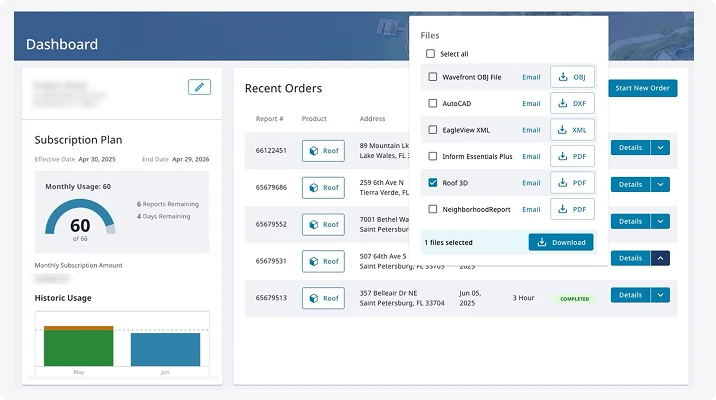
The delivery-tier story. Three-hour delivery has been on the menu since 2009. Standard Express and Premium delivery tiers exist but aren’t formally named on the 2026 public site. The sharper concern showing up across Capterra reviews is a pattern of Standard reports being held 48+ hours with an upgrade prompt appearing during the delay — enough contractors have flagged this independently that it’s worth treating as a documented pattern, not a one-off.
“You can’t charge MORE money for LESS measurements. Uncool.” — Jeff B., Owner (Source: Capterra EagleView review, March 2026)
What I actually pay. For my Louisiana residential mix in 2026, Premium Reports run an average of $38 apiece. On a typical month of 15-20 measurements that’s $600-$800. The legacy Edge Rewards tier I’m on still gives me volume discounts; the EagleView One quote I received for equivalent volume was 18% higher than what I pay today, which is why I haven’t migrated.
Why Insurance Adjusters Still Demand EagleView Reports
This is the moat. Carriers don’t universally “require” EagleView — they require adjuster-accepted measurements. In practice, that means EagleView for nearly every residential claim in the US, and for good reasons:
-
Carrier acceptance is automatic. Adjusters recognize EagleView reports without follow-up questions. A Roofr report ($13) or Hover model ($30+) often triggers “can you get an EagleView for this?” which means re-ordering at EagleView prices anyway and eating the first report’s cost.
-
Xactimate integration is native and live, not a file handoff. As of February 3, 2025, EagleView Assess data (3D sketches + drone images) uploads directly into Xactimate and XactAnalysis claim projects through the Verisk partnership. Adjusters can pull reports from inside the claim workflow. Roofr’s April 2026 ESX launch is a certified file export — it works cleanly for contractor-side Xactimate writing, but it’s not the same as EagleView’s bidirectional carrier-side integration.
-
Historical imagery is the only source for pre-storm condition. When a supplement requires proof that a shingle was intact before the storm, EagleView’s 25-year archive of proprietary aerial imagery is usually the only viable source. Roofr uses satellite imagery licensed from providers like Maxar; Hover uses contractor-taken photos. Neither can show you what the roof looked like in 2019.
-
The accuracy benchmark is published and independent. EagleView’s 98.77% accuracy number (June 2025 CompassData LiDAR study in the Denver metro) is the only published independent benchmark in the category. Roofr publishes no equivalent. Hover publishes a 2.6% variance claim without matching independent validation.
-
The accuracy guarantee is unique. If an EagleView report is disputed within 60 days and found inaccurate, the report is free. Nobody else in the category backs measurements with a money-back promise.
For restoration roofers, catastrophe-response operations, and contractors working 50%+ insurance claim work, that stack of reasons isn’t going anywhere in 2026. Roofr and Hover will keep eating the retail residential market on cost, but the insurance claim workflow is still EagleView’s to lose.
Ordering EagleView Directly From JobNimbus
This is my actual workflow and the most efficient path into EagleView for any JobNimbus-running contractor. The integration is one of the deepest in EagleView’s ecosystem — the only comparable native depth is AccuLynx.
The five-step flow inside JobNimbus:
- Open the Job — either web or iOS/Android mobile
- Navigate to Estimates → Measurements → Order under the EagleView option
- Enter the property address (auto-fills if already in the job), select the product (Premium Residential or Premium Commercial — these are the only two types supported through the JobNimbus ordering flow), choose delivery tier
- EagleView processes the order; the finished report appears in the Job’s Available Reports section when delivered
- Hit Apply — measurements sync to JobNimbus Measurement Tokens, the PDF auto-uploads to the Documents tab, and Smart Estimates pulls the tokens into any new estimate you generate
The one gotcha worth naming. If a team member other than the report owner applies the measurements, the waste-factor percentage sometimes doesn’t display. It’s a known JobNimbus support issue. The fix is either having the report owner apply, or manually setting the waste factor in the Smart Estimate. Set a team process around it and you’ll never hit it.
Saved hours per month, honestly measured. Before I started ordering EagleView through JobNimbus directly, I was downloading PDFs, manually transcribing measurements into estimate templates, and re-keying waste factors by roof section. The integration eliminates all three steps. On 15-20 reports per month, that’s roughly four hours I get back — worth noting because it materially changes the ROI math on the per-report cost. At my $75/hour internal rate, the integration alone justifies the subscription layer.
The Report Lineup — Bid Perfect, Premium, Walls, Full House
EagleView’s residential product inventory for contractors is six products:
Bid Perfect ($18, launched 2022): Fast virtual square data for sales-stage use — top four pitches, facet count, roof area, up to two structures per report. Replaced QuickSquares. Use it for door-knocking, phone quotes, and competitive bid responses where you need a number fast. The shingle undercount complaint across recent Capterra reviews is real — don’t bid production work from Bid Perfect data.
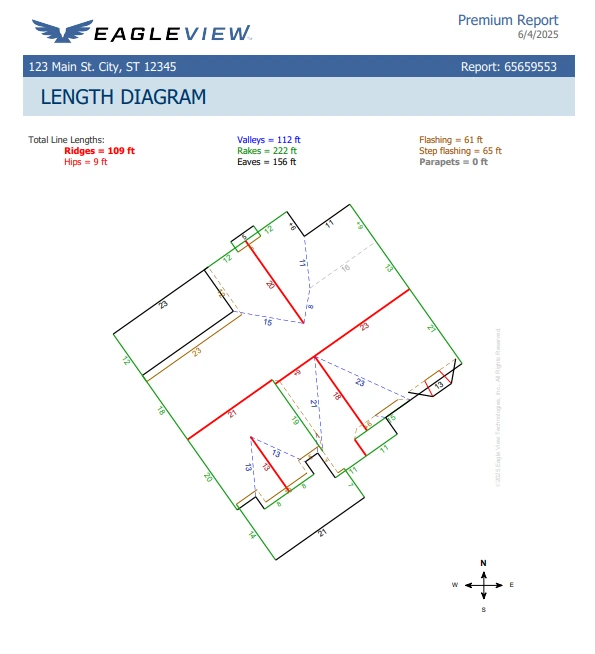
Premium Roof Report ($24.25, flagship): Per-facet dimensions, pitch diagram, rakes, eaves, valleys, ridges, hips, and suggested waste factor. This is the production estimate tool and the report most insurance adjusters expect to see. Use it for estimate writing, insurance supplements, and any scope that will be scrutinized.
Walls Report ($40): 3D wall diagram with elevations. For siders and contractors quoting exterior shell work where roof-only data isn’t sufficient.
Walls, Windows & Doors Report ($67.50): Full siding detail with openings, fascia, and facet breakdown. For exterior remodelers writing comprehensive scopes.
Full House Report ($91): Everything — roof, walls, windows, doors, penetrations. For total exterior remodels and multi-scope insurance claims.
EagleView Assess (quote-based): Autonomous drone inspection with AI damage detection. EagleView claims it identifies “5x more anomalies than the human eye” and it was expanded September 10, 2025 to handle large and complex roofs (churches, apartments). Feb 3, 2025 Assess integration into Xactimate was the deepening of the adjuster workflow. Most contractors won’t order Assess directly — it’s typically used by carriers or on catastrophe response projects.
Commercial reports are flat-fee per property, unpublished rates, and quote-based. For flat-roof commercial estimating where per-square pricing would be punitive, the flat fee is a real advantage.
EagleView Horizon: What Just Got Announced on April 21st
This is the most important 2026 news in the category and the reason a review in the estimating space has to cover it even though the product isn’t generally available until June 1.
On April 21, 2026 — two days before this review was written and six days after Roofr shipped its Verisk-certified ESX export — EagleView announced Horizon, an agentic AI engine built on Model Context Protocol (MCP) integrations. The timing is not coincidental. Horizon is EagleView’s pivot from “measurement reports for contractors and adjusters” to “geospatial intelligence platform for the enterprise and carrier market.”
What Horizon actually does: 20+ integrated agentic tools for property identification, filtering, scoring, and export. Agent-to-agent integration means external AI platforms (ChatGPT, Claude Projects, carrier-built workflows) can query EagleView’s property data directly. Nationwide change detection is “coming soon.” Targeted at what Dormeyer describes publicly as a “$1 trillion+ market.”
“Eagleview Horizon leverages our proprietary imagery and property intelligence at a scale we know no competitor can replicate.” — Piers Dormeyer, CEO of EagleView (EagleView press release, April 21, 2026)
What it means for individual roofing contractors in 2026: not much, yet. Horizon is invitation-only beta at GA. It’s carrier and enterprise first. For a residential roofer pulling Premium Roof Reports through JobNimbus, the day-to-day workflow doesn’t change. The strategic signal matters, though: EagleView is investing heavily in data-depth + agentic-AI differentiation because the core measurement-report market is commoditizing. Expect contractor-facing AI features (damage detection improvements, Assess expansion, proactive insights) to land faster over the next 12 months as the Horizon platform matures and features trickle down.
What it means for carrier-adjacent contractors: real competitive lever. If you do commercial, catastrophe response, or large-volume storm canvassing, Horizon is going to matter by Q4 2026. Bert Hess, CEO of Florida Roofing and Gutters, was in the beta and framed it directly on Roofr’s launch coverage:
“Identifying prospects used to take hours… Eagleview Horizon does this in one place… in just a few minutes.” — Bert Hess, CEO of Florida Roofing and Gutters (Roofing Contractor, April 2026)
The AI Story Behind EagleView’s 2026 Pivot
AI at EagleView isn’t a feature list — it’s a strategic direction the company has spent 18 months building up to. Four products sit under the AI umbrella in 2026:
EagleView Assess (autonomous drone + AI damage detection). Operational since before the 2025 rebrand, expanded September 10, 2025 to large and complex roofs. The “5x more anomalies than the human eye” claim is EagleView’s marketing, not an independent benchmark, but the drone + AI combination is genuine category-leading capability for catastrophe response and carrier-side claim documentation.
EagleView Inform (property data ecosystem, launched January 22, 2025). API-accessible AI extraction of property condition, roof age, structure identification, and solar suitability at the parcel level. 60+ petabytes of imagery underlying the extractions. This is the carrier-facing product — P&C insurers and lenders query Inform for underwriting and portfolio analytics.
EagleView One AI layer (launched June 24, 2025). The machine learning extraction engine behind the 98.77% accuracy number. Runs against 3.5 billion+ aerial images. The August 11, 2025 pitch editor upgrade let users input slope corrections for 3D sketches, which is a meaningful quality improvement but not a flashy feature.
EagleView Horizon (announced April 21, 2026, GA June 1). The MCP-based agentic platform covered in the prior section.
What’s missing from the AI story for contractors. There’s no generative AI for proposal narrative writing, no AI lead-capture voice agent (Roofr’s CEO Richy Nelson publicly teased this for 2026 on Roofr’s roadmap — EagleView hasn’t), and no AI-written scope-of-loss builder despite the Verisk partnership making it an obvious next step. The contractor-facing AI roadmap is thinner than the carrier-facing one — which is consistent with where the corporate strategy is heading.
Ownership context matters here. EagleView is owned by Clearlake Capital and Vista Equity Partners, with Morgan Stanley Capital Partners as a minority holder. The PE ownership model explains the 2025-2026 strategic direction: premium-priced measurement reports are a cash cow, but the long-term growth bet is on data-depth AI products that carry higher margins and defensibility. Horizon is the expression of that bet. For contractors, the practical signal is that the “cheap measurement report” business is not where EagleView wants to compete long-term — which means Roofr and Hover will keep closing the gap on that front while EagleView’s premium holds on defensibility and carrier workflow.
What Roofr’s ESX Launch Changed — and What It Didn’t
The April 15, 2026 Roofr + Verisk ESX launch (covered in depth in our Roofr review) is the most competitive pressure EagleView has faced on the contractor side in five years. Here’s what actually changed and what didn’t:
What changed: The $10 Roofr ESX add-on broke the EagleView monopoly on clean Xactimate imports. Before April 15, a Xactimate writer had three options — pay EagleView $35-$90 per insurance-grade report, re-key a Roofr report manually (one hour per complex roof), or measure by hand. After April 15, option four — pay Roofr $13 for the measurement plus $10 for a Verisk-certified ESX — went from “not a real option” to “quietly the default for retail residential.”
For the 60% of my work that isn’t insurance restoration, Roofr’s $23 total beats EagleView’s $38 Premium on unit economics. The accuracy is in the same ballpark for standard suburban roofs. The ESX file drops into Xactimate cleanly.
What didn’t change: Everything on the insurance side. Roofr’s ESX is a certified file export — you download it, you upload it to Xactimate, it works. EagleView’s integration is live, bidirectional, carrier-visible, and sits inside the XactAnalysis adjuster workflow. For a commercial catastrophe claim where the adjuster is reviewing the scope line-by-line, the adjuster wants EagleView data and EagleView historical imagery. A Roofr ESX doesn’t carry the same authority. Carrier acceptance, pre-storm imagery, and the 98.77% benchmark are still unique to EagleView.
The practical verdict. For my own work, I’m now using EagleView on insurance and commercial jobs, and Roofr on retail residential asphalt. Six months ago I would have used EagleView for everything. The shift is real, the cost savings are real, and I expect most Xactimate-writing residential roofers to follow the same pattern through 2026. The full per-report and subscription math on the Roofr side is in our Roofr pricing breakdown, and if you’re weighing photogrammetry instead, Hover vs Roofr covers that fork in the road.
When EagleView Is Worth Every Dollar
EagleView earns its premium if:
- Your book is 50%+ insurance claim work. Carrier acceptance, pre-storm imagery, native Xactimate integration, and the 60-day accuracy guarantee aren’t theoretical advantages — they’re daily-workflow advantages that translate to closed claims and fewer supplements.
- You’re on JobNimbus or AccuLynx as your primary CRM. The native integration depth eliminates copy-paste and saves 3-4 hours per month for most contractors. The integration quality alone is often worth the per-report premium over Roofr.
- You measure complex, multi-facet, or commercial roofs. EagleView’s pitch detection, facet dimensioning, and flat-fee commercial pricing hold up where Roofr and Hover’s satellite or photogrammetry approaches show their limits.
- You need historical aerial imagery for pre-storm condition. Nobody else has the 25-year proprietary archive. If you write catastrophe supplements, EagleView is the only credible source.
- You’re writing Xactimate scopes on restoration or catastrophe work. The February 2025 Verisk integration deepened EagleView’s in-Xactimate workflow in a way Roofr’s ESX file export can’t yet match.
- You run a carrier-adjacent operation — storm canvassing, catastrophe response, commercial at scale. Horizon (June 2026 GA) will give EagleView a competitive lever in this segment that no other vendor can approach on data depth.
When to Stop Paying EagleView Prices
EagleView is the wrong tool if:
- You do retail residential asphalt on standard suburban homes and bill 90%+ customer-pay. Roofr at $13 per report + $10 Xactimate ESX is now the cost-effective default for this exact workflow. You’re verifying on the roof anyway; the accuracy delta doesn’t matter at retail scale.
- You’re a solo or 2-3 person operator pulling fewer than 8 measurements a month. The per-report premium compounds against you at low volume. Roofr’s free Starter tier + per-report fees, or Bid Perfect at $18 for sales-stage data, will save material money.
- You run Jobber, Housecall Pro, or GoHighLevel as your primary CRM. Zero native EagleView integration across any of these — you’ll live in manual downloads and CSV imports. Roofr has the same gap on these platforms, so if your CRM is service-trade-focused, the measurement-service choice is less about EagleView vs Roofr and more about whether you need aerial at all.
- You specialize in tree-heavy or new-construction properties. Hover’s onsite-photo photogrammetry model has a 0% tree-obstruction failure rate vs EagleView’s 8%. New construction under 6-18 months old often has no aerial imagery at all in EagleView’s system — it’s unusable in those cases.
- You need generative AI for proposal writing, voice-based lead capture, or AI-written scope narratives. EagleView’s AI roadmap is carrier-facing, not contractor-facing. For AI-native contractor workflows, Roofr’s Instant Estimator and upcoming AI Lead Capture agents are further along for the residential market; RoofD AI and Beam AI are further along on estimate automation specifically.
- You’re unwilling to negotiate subscription terms. The EagleView One subscription is quote-only opaque and contractor reports suggest the posted quote is negotiable by 18-25% with volume commitment. If you’re not in a position to push back on quotes, the list rate will feel punitive.
The Verdict
EagleView in 2026 earns 4.0 out of 5 in our Estimating category. The specific breakdown against the published scoring dimensions:
- Estimate accuracy (4.8) — the 98.77% CompassData benchmark, industry-leading QA on complex roofs, and the accuracy guarantee combine to make this the category standard for adjuster-scrutinized work
- Integrations (4.5) — deep native integration with JobNimbus, AccuLynx, ServiceTitan, Xactimate, SumoQuote, Leap, JobTread, ABC Supply, SRS, and QXO; held back from 5.0 by zero native support for Jobber, Housecall Pro, GoHighLevel, Salesforce, or HubSpot
- Proposal generation (2.5) — not a proposal tool; reports flow into proposal software elsewhere, which is fine for the workflow but low for this dimension’s scoring criteria
- Trade specialization (4.5) — roofing-built from day one with full residential + commercial coverage, Walls/Windows/Doors for siders, Full House for exterior remodelers
- Aerial measurement (5.0) — category-defining; 25 years of proprietary imagery, 94% North American coverage, 98.77% benchmarked accuracy, only vendor with a 60-day accuracy guarantee
- AI capabilities (4.0) — Assess drone AI, Inform property data ecosystem, EagleView One ML extraction, and the April 2026 Horizon announcement position the platform ahead of most competitors on data-depth AI, with contractor-facing AI features weaker than carrier-facing
- Pricing (2.0) — the #1 contractor complaint and the single dimension dragging the overall score; per-report premium over Roofr and subscription opacity are both real friction
The rating translates like this: for insurance restoration, commercial, and carrier-adjacent contractors, EagleView is closer to 4.8 in practical value. For retail residential asphalt roofers, it’s closer to 3.5 because the accuracy-premium-times-volume math no longer pencils out against Roofr + ESX at half the cost.
Neither rating is wrong. The honest question for any roofer in 2026 is not “is EagleView good?” — it is, unambiguously. The question is “what fraction of my work actually needs the premium?” For me, that fraction is about 40% and shrinking. For a catastrophe-focused restoration contractor, it’s 90%+ and holding.
Horizon (June 1, 2026 GA) is the watch-list item. If it delivers what Dormeyer is positioning, EagleView’s defensibility against Roofr and Hover stops being about measurement accuracy and becomes about enterprise-grade intelligence. That’s a different competitive frame and one where the competitors can’t follow on data depth. Whether contractor-facing workflows benefit from it is the open question for the second half of 2026.
This review reflects the product as of April 23, 2026. We update this page every quarter as pricing, features, Horizon availability, and the competitive landscape evolve. Send us a note if you spot something that’s changed.