


What Roofr Actually Is (and Where It Sits in 2026)
Roofr is a roofing-focused measurement, proposal, and CRM platform that started as a cheap alternative to EagleView and has been expanding into the full operations stack — proposals, payments, material ordering, light CRM, and a $99/mo AI website builder. As of April 2026, 12,000+ roofing companies run on the platform, the company closed a Series B from TCV and ABC Supply in January 2025, and the team has grown from 10 to 150+ employees chasing the “one platform from leads to payouts” thesis CEO Richy Nelson talks about publicly.
I use Roofr almost daily, but in a narrow lane: I pull measurements from it for my own roofing jobs, and I write my insurance estimates in Xactimate. That means I’m evaluating Roofr primarily as an EagleView alternative plus — since April 15, 2026 — as a Xactimate bridge through the new ESX export. The CRM, proposal builder, and payment flow are adjacent to my actual workflow, so my take on those sections blends first-hand feedback with research across G2, Capterra, and the CEO’s public Q&As.
The one-sentence version of my verdict: Roofr is the right platform for the Xactimate-writing contractor who wants cheap, editable, fast measurements and a clean proposal tool — and the wrong platform for the production roofer who already runs JobNimbus or AccuLynx and needs true CRM depth.
“I am more than happy and I will never do takeoffs manually again.” — Aaron A., Owner (Source: Roofr G2 reviews, 2026)
Does Roofr Export ESX Files for Xactimate? (Yes — Here’s How)
Yes — as of April 15, 2026, Roofr exports Verisk-certified ESX measurement files that drop directly into Xactimate for $10 per report. This is the single biggest Roofr update of 2026 and the reason I’m rewriting this review now instead of next quarter.
Here’s what happened: Verisk — the company that owns Xactimate — partnered with Roofr to certify ESX output from Roofr Reports. Before this announcement, roofers writing Xactimate scopes had three options: pay EagleView $35-$87 for a Premium insurance-grade report (the typical contractor-paid range), measure by hand and sketch the roof in Xactimate from scratch, or pull a Roofr report and re-key the measurements into Xactimate line-by-line. The last option is how I was operating for most of 2025, and it eats easily an hour per complex roof.
The new workflow is four steps:
- Order a Roofr Report on any address — same process you already use.
- Tick the ESX checkbox at order time. It’s a single click. The $10 ESX add-on attaches to the report.
- Download the ESX file from your Roofr Dashboard once the measurement team delivers (2-hour guaranteed on paid plans).
- Upload the ESX into Xactimate. Sketch, measurements, waste factors, and line items auto-populate. No manual redraw, no re-keying.
The ESX add-on is priced identically across every Roofr tier — $10 on Starter, $10 on Essentials, $10 on Scale. You don’t have to upgrade to unlock it.
“We’re thrilled to offer Xactimate ESX measurement files through Roofr’s collaboration with Verisk, bringing roofers and insurance industry professionals faster, more accurate roof estimates and unlocking new efficiency for their businesses.” — Richy Nelson, CEO of Roofr (PR Newswire, April 15, 2026)
My honest take from an Xactimate writer: this is a legitimate workflow change, not a marketing bullet. The Roofr-generated ESX I’ve tested drops in cleanly, the measurements match what I’d sketch manually within a line-item or two of tolerance, and the pitch and waste factors carry through. The one caveat worth naming: Roofr had some form of ESX export referenced in an October 2025 masterclass before the Verisk partnership, so this April 15, 2026 launch is technically the Verisk-certified, officially-integrated version — not the first ESX capability ever. For the reader’s purposes that’s a distinction without much difference, because the Verisk-certified version is the one that drops in reliably.
If you write insurance estimates in Xactimate and you’re still paying EagleView insurance-grade prices, the $10 Roofr ESX add-on pays for itself on the first claim.
How Roofr’s Measurement Service Actually Works
Roofr is satellite-based, not photogrammetry like Hover and not proprietary-aerial like EagleView. (Our Hover vs Roofr comparison unpacks when each measurement model wins.) The measurement team pulls satellite imagery of the address, traces the roof outline, calculates squares, ridges, valleys, hips, rakes, starter, waste factor, and returns a report in PDF and CAD formats.
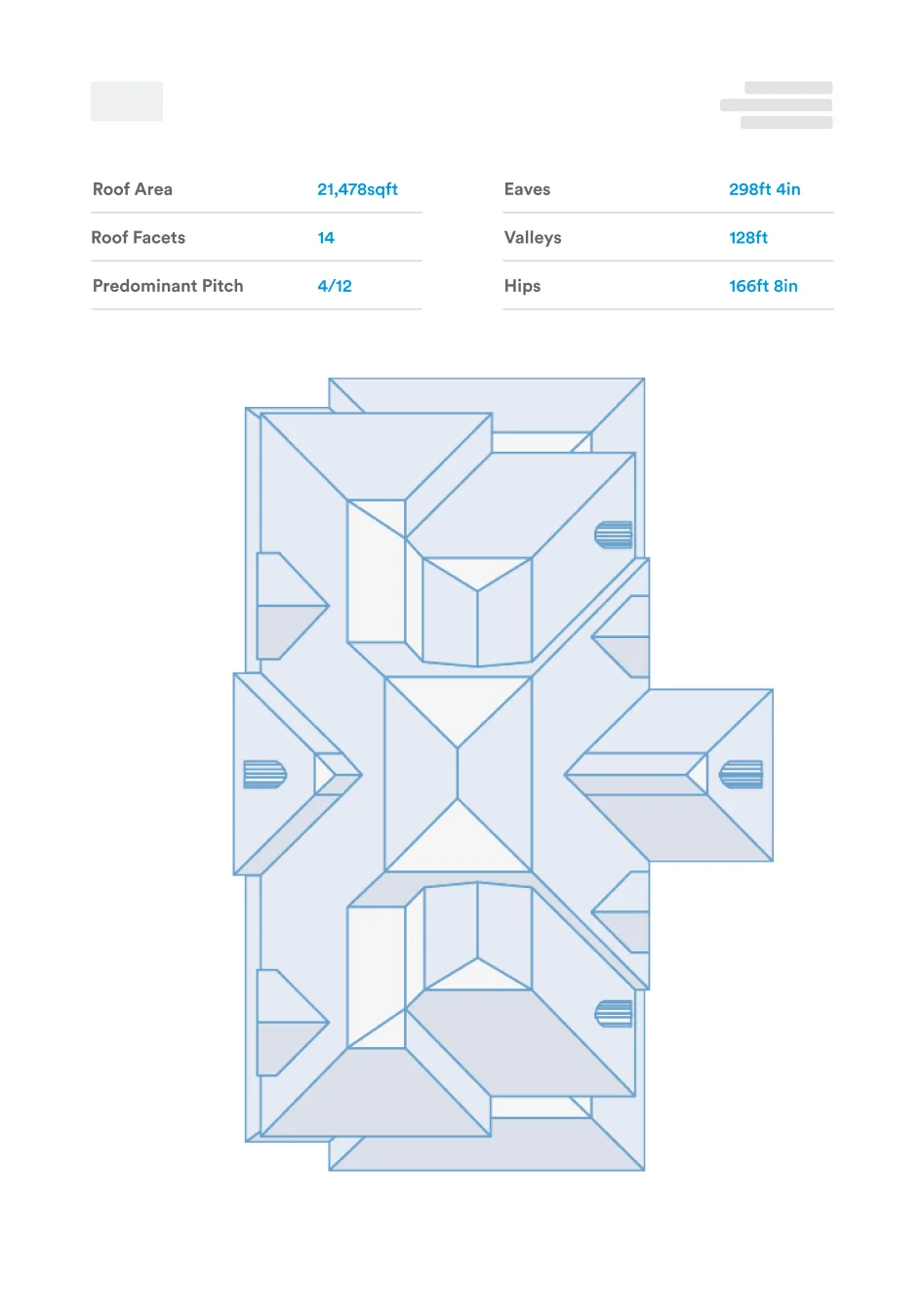
Pricing and delivery by tier:
| Tier | Report Cost | Delivery SLA | Monthly Subscription |
|---|---|---|---|
| Starter (free plan) | $19 | 24 hrs estimated | $0 |
| Measure+ add-on | $13-$19 | 6 hrs or 2 hrs guaranteed | $109-$169/mo |
| Essentials | $13 | 2 hrs guaranteed | $209 annual / $249 monthly |
| Scale | $13 | 2 hrs guaranteed | $299 annual / $349 monthly |
DIY Measurements (where you trace the roof yourself using Roofr’s imagery) are free on paid subscription plans with your own or Bing imagery, and $2-$3.50 per report if you use premium imagery. On Starter tier, DIY runs $3.50-$4 per report.
What I’ve seen in real-world use:
- On standard suburban residential roofs, the reports come back accurate within a shingle or two of what I’d measure on the roof. Delivery on subscription is genuinely 2 hours — I’ve had reports back in under an hour on slow days.
- On rural and heavily-tree-covered properties, satellite coverage gets thin. About 1 in 4 of my South Louisiana backroad homes needed manual outline correction after delivery, because the trees obscured part of the ridge line. Roofr’s editability saves this from being a dealbreaker — I fix the outline in the dashboard and the materials recalculate.
- On complex cut-up roofs with multiple pitches, dormers, and valleys, pitch detection is good but not perfect. Maybe once a month a report comes back with a pitch misread on a secondary plane that I catch because I’ve been on the roof. EagleView’s manual quality assurance catches more of these before delivery; Roofr’s is more automated and occasionally passes them through.
- Flashing quantities frequently need minor corrections, particularly step flashing on chimneys and wall-to-roof transitions. This is a consistent complaint across Capterra reviews and matches my experience.
The editability differentiator matters. Roofr is the only measurement service in this category that lets you edit a delivered report. EagleView deliverables are locked — if the pitch is wrong, you order a new report. Roofr’s line is straight from their own FAQ:
“No measurement service is 100% accurate (pretty sure that’s physically impossible) but we are known for our accuracy. We’re also the only service that allows you to edit a finished report.” — Roofr FAQ
That’s the honest framing. For my use case — retail residential re-roofs in Louisiana where I’ll be on the roof verifying conditions anyway — Roofr’s satellite + editability wins. For an adjuster-scrutinized commercial claim, I’d still pull an EagleView.
Roofr AI Capabilities: What’s Real, What’s Marketing, What’s on the Roadmap
Roofr markets “AI-powered” features across the platform. The honest breakdown, from someone who’s actually used them:
Instant Estimator ($149/mo add-on)
This is Roofr’s flagship “AI” feature. A homeowner lands on your website, enters their address, and Roofr generates a rough quote using satellite measurement plus your pre-set material templates and pricing rules. The homeowner sees Good/Better/Best tiers and can submit themselves as a lead.
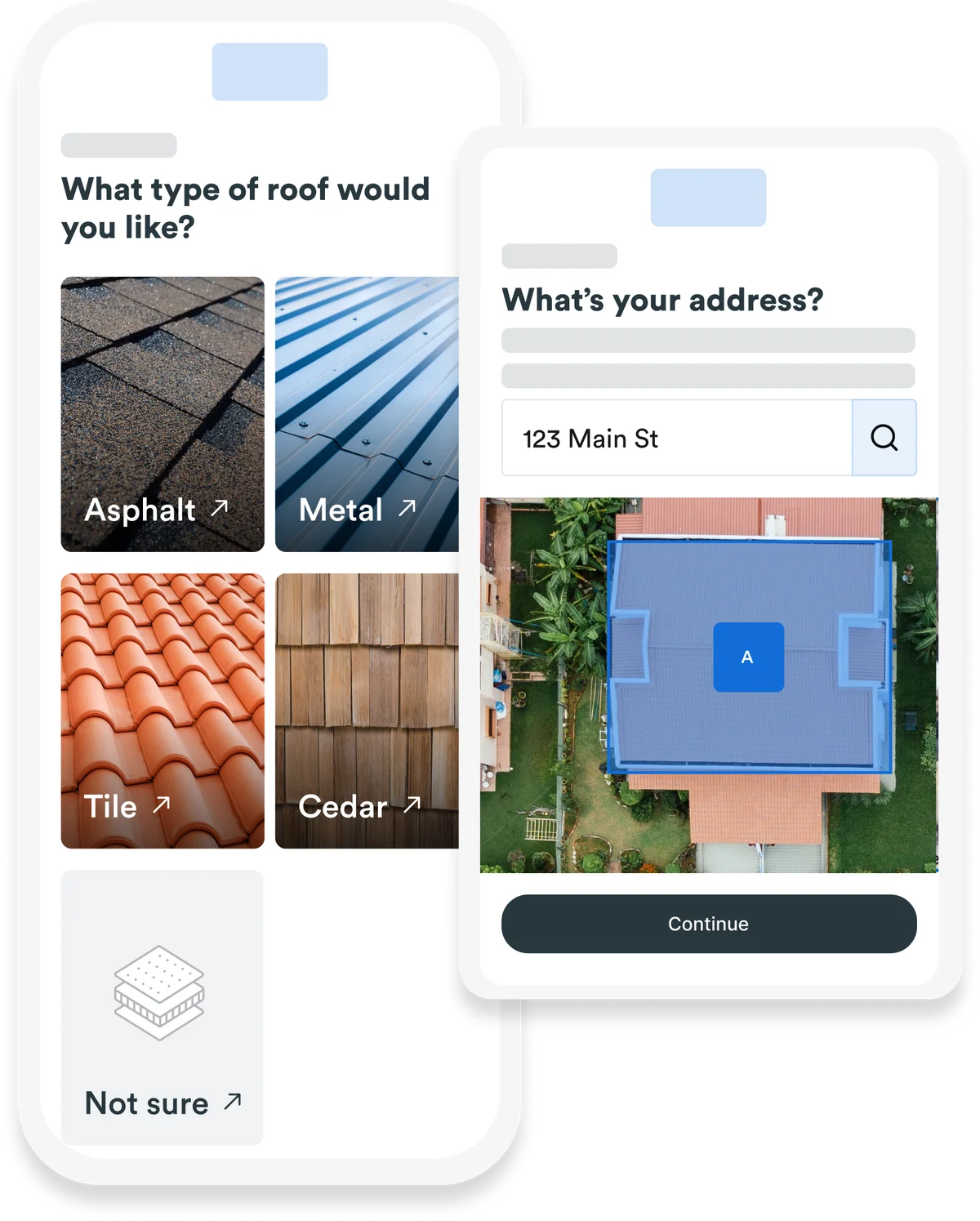
Is it AI? Technically no — there’s no large language model, no generative reasoning, no computer vision damage detection. It’s automation driven by aerial data and rules. That said, it works as a lead-gen tool: homeowners who submit themselves through an Instant Estimator land in your CRM pre-qualified and pre-priced. For contractors running paid Meta or Google ads to a landing page, it’s a real conversion-rate lift.
Roofr Sites ($99/mo beta)
Conversational AI builds a branded roofer website, updates content for SEO, and runs continuous optimization. This one is actual generative AI — the content creation uses LLM underpinnings. The beta pricing is aggressive; the long-term question is whether a roofer needs another $99/mo line item on top of their existing stack.
What’s on the 2026 Roadmap
The CEO went on record in a 2026 Roofing Contractor Q&A saying “three or four AI features are coming out on the roadmap.” Publicly teased:
- AI Data Reporting — analytics-driven insights from your platform data
- AI Lead Capture Agents — voice-answering automation, which puts Roofr into direct competition with Rosie, Goodcall, and Smith.ai for after-hours call coverage
- Continued AI website builder improvements
What Roofr Does NOT Do (Yet)
No AI damage detection from photos. No AI scope-of-loss builder (notable gap given the Verisk partnership). No voice-to-estimate. No AI-written proposal narratives. If you’re shopping specifically for AI-native estimating, the tools that are further along in 2026 are RoofD AI, Beam AI, XBuild, and iRoofing’s AI suite — Roofr is playing “AI-enhanced workflow” rather than “AI-first.”
“AI that streamlines workflows even further is becoming a competitive advantage for roofers.” — Richy Nelson, CEO of Roofr (Roofing Contractor, 2026)
How Roofr Stacks Up Against the AI Estimating Specialists
Roofr now cross-lists in three categories on this site — Estimating, CRM, and AI Estimating. The third placement is editorial, not promotional: Roofr earned its spot in the AI Estimating roster because the core workflow IS AI-driven estimate assembly — the Roofr Report (satellite measurement) feeds directly into AI line-item generation with real-time ABC Supply, SRS, and QXO supplier pricing pulled at quote time. That’s a fundamentally different architecture from a chatbot bolted onto a website or a takeoff service that exports to Excel.
Roofr’s per-dimension score in AI Estimating: 4.1/5 weighted — the highest in the cluster after XBuild and Roofle, and the only product in the category that handles measurement, AI line-item assembly, proposal, payment, and lightweight CRM in a single flat-rate subscription instead of forcing you to stitch together two or three tools.
AI Estimating Cluster · 5 Products
Where Roofr Wins, Where the Specialists Beat It
Roofr is the unified-stack pick. The AI-native specialists are deeper on specific axes (chat-first proposal, lead capture, multi-trade takeoff) but force you to assemble a stack instead of buying one tool.
Roofr's structural advantage
Native takeoff → AI line items → proposal → deposit, in one tool
5.0/5 on Takeoff Integration — the Roofr Report IS the AI takeoff, no external handoff. Real-time supplier pricing pulled into line items. e-Sign + Stripe collect the deposit on the same workflow. None of the AI specialists ship measurement + AI estimate + proposal + payment as one platform.
vs XBuild · AI-Native Estimator
XBuild wins on AI depth + chat-first speed
XBuild's chat-first workflow generates margin-accurate estimates in ~15 minutes with deeper AI inference. Roofr wins on bundled measurement + unlimited users on every tier (XBuild bundles seats too, but caps them at 3, 8, or 20 per plan). Pick XBuild if you want pure AI estimating; pick Roofr if you want measurement-bundled.
vs Roofle · Lead-Magnet Widget
Roofle wins on the homeowner-facing capture
Roofle's website-embedded instant quote runs in 29 seconds and converts at 8-10% (vs 1-2% baseline). Roofr's Instant Estimator is the same pattern but lighter. For pure lead capture, Roofle is deeper. For full measurement-to-bid workflow, Roofr is the broader stack.
vs RoofD AI · Conversational Chatbot
RoofD AI wins on free-tier accessibility
RoofD AI's free-forever tier captures partial leads from website bouncers — a dimension Roofr doesn't compete on. Pair them: RoofD AI for the website chatbot + Roofr for the measurement and proposal close. Different jobs, both useful.
vs Beam AI · Commercial Multi-Trade
Different categories, different customers
Beam AI is commercial GC + specialty subs at $8K-$25K/year per trade for 15+ trades with hybrid AI + human-QA. Roofr is residential roofing at $209-349/month flat. Not really a comparison — they don't share buyers.
Honest editorial position
Roofr is the unified-stack default for residential
If you want one tool that handles measurement + AI line items + proposal + payment + light CRM for residential roofing, Roofr is the cleanest pick. The AI-native specialists win on individual axes but force a multi-tool stack.
Top-line rating: 4.0/5 under 70/30 primary-weighted (estimating primary at 70% × 3.98 + 30% × avg(crm 3.78, ai-estimating 4.05) = 3.96). The ai-estimating cross-listing is the editorial driver of the +0.1 bump from the prior 3.9.
The dimensional truth of why Roofr scores 4.1/5 in AI Estimating specifically: the integration of in-house measurement with AI line-item generation against real-time supplier pricing is genuinely best-in-class because the takeoff isn’t an external handoff. Beam AI delivers ±1% accuracy via hybrid AI + human QA but ships Excel files you import elsewhere; XBuild has the chat-first AI but pulls measurement from EagleView/Hover/Roofr Reports as external inputs; Roofle is faster on the homeowner side but its measurement is for lead qualification, not bid math; RoofD AI is the lead-capture conversational layer at homeowner-pre-qual precision. Roofr is the only product in the cluster where measurement, AI line items, and proposal generation live inside one workflow — that’s what the 5.0/5 on Takeoff Integration is rewarding, and it’s what justifies the third category placement.
What still drags Roofr’s AI estimating score below the top of the cluster: AI capability itself is “automation driven by aerial data and rules” rather than generative inference (the section above unpacks this), trade coverage is roofing-only (same as Roofle and RoofD AI, narrower than Beam AI’s 15 trades), and integration breadth on the CRM side has gaps that the AI handoff inherits. The roadmap’s AI Lead Capture Agents and AI Data Reporting will lift the AI dimension if they ship in 2026.
Roofr Pricing in 2026 (Fully Verified on the Pricing Page)
Roofr overhauled pricing in March 2026. The old Pro / Premium / Elite tiers are retired. Here’s what’s live as of July 30, 2026, verified against roofr.com/pricing. If you want the full cost workup, per-report volume math, and real stack scenarios, that lives in our dedicated Roofr pricing breakdown:
| Tier | Monthly | Annual (billed yearly) | Report Cost | Delivery | Seats | Headline Features |
|---|---|---|---|---|---|---|
| Starter | $0 | n/a | $19 | 24 hrs estimated | Unlimited | 10 trial proposals, material ordering, email, no CC required |
| Essentials | $249 | $209 | $13 | 2 hrs guaranteed | Unlimited | Unlimited proposals + invoices, CC/ACH payments, signable PDFs, SMS add-on ($49/mo), dedicated account manager |
| Scale | $349 | $299 | $13 | 2 hrs guaranteed | Unlimited | Custom job boards + tags, crew management, performance dashboard, job costing, QuickBooks integration |
Add-ons (separate monthly subscription line items):
- Measure+: $109/mo (6-hr delivery) or $169/mo (2-hr delivery) — upgrades Starter tier delivery and discounts per-report pricing. Not needed on Essentials or Scale.
- Instant Estimator: $149/mo monthly / $125/mo annual — the embeddable homeowner-facing quote widget.
- Roofr Sites (Beta): $99/mo monthly / $85/mo annual — AI-powered website builder.
- ESX Xactimate file: $10 flat per Roofr Report, all tiers.
Payment processing (separate from subscription, on collected payments only):
- Visa/Mastercard/Discover: 2.8% + $0.30
- Amex: 3.25% + $0.30
- ACH: 0.5% (capped at $40 per transaction)
Real Contractor Cost Math
A typical mid-size roofer pulling 20 measurements per month on Scale annual, with Instant Estimator, averaging $30K/month in processed payments through Roofr:
| Line Item | Monthly |
|---|---|
| Scale subscription (annual) | $299 |
| 20 Roofr Reports × $13 | $260 |
| Instant Estimator | $125 |
| Payment processing (~50% card, avg 2.8% + $0.30) | ~$420 |
| Total | ~$1,104/mo |
Compare that to the same contractor on AccuLynx with a 5-person office: $60/user × 5 = $300/mo plus EagleView reports averaging $50 each × 20 = $1,000/mo, for $1,300/mo before proposal or payment tools. Roofr is genuinely cheaper at this volume — and that’s before the ESX add-on replaces EagleView insurance-grade reports entirely on the jobs where it’s appropriate.
Where the Pricing Gets Uncomfortable
Stack Scale + Instant Estimator + Roofr Sites and you’re at $547/month base before a single report. That’s a big jump from the $249 Essentials impression most contractors leave the pricing page with. The add-on architecture is a genuine line-item risk. If you’re evaluating Roofr, budget the real stack you’ll actually run, not the starting tier sticker price.
Proposals, Payments, and Closing Jobs at the Kitchen Table
This is where Roofr’s product quality peaks. The proposal builder auto-populates from the measurement report — materials, labor, waste percentage, your branded template — and outputs a clean, customer-facing PDF with native e-signature and Stripe-backed payment collection.
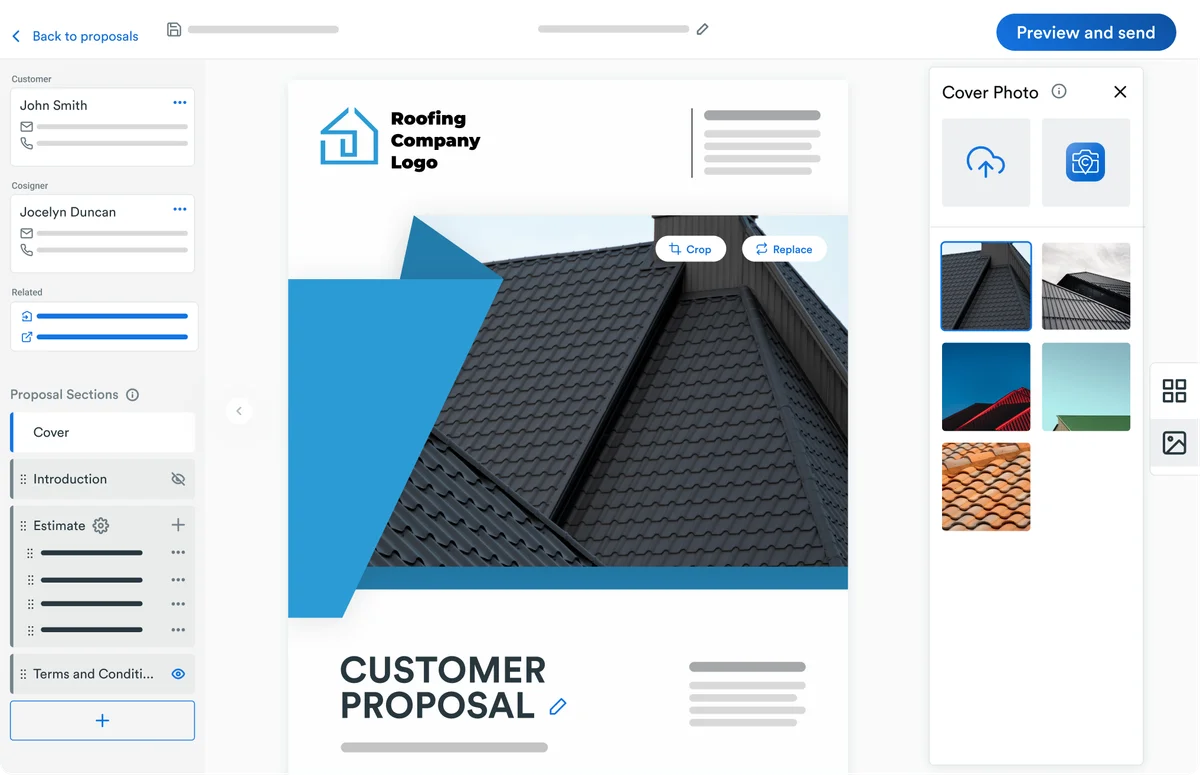
What it does well:
- Multi-option proposals (Good/Better/Best) — the closing-rate multiplier that ServiceTitan has bet its whole pricebook model on, and that Roofr now offers on residential re-roofs.
- Native CompanyCam photo import directly into proposals — tap photos from the job into the scope narrative.
- Real-time ABC Supply material pricing pulled into line items — your estimates stay current to actual supplier pricing, not your last year’s markup sheet.
- Native e-signature, multi-signer support, partial payment collection, deposit collection from the proposal link.
- GoodLeap financing integrated natively — homeowners see “as low as $X/mo” financing options in the proposal before they sign.
- Mobile proposal creation via the January 2026 PWA.
What it doesn’t do as well as AccuLynx:
- No supplement workflow for insurance restoration — adjuster correspondence tracking, supplement status, and carrier documentation trails are AccuLynx territory.
- Multi-trade line items are possible but not template-native — Roofr is roofing-first, so siding and gutter quotes work but don’t get the deep assemblies AccuLynx offers across accessory categories.
“The roof diagram impresses the homeowners and gives confidence they’re dealing with professionals.” — Steven Whitworth, CEO of World Class Roofing (Source: Roofr customer reviews, 2025-2026)
Roofr Integrations: The Honest Map
This is the most misrepresented section in every other Roofr review I’ve read. Here’s what Roofr actually integrates with, separated by depth:
| Platform | Integration Type | Real-World Usability |
|---|---|---|
| ABC Supply | Native | Real-time pricing in proposals, order creation, shipment notifications |
| SRS Distribution | Native | Same as ABC — real-time pricing and ordering |
| QXO | Native | Supplier integration, real-time pricing |
| CompanyCam | Native | Photos auto-sync to proposals; jobs can be created from CompanyCam projects |
| GoodLeap | Native | Homeowner financing in proposals (paid plans only, 5-day setup) |
| Google Calendar | Native (Oct 2025) | Two-way job scheduling sync |
| Verisk / Xactimate ESX | Native (April 15, 2026) | $10 per report, certified export |
| QuickBooks Online | Partial (Scale tier) | One-way sync, no true two-way as of April 2026 |
| Stripe | Underlying | Powers Roofr Payments — not contractor-facing |
| JobNimbus | Zapier only | Manual workflow, no direct sync |
| AccuLynx | Zapier only | Manual workflow, no direct sync |
| GoHighLevel | Zapier via LeadConnector | Manual workflow, Zapier trigger latency |
| HubSpot | Zapier only | Manual workflow |
| Jobber | Not listed | No native integration, not in Roofr’s Zapier trigger/action set |
| Housecall Pro | Not listed | No native integration |
| ServiceTitan | Not listed | No native integration |
Zapier trigger events Roofr exposes: Lead Created (via Instant Estimator), Proposal Sent, Proposal Viewed, Proposal Signed, Proposal Lost, Proposal Total Adjusted, Report Ordered. Zapier actions: Create Job and Customer.
The Integration Ceiling
This is where Roofr structurally caps out for multi-platform contractors. If you’re running Jobber or Housecall Pro as your service-trade CRM and you do roofing as one of several trades, Roofr is an awkward fit — there’s no direct bridge at all, not even through Zapier’s public trigger surface. Your options are migrate the roofing side to Roofr’s native CRM, run both platforms in parallel with manual data transfer, or stick with AccuLynx-to-JobNimbus style workflows that have more mature cross-platform tooling.
For pure-play residential roofers who don’t need a service-trade CRM, Roofr’s integration set is adequate. For everyone else, the gap is real.
No public API as of April 2026 either — the Zapier surface is the only programmatic access. If your stack includes custom tools, flag this early in your evaluation.
The CRM Reality: Good Enough, Not Deep
Roofr’s CRM is a pipeline-style job board with kanban views, job cards, contact history, and basic tagging. It works for a solo or 2-3 person roofing outfit. It becomes the limiting factor for a 10+ person production shop.
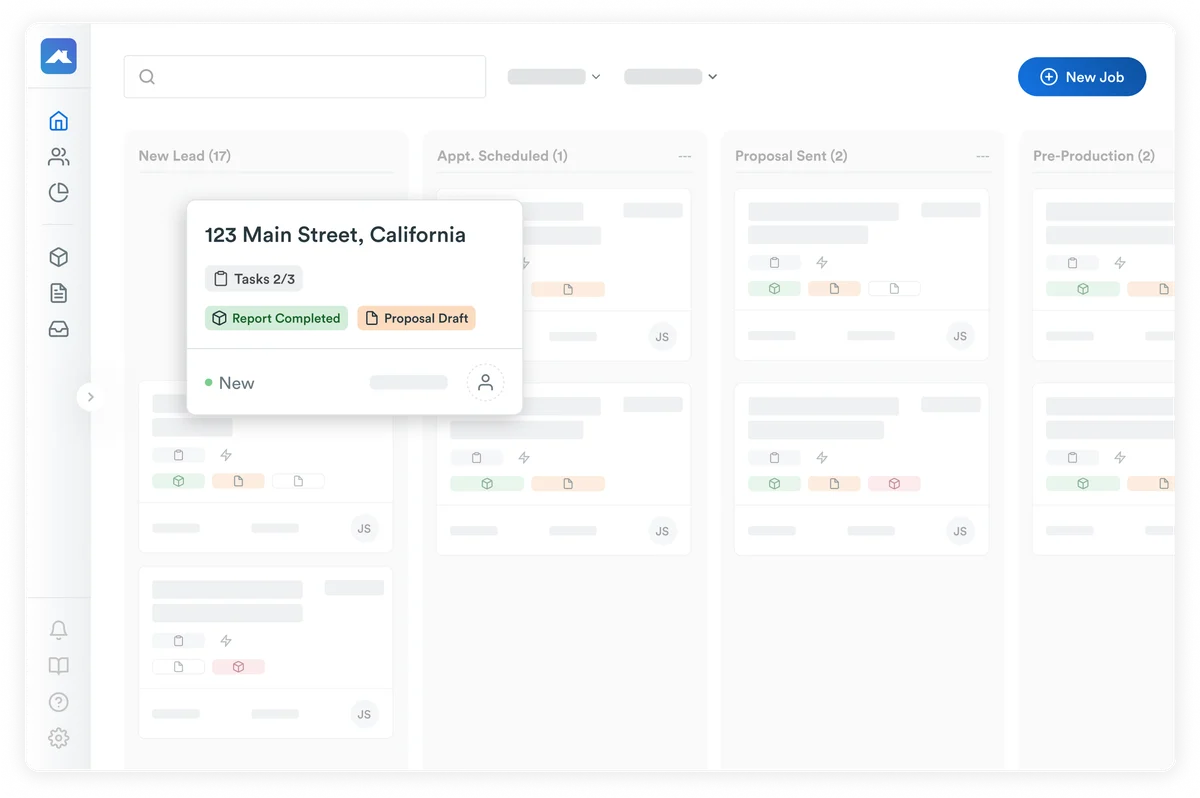
What it lacks compared to JobNimbus and AccuLynx:
- No route optimization for crews
- No dedicated business phone line or VoIP integration
- No inventory or material stock management
- No customer self-scheduling portal
- No true commission tracking for sales teams
- Limited reporting depth outside the Scale-tier performance dashboard
Where it’s actually fine:
- Solo roofer through 5-person office
- Measurement-and-proposal-centric workflow where the CRM is secondary to the estimating tool
- Teams that want a single clean UI over a deeper, messier alternative
This is the structural reality. Roofr built a measurement tool and is retrofitting CRM depth onto it. JobNimbus was built as a CRM first and added estimating. AccuLynx was built for production roofing from day one. If CRM depth is your primary need, those are the better picks. If measurement-driven proposal workflow is primary and CRM is secondary, Roofr holds up.
Roofr Scored Against the CRM Dimensions Specifically
Because Roofr is now cross-listed in the CRM category on this site, here’s how it actually scores against the 9 dimensions we use to rate contractor CRMs — separate from its (much stronger) estimating score.
- Pipeline & automation: 3.5/5. Solid kanban job board. No deep automation triggers, no drip campaigns, no lead-routing rules.
- Mobile field app: 3.8/5. PWA launched January 2026 — installs to home screen, works offline for core workflows. Not a native iOS/Android app, which limits push notifications and deep mobile-OS integration vs JobNimbus or AccuLynx.
- Setup & onboarding: 4.5/5. Genuine strength. Free Starter tier with no credit card means contractors can fully evaluate workflow before paying. Onboarding clarity is best-in-category.
- Feature depth: 3.0/5. Missing the production-CRM depth — no route optimization, no inventory, no business phone, no customer self-scheduling, no true commission tracking.
- Trade specialization: 4.5/5. Roofing-purpose-built UI and workflows.
- Integrations: 3.0/5. CRM-side integrations are thin — no native JobNimbus, no AccuLynx, no Jobber, no Housecall Pro, no GoHighLevel (Zapier-only for most). Strong on supplier side (ABC, SRS, QXO).
- Estimating tools: 4.7/5. This is where Roofr lives — best-in-CRM-category estimating tooling because Roofr started life as an estimating platform.
- AI & automation: 3.0/5. Instant Estimator and Roofr Sites are real AI features; AI Lead Capture Agents on the roadmap for late 2026. Light vs full AI-native CRMs.
- Value for team size: 4.5/5. No per-seat pricing on any tier — a 10-person office pays the same subscription as a 3-person office, which is rare in the CRM category.
The 70/30 honest math. Roofr’s primary category remains estimating (where it leads on dimension scores) and CRM is a secondary cross-list. Top-line rating reflects 70% of the estimating score plus 30% of the CRM score, which works out to 3.9 overall as of April 2026.
The honest editorial framing for buyers. Roofr is a narrow-vertical CRM that suits roofers who don’t want JobNimbus or AccuLynx’s overhead, want measurement and proposal in the same UI, and don’t need production-CRM depth (route optimization, inventory, dispatch, multi-crew scheduling). For solo through 5-person residential retail roofing operations, Roofr’s CRM is sufficient. Above that team size, the CRM becomes the constraint and JN/AccuLynx earn their per-seat premiums.
What Contractors Actually Say (G2, Capterra, and the Honest Patterns)
Roofr’s social proof is strong. Aggregating the verified data:
- G2: 5/5 across 25+ reviews, Spring 2026 Leader badge + Best Usability + Highest User Adoption + Best Relationship (Source: Roofr G2 page)
- Capterra: 4.6/5 across 101 reviews
- Roofr self-reported: 4.7/5 across 1,000+ reviews on the company homepage
The G2 category scores run 96-98% across Ease of Use, Meets Requirements, Quality of Support, and Ease of Setup — that’s the best support score in the roofing software category for 2026.
The five-star consensus (across platforms) centers on three themes:
- Affordability of measurements versus EagleView
- Speed to signed proposal once templates are set up
- Support responsiveness — 13-minute average response time is cited repeatedly
The critical review pattern centers on a narrower cluster:
- Per-report costs scale poorly at very high volume (a 100-measurement/month contractor is spending $1,300/mo on reports alone)
- Satellite coverage gaps on rural/tree-covered properties
- Limited QuickBooks two-way sync — this is the single most-repeated complaint in recent Capterra reviews
- CRM depth — the “bolted-on” critique from production-roofing voices
- Add-ons stack up — Scale + Instant Estimator + Roofr Sites = $547/mo before reports
“The setup is pretty easy to complete and it’s pretty much plug-and-play.” — Parker S., Accounts & Operations Coordinator (Source: Roofr Capterra review, November 20, 2025)
Who Should Use Roofr
Roofr is the right fit if:
- You write insurance estimates in Xactimate — the $10 ESX add-on is the cleanest satellite-to-Xactimate bridge on the market as of April 2026
- You’re a solo or small-team (2-10) roofer — the free Starter tier makes it a no-risk start, and subscription tiers don’t penalize you per-seat
- You pull 10-40 measurements per month — this is the volume band where Roofr’s per-report pricing beats EagleView by the widest margin
- Your customers are retail residential, not commercial or insurance-adjuster-scrutinized — Roofr’s accuracy is fine for the “I’ll verify on the roof” workflow
- You want proposals, payments, and measurement in one tool — the integrated Good/Better/Best proposal + Stripe payment + GoodLeap financing flow is genuinely strong
- You run paid ads to a landing page — the $149/mo Instant Estimator is a real conversion lift for lead-gen-focused roofers
Who Should NOT Use Roofr
Roofr is the wrong tool if:
- You run JobNimbus or AccuLynx already — you don’t need Roofr’s CRM, and neither of those has a native Roofr integration for the measurement side beyond Zapier. Stay on your existing stack and pull EagleView or QuickMeasure reports.
- You’re a production roofer running 50+ jobs/month — Roofr’s CRM hits its ceiling fast on crew management, inventory, route optimization, and reporting depth. JobNimbus and AccuLynx are meaningfully deeper for true production workflows.
- You specialize in commercial or insurance-heavy restoration — EagleView’s accuracy track record on adjuster-scrutinized scopes is still hard to beat, and AccuLynx’s supplement workflow is the category leader.
- You run Jobber or Housecall Pro for a multi-trade service business — Roofr has no native integration and isn’t in Jobber/HCP’s Zapier workflow set either. You’ll either migrate or live with manual data transfer, and neither is a good long-term answer.
- You need AI-native estimating — Roofr’s AI is automation-with-an-AI-label, not generative. RoofD AI, Beam AI, XBuild, or iRoofing’s AI suite are further along in 2026.
- Your average measurement volume is 100+/month — the per-report pricing starts to hurt above 75/mo. At very high volume, EagleView’s subscription model starts winning on unit economics.
Roofr 2026 Roadmap
Publicly disclosed in CEO Q&As and the January 2026 masterclass:
- AI Data Reporting — analytics insights from platform data (later 2026)
- AI Lead Capture Agents — voice answering to compete with Rosie and Smith.ai in the after-hours call category (later 2026)
- Expanded QuickBooks two-way sync — Roofr’s own FAQ confirms this is in active development
- Full Change Orders workflow — 2026
- Crew sign-offs and pricing updates on Work Orders — 2026
- Production scheduling features
- Expanded user permissions and role-based access
The mobile PWA already shipped January 2026. Roofr Sites (AI website builder) is in active beta. The Verisk ESX partnership launched April 15, 2026. The roadmap is moving fast, and the direction of travel is “platform depth” — which is exactly where Roofr needs to close the gap against JobNimbus and AccuLynx.
Bottom Line
Roofr earns 4.0 out of 5 in our Estimating category. The specific breakdown, weighted against our published scoring dimensions:
- Estimate accuracy (4.3) — generally reliable on standard suburban roofs with real-time ABC/SRS/QXO supplier pricing keeping line items fresh; editability after delivery closes most measurement gaps before they hit the proposal; held back from 4.5 by asphalt-only auto-calc and satellite coverage gaps on rural/tree-covered properties
- Integrations (3.0) — strong on supplier/distributor/measurement/financing, weak on CRM/FSM (no native Jobber, HCP, or ServiceTitan)
- Proposal generation (4.5) — multi-option proposals, e-signature, payments, financing — peak Roofr
- Trade specialization (4.5) — roofing-native, strong asphalt shingle assemblies, weaker on metal/tile
- Aerial measurement (4.5) — in-house + ESX + editability; category-leading value on per-report pricing
- AI capabilities (3.0) — automation with an AI label, with real generative AI in Roofr Sites beta and three-to-four new AI features teased for 2026
- Pricing (4.5) — no per-seat pricing, free Starter tier, genuinely cheaper per report than EagleView at most contractor volumes
The case for picking Roofr: cheapest credible path from measurement to signed, paid proposal; the new ESX bridge for Xactimate contractors; free Starter tier to trial at zero risk; genuinely strong proposal builder; good customer support; ownership of your data with an editable measurement workflow you can’t get anywhere else.
The case against: the CRM is a retrofitted layer on top of a measurement tool; no native integration with Jobber or Housecall Pro; QuickBooks sync is still partial; add-ons stack the monthly cost quickly; AI story is marketing-ahead-of-reality.
For the Louisiana Xactimate-writing roofer — which is me — Roofr at Scale annual + ESX add-ons is the right stack for measurement and proposal, paired with Xactimate for insurance scopes and JobNimbus or AccuLynx if I were running a larger production operation. At my current scale, I stay on Roofr and re-evaluate when the QuickBooks two-way sync ships or when one of those AI lead capture agents hits general availability.
We rank Roofr #1 for measurement value in 2026 with zero affiliate commission from them as of this review. The ranking earns itself on the product and the ESX launch, not on payout — that’s the editorial line this site holds.
This review reflects the product as of April 23, 2026. We update this page every quarter as pricing, features, and the roadmap evolve. If you spot something that’s changed, send us a note.