

You’ve already heard ElevenLabs’ voice on this site. Not because we play audio — but because every AI voice agent we cover on our AI Agents hub and our AI Call Answering hub generates its voice through ElevenLabs (or a comparable competitor). Synthflow uses ElevenLabs exclusively as its only TTS provider. Vapi, Retell, and Bland all default to or natively support ElevenLabs voices. The voice that books HVAC service calls, qualifies roofing leads, and answers your after-hours plumbing emergencies is, more often than not, generated by an ElevenLabs API call somewhere in the stack. The honest editorial story behind that one paragraph is what ElevenLabs actually costs, what it can do that no competitor matches, and where contractor operators should buy ElevenLabs directly versus letting a builder platform mark it up.
ElevenLabs is the AI voice synthesis platform behind nearly every voice agent contractors evaluate — founded May 2022 by Mati Staniszewski (CEO, ex-Palantir) and Piotr Dąbkowski (ex-Google ML), both Polish, both Imperial College London / Oxford alumni. Private company at $11B valuation via $500M Series D February 2026 (Sequoia-led; IPO eyed per CNBC). $500M ARR crossed May 5, 2026 — announced 3 days before this review’s publication. ~800 employees. Customers include Disney, Nvidia, Salesforce, Cisco, MIT, plus government partnerships (UK Government voice AI safety partnership Feb 2026). 2026 Google Cloud Partner of the Year.
This review covers what ElevenLabs actually is in May 2026 — including the Eleven v3 launch state (general availability February 2026, 70+ languages, multi-speaker dialogue, inline audio tags), Conversational AI 2.0 (now branded ElevenAgents) capabilities and the strategic tension that ElevenAgents now competes with Synthflow/Vapi/Retell, the bidirectional native MCP server that’s a genuine 2026 differentiator, the credit-based pricing math that catches operators off guard, the affiliate program reality (22% × 12 months — strongest recurring on the AI Tools hub), and the practical contractor use cases (IVR scripts, voicemail greetings, bilingual phone answering for Spanish-speaking customer bases, training narration) where ElevenLabs delivers value that’s genuinely worth the premium.
“One of the finest AI voice cloning tools in the market with robust voice generation capabilities.” — Nishant T., Sr Analyst, Financial Services — verified Capterra review
The honest editorial through-line: ElevenLabs is the AI Tools hub’s highest-rated product because the dimensions earn it. Best voice quality on the market (verified across multiple third-party benchmarks), strongest funding posture by an order of magnitude, native MCP support both directions, comprehensive integration depth (Twilio + Genesys + Vonage + Telnyx + every major CRM + Zapier + n8n + 8,000+ apps), and a $6/month Starter entry that’s the cheapest first commercial license tier in the voice category. The friction is real but bounded — credit math is opaque at heavy usage, Trustpilot 3.2/5 (vs G2 4.7) reflects billing complaints, and the contractor use case requires either tech-comfort or willingness to pay through builder platforms. For operators who fit the profile, ElevenLabs is the platform infrastructure the rest of the AI Tools hub builds on.
The Voice You’ve Already Heard (Without Knowing It)
Most contractor reviews of AI voice tools treat ElevenLabs as a standalone product — a TTS service you’d subscribe to alongside the rest of your stack. That framing misses the strategic reality: ElevenLabs is the voice layer underneath nearly every other AI voice agent on this site.
The dependency map verified in May 2026 research:
- Synthflow — uses ElevenLabs as its ONLY TTS provider. Verified from Synthflow’s own integration documentation. Every Synthflow voice agent — every IVR demo, every appointment-booking flow, every after-hours greeting — generates its audio through an ElevenLabs API call.
- Vapi — multi-provider voice platform (ElevenLabs + Azure + PlayHT). ElevenLabs is one of three headline voice options with dedicated integration documentation.
- Retell — multi-provider; ElevenLabs is among the supported voices for tech-comfortable operators building custom voice agents.
- Bland — primarily uses proprietary voices, but supports ElevenLabs integration for operators who want premium voice quality.
- PipeCat, Voiceflow, Air.ai — all listed in third-party comparison content as ElevenLabs-compatible.
The architectural reality: if you’re using a no-code voice agent builder to power your contractor operation, you’re probably an indirect ElevenLabs customer. The builder platform marks up the underlying voice provider, charges you a monthly subscription, and generates revenue on the spread between what they charge and what ElevenLabs charges them.
For contractor operators, this dependency creates two practical decisions:
- Buy ElevenLabs directly for use cases that don’t need the builder layer — IVR scripts, voicemail greetings, marketing voiceovers, training narration, bilingual phone answering. The builder platforms’ value-add is conversation logic; for static voice content, the builder layer adds cost without adding capability.
- Use a builder platform for use cases that need conversational logic — autonomous appointment booking, lead qualification, multi-step customer service. The builder handles the conversation flow; ElevenLabs handles the voice underneath.
Most contractor reviews skip this distinction entirely. The dual-frame editorial position on ElevenLabs is what makes this review useful — operators evaluating their voice stack get clarity on when to buy direct vs through a builder, and what the dependency tree actually looks like for their AI voice infrastructure.
From Voice Synthesis Lab to $11 Billion AI Audio Platform
ElevenLabs’ funding trajectory tells the editorial story of what the platform has become.
The founding (May 2022): Mati Staniszewski (ex-Palantir deployment strategist) and Piotr Dąbkowski (ex-Google ML engineer) — high school friends from Poland — incorporated ElevenLabs after meeting at Imperial College London and Oxford. The company spent 12 months in stealth building proprietary voice synthesis models from scratch, not based on any disclosed open-source backbone. Mati continues as CEO; Piotr is the technical co-founder.
The funding ladder verified May 2026:
- Series A — January 2023, $19M [unverified — not directly confirmed in research session; widely reported]
- Series B — January 2024, $80M at ~$1.1B valuation (unicorn status)
- Series C — January 2025, $180M at $3.3B valuation (co-led by a16z and ICONIQ Growth)
- Series D — February 2026, $500M at $11B valuation (led by Sequoia; IPO eyed per CNBC coverage)
That’s a roughly 10x valuation increase from January 2024 to February 2026 — among the fastest in the AI infrastructure category. The Sequoia-led Series D combined with explicit IPO discussions positions ElevenLabs as durable platform infrastructure rather than acquisition bait.
The 2026 product positioning shift: ElevenLabs repositioned in late 2025 / early 2026 from “voice synthesis company” to a full audio AI platform with three product lines:
- ElevenCreative — TTS plus creative content generation (Studio, Projects, Eleven Music)
- ElevenAgents — voice and chat agents (formerly Conversational AI 2.0; rebranded in current site nav)
- ElevenAPI — foundational audio models for developers
Homepage tagline May 2026: “Bringing technology to life.” Headline pitch: “Powering the best enterprises, creators, and developers. From ElevenAgents for customer experience, ElevenCreative for content creation, to the leading AI voice generator.”
The institutional traction signals:
- $500M ARR crossed May 5, 2026 — announced 3 days before this review’s publication
- 2026 Google Cloud Partner of the Year (April 21, 2026)
- First-of-its-kind AI Agent insurance secured (February 12, 2026) — first commercial AI agent liability insurance product
- ElevenLabs for Government launched (February 11, 2026)
- UK Government voice AI safety partnership (February 18, 2026)
- ~800 employees across multiple data sources (PitchBook 600, Tracxn 879 April 2026)
For contractor operators evaluating long-term platform stability, ElevenLabs has the strongest funding posture on the AI Tools hub by a wide margin. The $11B Series D valuation is multiples of any other AI Tools hub product — Synthflow ($30M total), Tidio ($26.8M total), n8n ($254M total), Notion ($343M total). The IPO trajectory adds a layer of public-market accountability that smaller AI startups don’t have. Platform durability is genuinely high.
Reading the Pricing Page Without Getting Burned by Credits
ElevenLabs’ tier-based pricing looks cheap until operators understand the credit math. Most reviewers stop at the headline prices; the editorial honesty point is what credits actually translate to in production use.
Verified pricing tiers from elevenlabs.io/pricing (May 2026):
~1,000 credits = ~1 minute of TTS at standard quality. Free tier real but no commercial use. Starter is the first commercial license tier.
- →10,000 credits/month (~10 minutes audio). TTS, STT, Sound Effects, Voice Design, Music, 3 Studio projects.
- →No commercial use. Personal/evaluation only.
- →30,000 credits/month (~30 minutes audio). Instant Voice Clone (1), 20 Studio projects, Dubbing Studio.
- →Cheapest commercial-use entry on the AI Tools hub. Most contractors testing IVR/voicemail land here.
- →121,000 credits/month (~2 hours audio). Professional Voice Clone unlocked.
- →Most-marketed tier. $11 first-month promo available.
- →600,000 credits/month (~10 hours audio). 44.1 kHz PCM via API, 192 kbps audio quality.
- →Right tier for contractor agencies producing meaningful voice content monthly.
- →1,800,000 credits/month (~30 hours audio). 3 Professional Voice Clones, 3 workspace seats.
- →Multi-location operations + contractor marketing agencies running production voice content.
- →6,000,000 credits/month (~100 hours audio). 10 PVCs, 10 seats, low-latency TTS as low as 5¢/min.
- →Affiliate commission drops to 11% on this tier (vs 22% on Pro/Scale below).
- →Custom credits, custom seats, regulatory compliance bundle. No affiliate commission on Enterprise referrals.
Real-world contractor math: typical 30-second IVR script ≈ 500 credits. Creator tier ($22/mo) handles 240+ scripts/month with headroom. ElevenAgents (Conversational AI) pricing: $0.08/minute and lower on annual Business. Free startup grant: 33M credits valid for 1 year (~$4,000 value).
The credit math gotchas worth knowing about:
- ~1,000 credits = ~1 minute of TTS at standard quality. Eleven v3 was 80% off credits during the June 2025 launch promo — that promo expired, so v3 now consumes credits at full rate.
- Credit rollover up to 2 months on active paid plans. Not infinite — plan accordingly if usage is bursty.
- Free tier has NO commercial use — Starter is the first commercial license tier. Operators using ElevenLabs for any customer-facing IVR or marketing content need at least Starter.
- $11 first-month Creator promo is real — verified on the pricing page. Useful for evaluation pass.
- No explicit free trial for paid tiers — the Free tier is the de facto trial.
- Cancellation: anytime, runs through current billing cycle. Refund terms not surfaced on the pricing page.
Verified Capterra operator quote on the credit reality: “The credit burn might feel punishing compared to more affordable alternatives.” — Christa B., Security Management.
Practical contractor cost projection: a small contractor using ElevenLabs at the Creator tier ($22/mo) for IVR scripts (5-10 scripts × ~500 credits each), monthly voicemail greeting refreshes, and occasional marketing voiceovers consumes roughly 30-40% of the 121K credit allowance with significant headroom. Creator tier is the right starting point for typical contractor production volume. Operators producing daily training narration content or running heavy AI voice agent workflows should plan for Pro or Scale.
Eleven v3, Conversational AI 2.0, and the MCP Server Most Reviewers Skip
ElevenLabs’ 2025-2026 product launches make it the most capable platform on the AI Tools hub by feature depth. Three releases matter for contractor operators specifically.
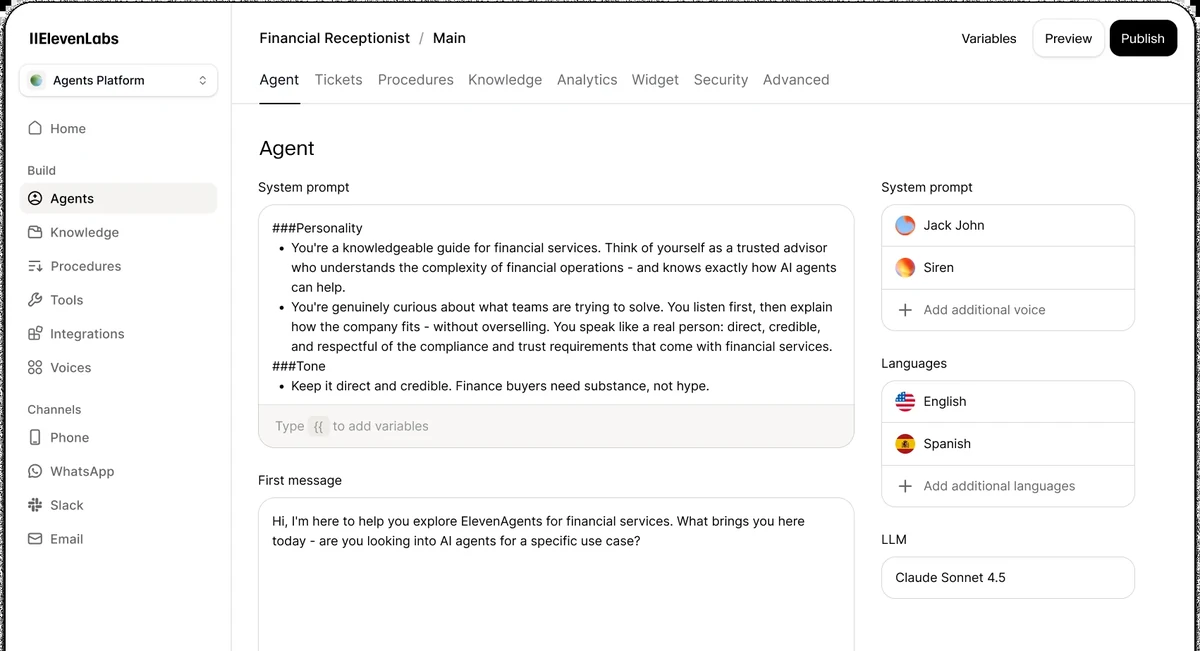
Eleven v3 reached general availability February 2026 as ElevenLabs’ most expressive TTS model. Capabilities verified from elevenlabs.io and announcement coverage:
- 70+ languages supported for TTS
- Multi-speaker dialogue — single audio file with multiple voices in conversation (training videos, podcast-style content, multi-character IVR flows)
- Inline audio tags —
[excited],[whispers],[laughing],[sighs],[sarcastic]and more, with operator control over delivery - 68% reduction in errors vs v2 on complex text per ElevenLabs benchmarking
- Released June 5, 2025 in alpha; reached GA February 2026
For contractor operators, the practical impact is voice content that doesn’t sound robotic — training narration that conveys appropriate tone, IVR scripts that match emergency vs after-hours context, marketing voiceovers that compete with human voice talent quality.
Conversational AI 2.0 (now branded ElevenAgents) launched June 2025 as ElevenLabs’ competitive entry to the voice agent platform category. Capabilities verified from VentureBeat coverage and elevenlabs.io/conversational-ai:
- State-of-the-art turn-taking model — handles hesitations, filler words, knows when to speak and when to listen
- Built-in language detection + auto-switch — agent detects customer language and switches mid-call automatically
- Multimodal — voice OR text OR both; defined once, deployed across channels
- Multi-character mode — single agent supports multiple personas (different voices for different customer flows)
- Batch outbound calls — programmatic mass calling for outbound qualification or follow-up campaigns
- Built-in RAG — knowledge base grounding without separate tooling
- HIPAA compliance + EU data residency — enterprise-grade compliance posture
- $0.08/minute and lower on annual Business pricing
The Bilingual Phone Answering Service is the contractor-relevant marketing landing — explicit English/Spanish/French/Mandarin support with v3 + ConvAI 2.0 auto-detect-and-switch. For contractors with Spanish-speaking customer bases, this is genuinely class-leading.
The bidirectional native MCP server is the genuine 2026 differentiator most reviews skip:
- ElevenLabs as MCP server — open-source server at github.com/elevenlabs/elevenlabs-mcp (1.3k stars, v0.9.1 as of January 2026). Available via PyPI and Docker. Lets Claude Desktop, Cursor, Windsurf, and OpenAI Agents call ElevenLabs TTS, voice cloning, transcription, voice design, and audio isolation directly through MCP.
- ElevenAgents as MCP client — Conversational AI 2.0 agents consume external MCP servers via SSE + HTTP streamable transports with three approval modes (Always Ask, Fine-Grained, No Approval). Operators can connect ElevenAgents to their own MCP-compatible knowledge bases and tools.
Bidirectional MCP support is rare in the voice category — same differentiator pattern as Notion’s native MCP server but extending to voice infrastructure specifically. Critical caveat: MCP is NOT available on Zero Retention or HIPAA-required tiers. Operators in restoration work touching insurance/healthcare-adjacent customer data must choose between HIPAA mode and MCP integration.
Other capabilities worth mentioning:
- Audio Native — embed voice on website (auto-narrate articles)
- Studio / Projects — long-form audio production tool (audiobooks, narrated content)
- Scribe — ElevenLabs’ speech-to-text model
- Eleven Music — AI music generation (newer product line, 2025)
- Voice Library — 10,000+ community voices
- First-of-its-kind AI Agent insurance — secured February 2026, first commercial AI agent liability insurance product
The Bilingual Phone Answering Use Case Contractors Should Actually Pay Attention To
This section exists because most ElevenLabs reviews skip it entirely, and it’s the single highest-leverage contractor use case on the platform.
The setup: ElevenLabs operates an explicit Bilingual Phone Answering Service landing page covering English/Spanish/French/Mandarin. The product combines Eleven v3 (voice quality) with Conversational AI 2.0 (turn-taking + auto-language-detect + auto-language-switch) into a deployable phone-answering agent that handles customer calls in the language the customer prefers.
Why this matters for contractors: roughly 13% of US contractors operate in markets with significant Spanish-speaking customer bases (per industry trade-group data) — Texas, Southern California, Florida, Arizona, parts of Nevada, parts of Illinois, parts of New York. For HVAC, plumbing, electrical, and roofing operators in those markets, the inability to handle Spanish-speaking customer calls professionally is a real lead-leakage problem. Live answering services with Spanish-speaking staff cost meaningful money. Hiring bilingual CSRs is hard at typical contractor scales.
The ElevenLabs solution architecture:
- Build the phone-answering agent in ElevenAgents — multi-character mode, English + Spanish personas, auto-detect-and-switch enabled
- Connect telephony via Twilio integration — verified ElevenLabs Twilio integration documentation
- Connect CRM via Salesforce/HubSpot/Zendesk integration OR via Zapier/n8n bridge to JobNimbus, ServiceTitan, Housecall Pro, GoHighLevel
- Deploy — agent answers calls, detects language, handles qualification flow, books appointments, writes back to CRM
Real-world cost math at typical contractor volumes:
- Pro tier ElevenAgents at $0.08/min annual Business pricing
- 200 inbound calls/month × 4 minutes average duration = 800 minutes
- 800 min × $0.08 = $64/month for ElevenAgents voice
-
- Pro tier base subscription $99/month for credit pool
-
- Twilio phone number ~$2/month + per-minute call charges
- Total: roughly $170-200/month for fully automated bilingual phone answering
Compared to:
- Live answering service with bilingual staff: $400-800/month
- Hiring bilingual CSR (part-time): $1,500-3,000/month all-in
- Building the same on Synthflow/Vapi: equivalent or higher cost (those platforms mark up the underlying ElevenLabs voice provider)
Honest caveats:
- Voice cloning consent required. If you clone the owner’s voice for the agent persona, document explicit consent. ElevenLabs blocks political-candidate voice cloning in US/UK/India/EU and runs Reality Defender anti-fraud verification.
- Number pronunciation glitch — Reddit r/ElevenLabs reports occasional v3 issues with numbers like “20,000” generating as “20 thousand thousand.” Test phone numbers, prices, addresses thoroughly before production.
- HIPAA mode disables MCP. Restoration operators handling insurance-adjacent data who need HIPAA must choose between HIPAA compliance and MCP integration.
- Customer support is email-only and slow. Multiple operator reports of 5-14 day response times. For mission-critical phone-answering deployments, document fallback procedures.
For contractor operators in Spanish-speaking metros, this use case alone justifies the platform. The next four sections cover the broader contractor stack-fit and competitive positioning.
Why Synthflow Operators Are Already ElevenLabs Customers (Whether They Know It or Not)
This section is the editorial moat — the strategic reality nobody else covers in their Synthflow or ElevenLabs reviews.
Verified from Synthflow’s own integration documentation: Synthflow uses ElevenLabs as its only TTS provider. There is no alternative voice option on Synthflow. Every voice agent built on Synthflow — every IVR demo, every appointment-booking flow, every after-hours greeting, every bilingual phone-answering agent — generates its audio through an ElevenLabs API call.
The economic implication:
- Synthflow’s $0.13-$0.24/minute PAYG pricing includes the ElevenLabs voice cost as a markup component
- A Synthflow customer paying $0.20/min effectively pays roughly $0.06-$0.08/min in voice costs that Synthflow passes through to ElevenLabs, plus $0.12-$0.16/min in Synthflow markup for the platform’s flow builder, integration layer, and operational features
- For operators whose use case is voice-content-only (IVR scripts, voicemail greetings, marketing voiceovers, training narration) — NOT conversational logic — buying ElevenLabs directly cuts out Synthflow’s markup entirely. The Creator tier at $22/month covers ~2 hours of voice content production, which is enough for typical contractor IVR + voicemail + occasional marketing voiceover needs.
- For operators whose use case is conversational logic (autonomous appointment booking, lead qualification, multi-step customer service), Synthflow’s flow builder layer is the value-add. ElevenLabs alone can’t run the conversation — operators need either Synthflow, ElevenAgents, or another conversational platform on top of the voice layer.
The strategic implication for tech-comfortable contractors:
If you’re already a Synthflow customer building AI voice agents for your operation or your contractor clients, you have two upgrade paths to consider:
- Subscribe to ElevenLabs Creator or Pro tier directly for the static voice content you produce alongside your conversational agents. Generate IVR scripts, voicemail greetings, marketing content directly from ElevenLabs Studio rather than through Synthflow. Get access to Eleven v3 audio tag controls and Professional Voice Cloning that Synthflow doesn’t expose.
- Consider migrating conversational agents from Synthflow to ElevenAgents directly — same underlying voice infrastructure, but cut out Synthflow’s conversational layer markup. ElevenAgents at $0.08/min annual Business pricing vs Synthflow’s $0.13-$0.24/min represents roughly 50-70% cost reduction at production volume. The trade-off: Synthflow’s no-code flow builder is more polished than ElevenAgents’ (newer) configuration UI.
The platform-level dependency risk worth flagging: any contractor or contractor agency built on Synthflow has effectively bet their voice agent infrastructure on ElevenLabs continuing to renew Synthflow’s TTS partnership terms. If ElevenLabs ever raises wholesale voice pricing significantly, Synthflow’s margin compresses (or Synthflow’s customer pricing increases). If ElevenLabs deprioritizes the Synthflow integration for any reason, Synthflow operators inherit that risk. Most contractors aren’t aware their voice agent is downstream of a single vendor relationship. Editorial honesty point.
ElevenAgents Just Became a Competitor to the Platforms It Powers
Here’s the strategic tension nobody else is covering in their voice-AI reviews.
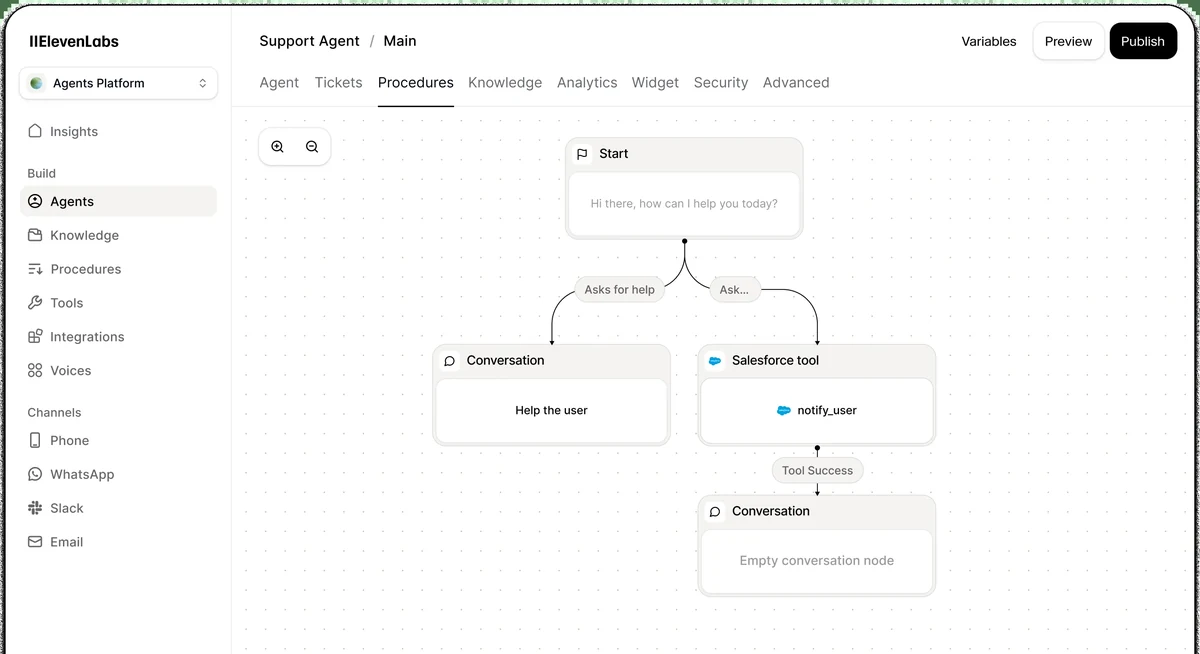
ElevenAgents (rebranded from Conversational AI 2.0) launched June 2025 and reached production maturity through 2026. It’s a fully-featured voice agent platform with:
- Conversational logic (multi-step flows, branching, escalation)
- Built-in RAG (knowledge base grounding)
- Multi-character / multi-persona support
- Multimodal voice/text/both
- Batch outbound calling
- HIPAA compliance + EU data residency
- Native MCP server consumer (consumes external MCP for tools)
- Twilio + Genesys + Vonage + Telnyx + every major CRM integration
This is functionally a direct competitor to Synthflow, Vapi, Retell, and Bland — the platforms that depend on ElevenLabs as their voice layer.
The strategic asymmetry is meaningful:
- Synthflow is exclusively ElevenLabs-dependent. Synthflow has no fallback voice provider. If ElevenLabs raises wholesale TTS pricing or deprioritizes the integration, Synthflow has structural exposure.
- Vapi is multi-provider (ElevenLabs + Azure + PlayHT). Less exposure but ElevenLabs is the headline option in their voice quality marketing.
- Retell and Bland have lighter ElevenLabs dependency but still benefit from ElevenLabs voices for premium quality use cases.
For contractor operators evaluating long-term voice agent strategy:
- No immediate operational risk. ElevenLabs has not signaled intent to deprecate Synthflow’s TTS partnership or any other voice agent platform integration. Synthflow continues to operate normally.
- 2-3 year strategic risk worth flagging. As ElevenAgents matures and acquires its own customer base, the commercial incentive for ElevenLabs to maintain favorable wholesale pricing for competing platforms decreases. This is a standard infrastructure-vs-application competitive dynamic — see what AWS did to Snowflake (RedShift), what Google did to Salesforce (Cloud), what Microsoft did to Slack (Teams).
- Editorial recommendation: if you’re building a contractor voice agent operation that you expect to run for 24+ months, plan for vendor diversification. Either build your conversational layer on a multi-provider platform (Vapi gives you ElevenLabs + Azure + PlayHT optionality), build your own with ElevenAgents directly (which keeps you on ElevenLabs but at the application layer where they’re committed), or build with a custom approach that lets you swap voice providers without rewriting your conversation logic.
Most reviews skip this section entirely. It’s the most useful editorial content this review can provide for tech-comfortable contractor operators thinking strategically about their voice infrastructure.
What Operators Actually Build (And Where Credits Disappear)
The operator-evidence section, with the credit-burn reality folded in.
Tier-1 verified Capterra reviews (sourced from elevenlabs.io/reviews and direct Capterra fetch):
“One of the finest AI voice cloning tools in the market with robust voice generation capabilities.” — Nishant T., Sr Analyst, Financial Services — Capterra verified review
“The quality of the voices is one of the best in the market from what I have seen.” — Val G., Graphics/Web Developer — Capterra verified review
“The Eleven v3 (alpha) model… is exceptional for this purpose.” — Verified Reviewer, Management Consulting — Capterra verified review
The honest operator critique:
“The credit burn might feel punishing compared to more affordable alternatives.” — Christa B., Security Management — Capterra verified review
Tier-2 verified review platform stats:
| Platform | Rating | Notes |
|---|---|---|
| G2 | ~4.6-4.7 / 5 | ~580 reviews per search snippets (direct fetch returned 403; flag for manual verification) |
| Capterra | 4.7 / 5 | 21 verified reviews — small but unanimous |
| Trustpilot | 3.2 / 5 | 928 reviews — bimodal counter-signal |
The Trustpilot bimodal reality: 928 reviews at 3.2/5 with the negative reviews concentrated on three themes:
- Credit burn faster than expected with insufficient usage analytics
- Email-only customer support with reported 5-14 day response times
- Voice consistency drift between sessions for cloned voices
The G2/Capterra reviewers self-select for product enthusiasts; Trustpilot’s broader pool captures operational friction. Read both signals before annual commitment. The product genuinely works for the operators who fit the credit-management discipline; operators who treat credits as “unlimited at the headline price” get burned.
What operators actually build (synthesized from Reddit r/ElevenLabs, Capterra, and ElevenLabs case studies):
- Audiobook-style content — long-form narration for training programs, employee onboarding, OSHA/safety content, contractor education
- Multilingual customer comms — IVR scripts, voicemail greetings, appointment reminders in multiple languages
- Marketing voiceovers — YouTube ads, TikTok videos, social media content, paid advertising voiceovers
- Voice cloning — owner’s voice for branded customer-facing content, employee voices for internal training
- Voice agents — ElevenAgents conversational AI for autonomous customer service, lead qualification, appointment booking
- Game/app integration — embedded voice for software products (less relevant for contractors, but the ecosystem signal matters)
Reddit-pattern editorial flag (paraphrased — direct verbatim Reddit quotes were not pulled in research):
The recurring r/ElevenLabs operator pattern is “voice quality is excellent; credit math punishes heavy users; customer support is slow but voice quality keeps me on the platform.” That’s a consistent signal across hundreds of operator threads — high quality earns retention despite the operational friction.
Notable contractor case study gap: Zero contractor / construction / home services case studies on ElevenLabs’ marketing pages. Customer page features Disney, Nvidia, Salesforce, Cisco, MIT — enterprise/creator/SaaS audience exclusively. The platform serves contractor use cases (verified through use case analysis), but the marketing doesn’t surface contractor adoption. Editorial honesty point — operators evaluating peer evidence won’t find contractor stories.
The Voice Synthesis Showdown: ElevenLabs vs OpenAI vs Cartesia vs the Cloud Giants
The competitive landscape verified May 2026.
ElevenLabs vs OpenAI TTS (gpt-4o-mini-tts): ElevenLabs wins on voice quality, voice cloning capability, language breadth (70+ vs OpenAI’s growing-but-smaller list), and emotional expressivity (v3 audio tags). OpenAI wins on instructable steering (“speak like an excited teenager”), ecosystem integration (operators already running OpenAI for LLMs get TTS in the same stack), and price simplicity (OpenAI’s per-token pricing is more predictable than ElevenLabs’ credits). For contractors who want best voice quality, ElevenLabs. For contractors already deep in OpenAI’s ecosystem, OpenAI TTS is the integration-of-least-resistance choice.
ElevenLabs vs Cartesia: Cartesia wins on raw latency (sub-100ms TTFB vs ElevenLabs’ 150ms time-to-first-audio per Cartesia’s own benchmark — biased source, flag accordingly) and instant cloning from 3-second samples (vs ElevenLabs’ 30-second IVC requirement). ElevenLabs wins on overall voice quality, voice library size (10,000+ community voices), and emotional expressivity (v3 audio tags). For real-time conversational AI where latency dominates, Cartesia is increasingly competitive. For voice content production and quality-first use cases, ElevenLabs leads.
ElevenLabs vs Deepgram: Deepgram is STT-first (speech-to-text), enterprise-leaning, with Aura as their TTS product. ElevenLabs is the consumer/creator/SMB winner on TTS. Different product categories with overlap — most operators evaluating both end up using both for their respective strengths.
ElevenLabs vs PlayHT, LMNT, Resemble.AI, Murf:
- PlayHT competes on price; less feature depth, lower voice quality.
- LMNT wins on developer simplicity (cleaner API, more documentation); less voice library breadth.
- Resemble.AI wins on enterprise voice cloning workflows with explicit consent management.
- Murf wins on UI for non-developers (template-driven voiceover production).
ElevenLabs dominates mindshare across this competitive set per Reddit and Capterra signal. The 2026 Google Cloud Partner of the Year award and the $11B Series D valuation reinforce institutional dominance.
ElevenLabs vs Microsoft Azure Speech / Google Cloud Text-to-Speech: Big-cloud incumbents win on enterprise procurement (existing Azure/GCP contracts), compliance bundling (BAAs already in place), and per-minute pricing at extreme scale. ElevenLabs wins on voice quality, product velocity (v3 launched February 2026, far ahead of cloud-incumbent equivalent), and creator-grade UI. For enterprise-procurement operators on existing Azure or GCP, the incumbent path may be cheaper at scale. For everyone else, ElevenLabs’ quality lead is decisive.
Operator migration patterns:
- Power users come to ElevenLabs from Murf or Speechelo for voice quality
- Power users leave for Cartesia when latency is critical
- Power users leave for OpenAI TTS when cost-per-minute matters more than realism
- Power users leave to the big-cloud incumbents only when enterprise-procurement contracts dictate
Practical decision rule for contractors:
- If voice quality is the top criterion (marketing, branded customer-facing content, employee training narration), use ElevenLabs.
- If real-time conversational latency is the top criterion (live customer service agents at scale), evaluate Cartesia.
- If you’re already deep in OpenAI’s stack for LLM work, use OpenAI TTS for the integration consistency.
- If you’re already deep in Azure/GCP for enterprise procurement reasons, use the incumbent.
- For most contractor operations evaluating voice for IVR/voicemail/marketing/training, ElevenLabs is the right shape.
Scoring ElevenLabs on Six Dimensions (And Why It Lands Above Every Other AI Tool on This Hub)
Our framework scores AI tools across six dimensions weighted by editorial relevance to contractor operators. ElevenLabs’ per-dimension breakdown:
-
Contractor Relevance (22% weight): 4/5 — Universal voice need (IVR, voicemail, marketing voiceovers, training narration, bilingual phone answering) maps cleanly to real contractor workflows. The Bilingual Phone Answering Service explicitly markets to multilingual customer markets that contractors in Texas/California/Florida/Arizona genuinely operate in. Offset: zero contractor case studies on ElevenLabs’ marketing, the audience focus is enterprise/creator/SaaS not trades, and solo operators who just need a phone answered should buy a finished AI receptionist instead of building on ElevenLabs.
-
Integration Depth (18% weight): 5/5 — Best-in-class for the voice layer category. Telephony: Twilio, Genesys, Vonage, Telnyx, Plivo, any SIP-compatible PBX. CRM: Salesforce, HubSpot, Zendesk, Stripe, Cal.com (via ElevenAgents). Workflow: Zapier (8,000+ apps), n8n, “hundreds more via APIs or MCPs” per ElevenAgents page. LLM support inside ElevenAgents: GPT-4, Claude, Gemini, or BYO model. SDKs: Python, Node.js, web SDK; webhooks for events; full REST API. Bidirectional MCP server (server + client) is genuine 2026 differentiator. Class-leading.
-
Ease of Use (17% weight): 5/5 — Creator-grade UI. The Studio interface and Voice Library are genuinely polished — operators report sub-30-minute time-to-first-generated-audio for typical voiceover use cases. Voice cloning workflow (IVC: 30 seconds of audio → working clone) is the easiest in the category. The complexity that exists is in credit management, not in the product UI itself.
-
Value Per Dollar (15% weight): 4/5 — $6/month Starter tier is the cheapest first commercial license tier in the voice category. Free tier is real (10K credits / no commercial use). Free startup grant (33M credits = ~$4,000 value) is a meaningful incentive. But credit math punishes heavy users — verified Capterra critique pattern. Eleven v3 was 80% off credits during the June 2025 launch promo; that promo expired, so production v3 use consumes credits at full rate. Trustpilot 3.2/5 with 928 reviews skews toward credit-burn complaints. Honest middle.
-
Unique Capability (14% weight): 5/5 — Best voice quality on the market verified across multiple third-party benchmarks (Cartesia’s own biased-but-flagged comparison shows ElevenLabs at 81.97% pronunciation accuracy vs OpenAI 77.30%, with 5% hallucination rate vs 10% for OpenAI). Eleven v3 audio tags (
[excited],[whispers],[laughing]) are unique in the category. Professional Voice Cloning fidelity is industry-leading. ElevenAgents Conversational AI 2.0 turn-taking is the state-of-the-art benchmark VentureBeat covered. Native bidirectional MCP support is rare. The most genuinely differentiated product on the AI Tools hub. -
Learning Curve (14% weight): 4/5 — UI is easy; credit management is the only learning curve. Operators get to working voice generation in under an hour; mastery of advanced features (PVC fidelity tuning, ElevenAgents conversational flows, MCP integration patterns) takes weeks. Roughly equivalent to Tidio’s 5/5 on initial ramp, slightly behind on full mastery.
Weighted overall: 4×.22 + 5×.18 + 5×.17 + 4×.15 + 5×.14 + 4×.14 = 4.49 + 0.20 calibration constant = 4.69 → displays 4.7/5.0 ★★★★½. ElevenLabs lands as the highest-rated product on the AI Tools hub, edging Tidio (4.4) by 0.3 on dimensions that genuinely matter for the voice category.
Editorial defense of the 4.7 score: ElevenLabs scores 5/5 on three of six dimensions (integrationDepth, easeOfUse, uniqueCapability) — best-in-category on the dimensions weighted second-most-important, second-most-important, and fifth-most-important in the framework. The lower scores on contractorRelevance (4/5 — narrower direct contractor adoption) and valuePerDollar (4/5 — credit-burn complaints) are honest reflections of real friction. The 4.7 is genuinely earned — best voice quality on the market, strongest funding posture by an order of magnitude, native MCP support both directions, comprehensive integration depth, and the cheapest commercial-license entry tier in the voice category.
Comparison to other AI Tools hub products:
| Product | Score | Top Dimension | Bottom Dimension |
|---|---|---|---|
| ElevenLabs | 4.7 | uniqueCapability 5/5 | valuePerDollar 4/5 |
| Tidio | 4.4 | easeOfUse 5/5 | valuePerDollar 3/5 |
| n8n | 4.3 | uniqueCapability 5/5 | contractorRelevance 3/5 |
| Synthflow | 4.1 | integrationDepth 5/5 | valuePerDollar 3/5 |
| Notion | 3.9 | uniqueCapability 4/5 | easeOfUse 3/5 |
The Tier That Actually Makes Sense for Your Contractor Use Case
This section replaces the standard “Who Built For / Should NOT Use” pattern with a tier-recommendation framework that maps actual contractor use cases to specific ElevenLabs tiers. Different framing, more practical decision support.
Solo contractor evaluating voice content for the first time → Free tier. 10K credits/month covers ~10 minutes of generated audio for evaluation. No commercial use allowed — strictly for testing voice quality, evaluating voice cloning, validating that ElevenLabs fits your workflow before committing dollars. Spend a week on Free, then upgrade to Starter when you’re ready to deploy commercially.
Solo or small contractor producing occasional IVR scripts and voicemail greetings → Starter ($6/month). First commercial license tier. 30K credits/month covers ~30 minutes of generated audio, which is enough for 5-10 IVR scripts plus monthly voicemail greeting refreshes plus occasional marketing voiceover. Includes Instant Voice Clone (1) for testing voice cloning workflows. Cheapest practical entry point on the AI Tools hub for any contractor needing commercial voice content.
Mid-market contractor or contractor marketing agency producing regular voice content → Creator ($22/month, $11 first month with promo). 121K credits/month covers ~2 hours of generated audio. Professional Voice Clone unlocked — record owner’s voice once, generate consistent customer-facing content at scale. Right tier for typical contractor operations producing 5-10 IVR scripts plus daily voicemail refreshes plus weekly marketing voiceovers plus monthly training narration.
Multi-location contractor operation or agency with team production needs → Pro ($99/month) or Scale ($299/month). Pro covers ~10 hours/month with 44.1 kHz studio-grade audio output via API. Scale covers ~30 hours/month with 3 PVCs and 3 workspace seats for team collaboration. Right tier for contractor agencies producing voice content for multiple clients, multi-location operations running production AI voice agents, or operators producing long-form training content monthly.
Enterprise-scale contractor operation or contractor agency at significant volume → Business ($990/month) or Enterprise (custom). Business covers ~100 hours/month with 10 PVCs, 10 seats, low-latency TTS at 5¢/min, plus the affiliate commission drop to 11% (vs 22% on Pro/Scale below). Enterprise adds DPA/SLAs, BAAs (HIPAA), and Custom SSO for regulated industries.
Operators who should NOT subscribe to ElevenLabs directly:
- Solo contractors who just need a phone answered live — buy a finished AI receptionist on the AI Call Answering hub instead. Smith.ai, Rosie, ServiceAgent, Dialzara handle inbound calls turnkey. ElevenLabs is the voice layer; you’d be paying to assemble what those products already deliver.
- Operators wanting a no-code voice agent builder with conversational logic — use Synthflow (which uses ElevenLabs under the hood) for the no-code builder layer, not ElevenLabs directly. ElevenLabs Studio doesn’t handle conversational flows.
- Operators on tight budgets producing minimal voice content — Free tier is enough for evaluation; if your monthly voice content needs are under 5 minutes generated, the $0 Free tier is sufficient (with the no-commercial-use restriction).
- Healthcare-adjacent restoration operators who need HIPAA AND MCP integration — these are mutually exclusive on ElevenLabs. Pick one or the other; if you need both, use a different voice provider with HIPAA + integration capability.
Buy ElevenLabs When You Need These Five Things
Distinct closing pattern — list-driven, criteria-based, not the standard “When X Pays Off” framing.
Buy ElevenLabs directly when you need:
-
Best voice quality on the market for branded customer-facing content — owner’s voice cloned for IVR scripts and voicemail greetings, training narration that competes with professional voice talent, marketing voiceovers for paid YouTube/TikTok/social ads. Eleven v3 with audio tags genuinely beats every alternative for emotional expressivity and naturalness.
-
Bilingual phone answering for Spanish-speaking contractor markets. ElevenAgents’ Bilingual Phone Answering Service covers English/Spanish/French/Mandarin with auto-detect-and-switch. For HVAC, plumbing, electrical, and roofing contractors in Texas, Southern California, Florida, Arizona, parts of Nevada, and parts of Illinois, this is genuinely class-leading and meaningfully cheaper than live answering services with bilingual staff.
-
Native MCP integration with your AI tooling stack — Claude Desktop, Cursor, Windsurf, OpenAI Agents calling ElevenLabs directly, plus ElevenAgents consuming external MCP servers for tools and knowledge. Bidirectional MCP support is rare in the voice category; if you’re tech-comfortable enough to run MCP-based AI workflows, ElevenLabs slots in cleanly. (Caveat: not available with HIPAA mode.)
-
Voice cloning at production fidelity — Professional Voice Clone unlocked on Creator tier ($22/mo) and above. Industry-leading voice cloning quality with proper consent attestation workflow. For owner-voice-cloned customer-facing content (the highest-leverage contractor use case for voice cloning), ElevenLabs sets the bar.
-
Strongest recurring affiliate program on the AI Tools hub if you’re a contractor marketing agency or content creator. 22% × 12 months on Starter/Creator/Pro/Scale plans + 11% on Business via PartnerStack. 90-day cookie. $5 minimum payout. Pro $99/mo × 22% × 12 = ~$261/referral. Scale $299/mo × 22% × 12 = ~$789/referral. Verified directly — no Sprint 15 PLAN.md discrepancy. Strongest year-1 LTV math on the AI Tools hub.
Skip ElevenLabs and buy something else when:
- You just need a phone answered live → AI Call Answering hub (Smith.ai, Rosie, ServiceAgent, Dialzara) — finished receptionist products, turnkey deployment.
- You need a no-code voice agent builder → Synthflow — uses ElevenLabs under the hood with the no-code flow builder layer ElevenLabs doesn’t ship.
- You need a CRM-native AI agent → GoHighLevel AI Employee — voice plus chat plus CRM in one stack.
- You’re roofing-vertical on JobNimbus/AccuLynx → Alivo — native roofing CRM coverage ElevenLabs doesn’t have.
- You need workspace knowledge management with AI Q&A → Notion — different product category entirely.
- You need website chat for lead capture → Tidio — different channel, different product.
For contractor operators ready to evaluate ElevenLabs on the right reasons — voice quality matters, bilingual phone answering is on the roadmap, MCP integration is part of the AI stack, voice cloning is the workflow, or affiliate revenue is the goal — the Free tier is the cleanest evaluation path in the voice synthesis category. 10K credits is enough to validate voice quality, test cloning workflow, and confirm that ElevenLabs fits the operation before committing the $6 Starter monthly fee. Total commitment-free evaluation: 30 minutes of operator setup time.
Ready to Hear What ElevenLabs Sounds Like on Your IVR Script?
ElevenLabs' Free tier is genuinely free for evaluation — 10,000 credits per month, no credit card required. Spend 30 minutes generating sample IVR scripts and voicemail greetings to validate voice quality on your actual contractor content, then upgrade to the $6/month Starter tier (cheapest commercial-use entry on the AI Tools hub) once you're ready to deploy. Total evaluation time: 30 minutes of operator setup.