

n8n is the open-source workflow automation platform with full free self-hosting, native AI agent nodes, and the deepest integration breadth in its category. It is also the wrong product for the typical contractor reading this site, and the right product for a meaningful minority of tech-comfortable operators and contractor marketing agencies whose workflows don’t fit any off-the-shelf AI agent on our hubs. Picking it for the wrong reason wastes weeks of build time. Picking it for the right reason produces automation flexibility no closed-source SaaS competitor can match.
n8n is founded Berlin 2019 by Jan Oberhauser, operating as n8n GmbH with $254M raised across four rounds — most recently a $180M Series C led by Accel in October 2025 at a $2.5B valuation. The company shipped n8n 2.0 in January 2026 with task runners enabled by default, sandbox isolation for the Code node, an improved AI Agent cluster, and human-in-the-loop tool gates that require explicit operator approval before agents execute deletion, production writes, or high-impact emails. Native MCP server support shipped in 2025 — built into Cloud, Enterprise, AND the free self-hosted Community Edition. 1,700+ total integrations including 400+ first-party native nodes plus ~1,300 community-built nodes plus a universal HTTP Request escape hatch.
This review covers what n8n actually is in May 2026 — including the 2026 pricing reality (free self-hosted with unlimited executions, Cloud Starter $20/mo, Pro $50, Business $667 with 50% discount under 20 employees), the genuine integration moat against Zapier and Make, the honest contractor-CRM integration gap (none of ServiceTitan, JobNimbus, AccuLynx, Housecall Pro, Jobber, GoHighLevel, CompanyCam, EagleView are native), the fair-code license trap most reviewers skip (you cannot resell or embed n8n in a paid product without a separate license), the steep learning curve operator complaint that’s consistent across G2, Capterra, and Reddit, the AI agent capabilities including MCP support and human-in-the-loop tool gates, and the explicit who-is-NOT-for filter that should run first before the who-IS-for question.
“I really like n8n for several reasons. It’s incredibly flexible and lets you build complex, multi-step workflows that fit your exact needs, which is great if you want to connect different APIs and customize logic. I also appreciate that it’s open-source, so you can self-host, extend it with custom nodes, and have full control over your workflows.” — Verified G2 review, technical operator
“What I find most challenging is the steep learning curve for non-developers. While the power is there, the UI can feel overwhelming when trying to map complex JSON data without a background in JavaScript.” — Verified G2 review, honest operator critique
The two reviews above are both real, both verified, and both consistent with the broader operator pattern. n8n’s positive reviews come overwhelmingly from technical operators — developers, DevOps engineers, IT operations, technical product managers — and from contractor marketing agencies whose business model is building automation for client contractors. The negative reviews come from non-technical operators who ran into the steep learning curve and the documentation gaps. The product genuinely works for the buyer profile it was designed for; the editorial honesty point is that 95% of contractors are not in that profile.
What n8n Actually Is in 2026 (After n8n 2.0 + the $2.5B Series C)
The n8n you’ll find at n8n.io in May 2026 is meaningfully different from the n8n that existed at the same URL even six months ago. Two events define the current state.
Event one: n8n 2.0 shipped January 2026. The release is positioned by n8n as the platform’s “enterprise-hardened” milestone. Headline features: task runners enabled by default (all Code node executions run in isolated sandboxed environments — meaningful security upgrade for operators running untrusted code in workflows), SQLite pooling driver that eliminates the “Database Locked” errors operators reported on prior releases, an improved AI Agent cluster node with better token management and native support for chained multi-LLM agentic workflows, and human-in-the-loop tool gates that let AI Agents require explicit operator approval before executing specific tools — deletion, production writes, high-impact emails. The Chat node “Send a message” action enables HITL pauses inside agent flows. For operators worried about autonomous AI agents making expensive mistakes, the HITL layer is the kind of guardrail that makes real production AI deployment defensible.
Event two: the $2.5B Series C in October 2025. $180M led by Accel, with Deutsche Telekom T. Capital, Felicis, Sequoia, Highland Europe, and HV Capital following on. The Series B was just seven months earlier — $60M led by Highland Europe at a $300M valuation in March 2025. Going from $300M to $2.5B in seven months reflects the AI agent automation category’s funding velocity in 2025-2026. n8n’s $254M total raised is the strongest funding posture in the AI Tools competitive set on our hub. $40M ARR in 2025 (up from $7.2M in 2024) per Latka — roughly 5.5x year-over-year growth. Employee count grew from ~467 to ~858 between late 2025 and March 2026.
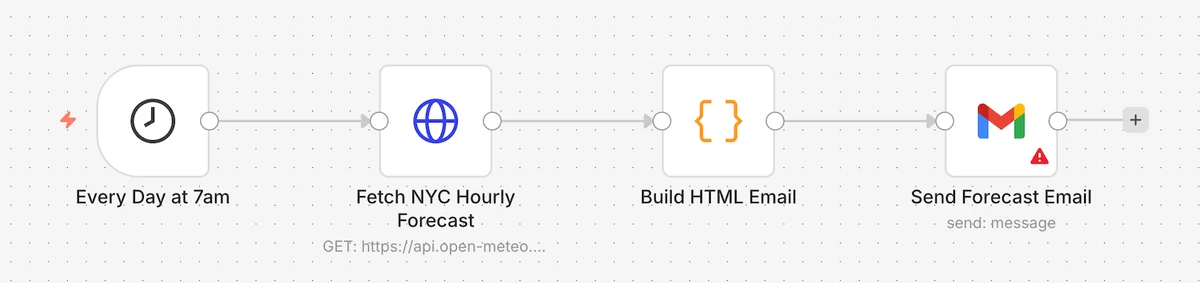
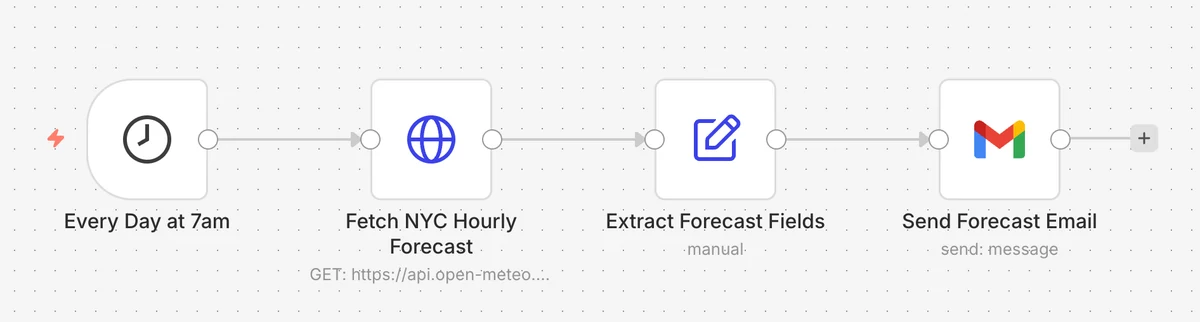
The architectural model is build-your-own-workflow on top of n8n’s infrastructure. Operators design workflows in the visual canvas using node-based logic — every workflow is a directed graph of nodes (triggers, actions, AI agents, code, conditional branches, HTTP requests, integration connections). Workflows execute in response to triggers (webhook, schedule, manual, app event) and chain through the configured nodes until completion. For AI agent workflows specifically, the AI Agent cluster node coordinates LLM calls, memory backends, vector stores, and tool execution — with the optional HITL tool gates layered in for high-stakes operations.
Where n8n fits on our AI Tools hub: Bucket A — Agent Builder Platforms, alongside Synthflow and Zapier (with Zapier covered as a mention rather than a full review). Cross-listed to the AI Agents hub as a builder reference (the agent you build IS an AI agent), but scored only against the AI Tools framework because n8n itself is the platform, not the finished agent. The natural cross-reference: when an operator on the AI Agents hub asks “what if no off-the-shelf agent fits my workflow?”, the answer is “see the AI Tools hub for builder platforms” — and n8n is the one for general workflows the way Synthflow is for voice-specific.
Genuinely useful contractor use cases for n8n specifically:
- Custom integrations between contractor CRMs and any system not natively supported — JobNimbus to Slack with custom routing logic, ServiceTitan webhooks to Google Sheets reporting, GoHighLevel to a custom analytics dashboard.
- Multi-step automations that exceed Zapier’s task-based pricing economics — 10-step lead-routing workflows, multi-tool data pipelines, daily report aggregation across 5+ systems.
- MCP-based AI integrations — building Model Context Protocol agents that span Claude or ChatGPT with multiple operator systems via n8n’s first-party MCP server support.
- Self-hosted deployments where data sovereignty is a buying criterion — operators who specifically want customer data to stay on infrastructure they own rather than third-party cloud servers.
- Contractor marketing agency white-label deployments — agencies building automation services for multiple contractor clients, with the Embed Partner license enabling resale (separate $50K/year license, not standard PartnerStack).
The wrong contractor use cases for n8n:
- Solo or small-team operators who just need a finished AI receptionist — the AI Call Answering hub ships value the day you sign up.
- Roofing operators on JobNimbus or AccuLynx — n8n has no native integration with either; Alivo is the right shape for vertical roofing AI.
- Multi-trade home service operators on ServiceTitan or Housecall Pro who want managed deployment — Avoca AI covers HVAC, plumbing, electrical with done-for-you setup.
- Operators already on GoHighLevel — GoHighLevel AI Employee at $97/mo Unlimited inside an existing GHL account beats the build-it-yourself math.
- Non-technical operators of any size — the steep learning curve consistently shows up in operator reviews; Zapier at $19.99-$103.50/mo trades cost for accessibility.
The Pricing Reality: Free Self-Hosted vs Cloud Tiers
This is the section where the public information has the most landmines, and where the pricing in EUR (not USD) catches buyers off guard. Verified directly from n8n.io/pricing as of May 2026.
Free Self-Hosted (Community Edition):
- Free forever under the Sustainable Use License (fair-code, not OSI open-source — see the license section below).
- Unlimited workflow executions on hardware you provision yourself.
- Concurrent workflow limit is hardware-bound — practically unlimited for most contractor workloads.
- Unlimited projects.
- Feature parity with Cloud Starter for most use cases — Cloud-only feature gates kick in at the Enterprise tier (1,000 AI credits/mo Cloud-only, 365-day insights retention).
Cloud Starter — $20/month (annual billing with 17% discount):
- 2,500 workflow executions per month.
- 5 concurrent workflows.
- 1 shared project.
- 50 AI credits (small allowance — production AI workflows require BYO OpenAI/Anthropic/Google API keys).
- Forum support only.
- Free trial without credit card.
Cloud Pro — $50/month:
- 10,000 executions per month.
- 20 concurrent workflows.
- 3 shared projects.
- 150 AI credits.
- 7-day insights retention.
- Free trial without credit card.
Self-Hosted Business — $667/month (50% startup discount under 20 employees brings it to ~$333/mo):
- 40,000 executions per month.
- 30 concurrent workflows.
- 6 shared projects.
- SSO, SAML, LDAP authentication.
- Git version control.
- Multiple environments (dev/staging/prod separation).
- 14-day trial requires credit card.
Enterprise — custom-quoted:
- 200+ concurrent workflows.
- Unlimited projects.
- 1,000 AI credits per month (Cloud-only).
- 365-day insights retention.
- Dedicated SLA.
- Cloud or self-hosted deployment.
- MSA support, geo-based processing, on-premise option, advanced security controls.
Critical execution model: one execution = one workflow run regardless of step count. A 30-step workflow counts as 1 execution in n8n. The same workflow on Zapier counts as 30 tasks. Sample math for a contractor agency running 10 client workflows × 20 executions/day × 10 steps each = 2,000 executions/day on n8n vs 60,000 tasks/day on Zapier. n8n Cloud Pro at $50/mo handles the 2,000-execution/day load; Zapier needs the $400+/mo enterprise tier for the equivalent task volume. For multi-step workflow operators, n8n’s economics meaningfully beat Zapier — and that’s before considering self-hosted.
Cloud overage: $4,000 for an extra bucket of 300,000 executions (~$0.013/execution). Cheap per-execution but the bill arrives in one chunk if you blow past your tier. Cloud customers should monitor execution counts weekly during the first 60 days post-launch and set alerts at 80% of tier capacity.
Embed pricing (white-label deployment for agencies and SaaS companies): not publicly listed on n8n.io. Third-party citation suggests $50,000/year minimum but this should be treated as [unverified] until confirmed during enrollment. The Embed Partner program enables agencies to legally resell n8n as part of a managed service offering — without it, the standard Sustainable Use License prohibits commercial resale.
AI Agent Capabilities: Cluster Nodes, Native MCP Server, Human-in-the-Loop Tool Gates
The AI capability story is where n8n materially leads its closed-source competitors and where the n8n 2.0 January 2026 release added the most editorially-significant features.
The AI Agent cluster node supports six agent types per docs.n8n.io/advanced-ai/: Conversational, OpenAI Functions, Plan and Execute, ReAct, SQL, and Tools. Each agent type optimizes for different workflow patterns — Conversational for chat-style interactions with memory, Plan and Execute for multi-step task decomposition, ReAct for reasoning-then-action loops, SQL for database-querying agents, and Tools for autonomous tool selection from a configured tool list.
LLM provider integrations are comprehensive — verified from n8n docs: OpenAI, Azure OpenAI, Anthropic, Google Gemini, Google Vertex, Cohere, Mistral Cloud, Ollama (local LLMs), Groq, DeepSeek, Alibaba Cloud, Perplexity, xAI Grok, MiniMax, Moonshot Kimi. Operators can run cost-sensitive workloads on cheaper models (DeepSeek, Mistral, Groq) and complex conversations on premium models (GPT-5, Claude 3.5 Sonnet) within the same workspace.
Memory backends: Simple Memory (default in-workflow), Motorhead, MongoDB Chat Memory, Redis, Postgres, Xata, Zep. Vector stores: Pinecone, Qdrant, Chroma, Milvus, MongoDB Atlas, PGVector, Redis, Supabase, Weaviate, Zep, Azure AI Search. Embeddings: OpenAI, Azure OpenAI, Google (Gemini/PaLM/Vertex), Cohere, HuggingFace, Mistral, Ollama, Lemonade. The breadth across the AI infrastructure stack is class-leading.
Native MCP (Model Context Protocol) server support shipped in 2025 and is built into Cloud, Enterprise, AND the free self-hosted Community Edition. Works with Claude, ChatGPT, Cursor, Windsurf, and any MCP-compatible AI client. n8n generates TypeScript representations of workflows for type-checked agent generation. Available nodes: MCP Client node, MCP Client Tool, MCP Server Trigger. For tech-comfortable contractors building MCP-based AI integrations, n8n is the only top-tier workflow platform with first-party MCP support today.
Human-in-the-loop tool gates (the most significant n8n 2.0 addition) allow AI Agents to require explicit operator approval before executing specific tools. Configure a tool gate, and when the AI Agent attempts to call that tool, the workflow pauses, sends a notification to the configured operator (Slack, email, dashboard), and waits for approval before continuing. The Chat node “Send a message” action enables HITL pauses inside conversational agent flows. For contractor operations worried about autonomous AI agents accidentally deleting customer records, sending wrong-recipient invoices, or making API calls to production systems, the HITL layer is the kind of guardrail that turns “I’d never let AI do that unsupervised” into “I’ll let AI handle the routine work and approve the 5% that matters.”
Code node: JavaScript and Python execution within sandboxed task-runner environments (default-on in n8n 2.0). For workflows that need custom logic the no-code nodes don’t cover, the Code node is the universal escape hatch. Supports importing npm packages, custom error handling, and structured data transformations.
The honest scoping signal on AI capabilities: n8n is the orchestration layer, not the LLM provider. The 50/150/1,000 AI credits per Cloud tier are small allowances meant for testing — production AI workflows require operators to bring their own OpenAI, Anthropic, or Google API keys (or run local LLMs via Ollama). Self-hosted Enterprise customers provide their own AI infrastructure entirely. Plan for separate AI provider costs in any production deployment budget.
1,700+ Integrations: Wider Than Marketing Claims — But Not For Contractors
This is the dimension where n8n earns its 5/5 score on integration depth — and where the editorial honesty story has to address both the strength and the contractor-specific gap.
The total integration count is wider than n8n’s own marketing claims. The n8n.io homepage cites “500+ integrations.” The actual count rendered on n8n.io/integrations at time of research is 1,728 integrations. Third-party reviewers cite 1,202 (Hackceleration). The honest framing: 400+ first-party native nodes + ~1,300 community-built nodes, plus the universal HTTP Request node for any REST API. n8n’s GitHub repository — 187,000 stars, 91% TypeScript codebase, 609 total releases shipped — describes the platform as “Fair-code workflow automation platform with native AI capabilities. Combine visual building with custom code, self-host or cloud, 400+ integrations.” That 400+ figure is the conservative first-party count.
Integrations operators actually use (verified from n8n docs and integration browse):
- Communication: Slack, Discord, Microsoft Teams, Telegram, plus Gmail, Outlook, SendGrid, Mailgun, Postmark, and most major email providers.
- Databases: Postgres, MySQL, MongoDB, Redis, Supabase, plus the 11 vector stores listed in the AI section above.
- Cloud platforms: AWS (S3, Lambda, DynamoDB, SES, etc.), Google Cloud (Sheets, Drive, Calendar, Cloud Functions), Microsoft 365, Azure.
- Webhooks: First-class support — any workflow can be triggered by webhook, and n8n exposes webhook endpoints natively. This is the universal escape hatch for non-native integrations.
- Code execution: JavaScript and Python via the Code node, with full sandbox isolation in n8n 2.0.
- AI/LLM: 15 providers (see AI section above) plus 11 vector stores, 7 memory backends, comprehensive embeddings.
The contractor-specific reality is the editorial honesty point: none of ServiceTitan, JobNimbus, AccuLynx, Housecall Pro, Jobber, GoHighLevel, CompanyCam, EagleView, FieldEdge, or Buildertrend appear as native integrations. All would require the universal HTTP Request node plus custom OAuth or API-key authentication setup. n8n’s marketing emphasizes “connect to anything,” which is technically true via webhooks and HTTP, but the practical lift is real.
For each contractor CRM integration, the operator workflow looks like:
- Read the CRM’s API documentation (often dense, sometimes outdated).
- Configure authentication — OAuth flow registration, API key rotation strategy, token refresh handling.
- Map data structures between the CRM’s API responses and n8n’s workflow data format.
- Handle error states — rate limiting, authentication expiry, schema changes.
- Build webhook receivers if the CRM supports outbound webhooks (most do, but documentation quality varies).
- Test, debug, monitor for silent failures.
For tech-comfortable agencies serving multiple contractor clients, the one-time custom build pays back across deployments — build the JobNimbus integration once, deploy it for 10 client agencies, capture the value over 10× the development time. For solo contractors, the lift is structurally wrong — no contractor wants to spend 20-40 hours building API integrations to JobNimbus when Alivo ships native JobNimbus + AccuLynx + ServiceTitan + Housecall Pro at $1,299/mo Agent Team in days, not weeks.
The Fair-Code License Trap Most Reviewers Skip
This section addresses a meaningful editorial gap in most n8n reviews — the license terms most reviewers either don’t read or don’t explain — and it matters for contractors planning any commercial deployment.
n8n’s license history went through three phases: Apache 2.0 originally (fully OSI-open-source), then Apache 2.0 + Commons Clause (open-source with a non-compete restriction), then Sustainable Use License starting 2022 (fair-code, NOT OSI open-source). n8n explicitly coined the term “fair-code” in 2022 specifically to distinguish their licensing approach from open-source as defined by the Open Source Initiative.
The Sustainable Use License terms (full text at docs.n8n.io/sustainable-use-license/):
- Permitted: Free use for internal business operations, personal use, non-commercial purposes, contributing to the codebase, self-hosting your own deployment.
- NOT permitted without separate Embed license: Reselling n8n as part of a paid service to your own clients, embedding n8n inside a paid SaaS product you sell, running a managed n8n hosting service for third parties, distributing modified versions of n8n commercially.
Practical implications for contractors:
- Internal contractor business automation is fully permitted and free. Use n8n internally to automate JobNimbus-to-Slack lead routing, ServiceTitan reporting pipelines, multi-tool data dashboards — no license issue, no fees beyond hosting.
- Self-hosting on your own VPS for your own business is fully permitted and free. This is the largest cost-savings use case — free self-hosted with unlimited executions for any internal contractor workflow.
- Building a contractor-services SaaS product on top of n8n is NOT permitted under the standard license. If you’re a contractor consultant building “MyContractorAutomation.com” as a paid service to other contractors and the backend uses n8n, you need the Embed Partner license — third-party citation $50,000/year minimum, not publicly published on n8n.io.
- Contractor marketing agencies offering “we’ll set up your n8n automations” as a billable service are in a gray area. Building the automation IN the client’s own n8n instance (the client owns the deployment) is permitted. Hosting the automation on the agency’s shared n8n instance and billing the client for access is restricted under the standard license. Read the terms carefully or ask for clarification before committing.
For most contractor operators, the license is genuinely not a problem — internal business use is fully permitted. For agencies and consultants planning to monetize n8n deployments, read the license terms before building the business model.
Real Customer Evidence (And the Steep-Learning-Curve Critique)
n8n’s review platforms surface a consistent pattern: technical operators rate the platform highly; non-technical operators rate it poorly. The honest editorial story is that the platform genuinely works for the target audience and genuinely fails for non-target users.
G2 ratings: 4.5+ across 270+ reviews per the seller page (the exact decimal varies by source — some cite 4.9, some 4.5; we use 4.5+ as the conservative defensible figure). G2 lists n8n as one of the top-rated workflow automation platforms.
Capterra rating: 4.6/5 across 41 reviews per the Capterra n8n.io profile. Average across published reviews trends toward 4.9.
Verified Tier-1 G2 quotes (full attribution preserved):
“I really like n8n for several reasons. It’s incredibly flexible and lets you build complex, multi-step workflows that fit your exact needs, which is great if you want to connect different APIs and customize logic. I also appreciate that it’s open-source, so you can self-host, extend it with custom nodes, and have full control over your workflows.” — Verified G2 review, technical operator
“We use n8n as our iPaaS layer to connect a variety of internal and external services… n8n enables us to automate API-driven workflows, monitor system health, and handle transaction logic without the need to write custom scripts for each integration.” — Verified G2 review, iPaaS operator
“I love the flexibility of the self-hosted version.” — Verified G2 review, self-hosting operator
The honest critique (verbatim G2):
“What I find most challenging is the steep learning curve for non-developers. While the power is there, the UI can feel overwhelming when trying to map complex JSON data without a background in JavaScript.” — Verified G2 review
Top G2 mention themes (paraphrased from review aggregation): flexibility, self-hosting, open-source nature, integration breadth, AI agent capabilities. Top complaint themes: steep learning curve, vague debugging messages, documentation gaps, silent node failures.
Capterra theme summary:
- Positive: “Reliable tool for building automations across the web; workflows are easy to manage and modify.”
- Negative: “Hard to debug issues with workflows because of lack of documentation and vague debugging messages.”
Reddit and operator-forum sentiment (paraphrased — direct attribution not always available):
- A solo operator built an n8n agency to $8,200/month working ~25 hours/week by serving SMB clients with manual processes. First paying client came from a Reddit comment answering an email automation question; first project was $600. (Not contractor-specific — SMB general.)
- Self-hosting realism: most operators who try self-hosting end up on Cloud within 6 months. Server maintenance, security patching, dependency updates, and debugging silent failures eat the savings unless the agency has a dedicated dev/sysadmin already on staff.
No verified contractor-specific operator quotes exist publicly. This is the editorially honest framing — n8n’s contractor adoption is real among the technical 5% but small enough that public testimonials skew SaaS, developer tooling, agency, and iPaaS use cases. Frame the editorial position around contractor marketing agencies rather than direct contractor trades operations — that’s where the real adoption story is and that’s the audience the public proof actually validates.
n8n vs Zapier vs Make: Picking the Right Workflow Platform
The three-way comparison is where most contractor evaluations actually land — operators researching n8n are usually comparing it against Zapier and Make in parallel. Honest editorial framing on each:
n8n is the developer-friendly, self-hostable, code-comfortable workflow platform. Visual canvas plus full Code node support (JavaScript and Python). 1,700+ integrations including 400+ native + community nodes. Free self-hosted with unlimited executions; Cloud $20/mo Starter. Native MCP server support, comprehensive AI agent capabilities, human-in-the-loop tool gates. Best-fit buyer: tech-comfortable operators and contractor marketing agencies who value flexibility and cost economics over no-code accessibility.
Zapier is the no-code-first, easy-to-use, cloud-only workflow platform. Visual builder optimized for non-technical users. 8,000+ integrations — roughly 5x n8n’s first-party count and the broadest in the category. Pricing: $19.99/mo Starter through $103.50/mo Team annual ($400+/mo for Enterprise tier handling high-volume workflows). Per-task pricing model — every individual workflow step counts as a task. Best-fit buyer: non-technical operators with simple workflows (1-3 steps) where ease-of-use beats cost economics. Most contractor owner-operators land here.
Make (formerly Integromat) sits between n8n and Zapier on technicality. More generous free tier than Zapier (1,000 operations, 2 active scenarios). Operation-based pricing — each module execution counts as 1 op. Best-fit buyer: visual-thinking operators who want more depth than Zapier but don’t need n8n’s code flexibility. Make’s UX polish is genuinely strong for less-technical users.
The cost economics math that drives most n8n vs Zapier decisions: a contractor agency running 10 client workflows × 20 executions/day × 10 steps each. n8n = 200 executions/day = 6,000/month → Cloud Pro $50/mo handles it. Zapier = 60,000 tasks/day = 1.8M tasks/month → Enterprise tier $400+/mo minimum, possibly $1,000+/mo at this volume. At multi-step workflow scale, n8n is materially cheaper than Zapier — by 10-20x.
The accessibility tradeoff that drives most Zapier vs n8n decisions: a non-technical contractor owner trying to build a JobNimbus-to-Google-Sheets sync. Zapier has a native JobNimbus integration (search “JobNimbus” in Zapier’s app library, click connect, configure trigger, done — 30 minutes). n8n requires the HTTP Request node plus custom JobNimbus API authentication plus data mapping plus error handling — minimum half a day for a tech-comfortable operator, often days for a non-technical one. For non-technical operators with simple workflows, Zapier’s ease-of-use is worth the cost premium.
Operator migration patterns surfaced during research:
- Zapier → n8n: cost reasons at multi-step workflow volume. Most contractor agencies who scale beyond Zapier’s Team tier ($103.50/mo) start evaluating n8n for the cost economics.
- n8n → Zapier: when non-technical staff need to maintain workflows. Operators sometimes move back to Zapier when the original technical builder leaves and the remaining team can’t maintain n8n’s complexity.
- Self-hosted n8n → n8n Cloud: maintenance burden reasons. Self-hosting works for ~6 months for most operators before the maintenance time exceeds the cost savings.
Practical decision rule for contractors:
- If you’re not technical and your workflows are simple (1-3 steps), use Zapier. The accessibility is worth the cost premium and the JobNimbus/ServiceTitan/etc. native integrations save hours.
- If you’re tech-comfortable, run multi-step workflows at volume, or want self-hosted control, use n8n. The cost economics and integration depth win at scale.
- If you want visual depth with lower technical lift than n8n, evaluate Make as the middle path.
- If voice is the use case specifically, use Synthflow — different category, voice-agent-specific.
- If you don’t actually want to build a workflow and just want a finished AI agent, use the products on our AI Agents hub — Alivo, Avoca AI, GoHighLevel AI Employee, Hatch, Viktor all ship value the day you sign up.
n8n’s Score Across Our 6 AI Tools Dimensions
Our framework scores AI tools across six dimensions weighted by editorial relevance to contractor operators. n8n’s per-dimension breakdown:
-
Contractor Relevance (22% weight): 3/5 — none of the dominant contractor CRMs (ServiceTitan, JobNimbus, AccuLynx, Housecall Pro, Jobber, GoHighLevel, CompanyCam, EagleView, FieldEdge) are native integrations. All require HTTP Request node + custom auth. The honest read: tech-comfortable operators DO route real contractor work through n8n today — lead-source aggregation, multi-CRM data pipelines, AI-driven follow-up, MCP-based agent workflows — and the universal HTTP escape hatch + Code node make any contractor system reachable with engineering time. Marketing-agency operators serving 5+ contractor clients are the modal user. Materially less plug-and-play than Synthflow (4/5) which has ServiceTitan/HCP/Jobber/GHL natively, but reachable for operators with development resources.
-
Integration Depth (18% weight): 5/5 — 1,700+ total integrations (400+ first-party native + ~1,300 community nodes). 15 LLM provider integrations, 11 vector stores, 7 memory backends, comprehensive embeddings. Native MCP server support. Universal HTTP Request escape hatch. Class-leading in the workflow automation category and meaningfully wider than the published 500+ marketing figure suggests.
-
Ease of Use (17% weight): 4/5 — once an operator builds the mental model for visual workflow nodes, the Flow Designer is genuinely intuitive — drag, connect, configure, run, debug inline. The template library covers most contractor automation patterns (lead routing, CRM sync, AI agent chains, scheduled reports) and removes blank-canvas friction. Tech-comfortable operators get to working workflows in hours, not days. The honest caveat: “intuitive once you understand workflow automation” is a real conditional — operators who have never wired a Zap, automation, or webhook before will still face conceptual ramp time. Materially harder than Zapier on first contact; cleaner than every Zapier alternative we’ve tested once the model clicks.
-
Value Per Dollar (15% weight): 5/5 — free self-hosted with unlimited executions is genuinely unique on the AI Tools hub. Cloud $20/mo Starter is very low entry. Execution-vs-task pricing rewards complex workflows (1 workflow run = 1 execution regardless of step count). At multi-step workflow volume, n8n is 10-20x cheaper than Zapier. The 50% startup discount on Business (under 20 employees → ~$333/mo) is meaningful.
-
Unique Capability (14% weight): 5/5 — self-hosted with full feature parity, native MCP server support, AI Agent cluster nodes, Code node (JavaScript + Python sandboxed), human-in-the-loop tool gates (n8n 2.0), 1,700+ integrations, MIT-licensed alternative (ActivePieces) doesn’t match the ecosystem. No comparable alternative in the contractor AI Tools competitive set.
-
Learning Curve (14% weight): 3/5 — moderate, not punishing. “The UI can feel overwhelming when trying to map complex JSON data without a background in JavaScript” is a real recurring complaint, and JSON-mapping + debugging come up consistently in G2/Capterra/Reddit. But operators who clear the workflow-automation conceptual hurdle (typically the first 2-4 hours of hands-on time) describe steady weekly progress thereafter. Equivalent to Synthflow (3/5) and Notion (3/5) — all three are 1-2 weeks to basic team proficiency, 1-2 months to advanced workspace mastery. Meaningfully harder than Tidio (5/5) which ships turnkey.
Weighted overall: 4.11 + 0.20 calibration constant = 4.31 → displays 4.3/5.0 ★★★★½. n8n lands as the third-highest-rated product on the AI Tools hub (behind ElevenLabs at 4.7 and Tidio at 4.4) — class-leading on integrations + value + capability + unique infrastructure depth, with the contractor-fit caveat that operators still need to bring workflow-automation literacy and (ideally) some development resources. The audience filter is real but the platform earns its score: free self-hosted + native MCP + AI Agent cluster nodes + 1,700+ integrations + n8n 2.0 human-in-the-loop tool gates is a genuinely differentiated stack.
Who n8n Is Built For
The right operator profile for n8n is specific and narrower than the marketing implies, but genuinely real for operators who fit:
- Contractor marketing agencies serving multiple clients — agencies running automation services for 5+ contractor clients across HVAC, plumbing, electrical, roofing, and home improvement. The 1,700+ integrations + Code node flexibility + Embed Partner license (separate $50K/year) make n8n the right shape for white-label automation. The single fully-named operator pattern in n8n’s testimonials is exactly this profile — agency operators building automation services for SMB clients, often crossing into contractor-adjacent industries.
- Multi-location HVAC, plumbing, or electrical operations with internal ops staff who can read code or comfortable with API/webhook concepts. The investment to build custom JobNimbus or ServiceTitan integrations pays back across multiple locations.
- Tech-comfortable contractor consultants and rollup operators building voice automation, lead routing, or reporting pipelines across heterogeneous CRM stacks. n8n’s flexibility covers use cases the off-the-shelf vertical agents don’t reach.
- Operations evaluating MCP-based AI integrations — building Model Context Protocol agents that span Claude or ChatGPT with multiple operator systems. n8n is the only top-tier workflow platform with first-party MCP support today.
- Operators with data-sovereignty buying criteria — self-hosted deployments where customer data stays on infrastructure the operator owns. The compliance flexibility and on-premise option at the Enterprise tier make n8n viable for operations that explicitly want non-cloud deployment.
- Contractor agencies running multi-step workflows at volume where Zapier’s per-task pricing economics break down. The execution-vs-task pricing model saves real money at 10+ step workflows × 100+ daily runs.
Who Should NOT Use n8n
The audience-mismatch filter is just as important as the audience-fit description. If any of the following apply, n8n is the wrong product for your operation:
- Non-technical solo or small-team contractors who just need their phone answered. n8n requires meaningful technical comfort to build production workflows. For solo operators where the cost of build time exceeds the cost of a finished AI receptionist, the math is structurally wrong. The right alternatives are on the AI Call Answering hub: Smith.ai, Rosie, Dialzara, ServiceAgent — all four ship value the day you sign up.
- Roofing operators on JobNimbus or AccuLynx. n8n has no native integration with either CRM. Building custom integrations requires reading API docs, configuring auth, mapping data structures, handling errors — minimum 20-40 hours of operator or developer time. The right shape is Alivo — Tier 1 vertical roofing AI agent with native JobNimbus + AccuLynx + ServiceTitan + Housecall Pro + Jobber + 600 more via API at $1,299/mo Agent Team. Roofing operators picking n8n over Alivo are usually choosing wrong unless they specifically need a builder platform for non-roofing workflows.
- Multi-trade home service operators on ServiceTitan or Housecall Pro who want done-for-you, not build-it-yourself. Avoca AI at sales-quoted ~$1K-$3K/mo covers HVAC, plumbing, and electrical with managed deployment, three-pillar Convert/Nurture/Coach architecture, and ServiceTitan Gold Partner integration depth. Avoca’s Series B at $1B valuation removes the build time that n8n requires.
- Operators already on GoHighLevel. GoHighLevel AI Employee at $97/mo Unlimited inside an existing GHL account beats the build-it-yourself math at any meaningful workflow count — and the AI lives inside the same system as your CRM, calendars, pipeline, and automations rather than alongside it requiring custom integration.
- Operations where voice is the primary use case. Synthflow at PAYG pricing is voice-agent-specific with 50+ native integrations including the contractor CRMs n8n lacks. Building voice agents on n8n’s general-purpose framework is structurally harder than using a voice-specialized platform.
- Non-technical operators who want workflow automation but don’t have time to learn JSON, API authentication, and webhook debugging. Zapier at $19.99-$103.50/mo trades cost for accessibility. The native JobNimbus, ServiceTitan, Housecall Pro, GoHighLevel, and 8,000+ other app integrations save weeks of build time. For simple 1-3 step workflows, Zapier’s premium over n8n is worth it.
- Agencies planning to resell n8n as part of a paid service without separate licensing. The Sustainable Use License prohibits commercial resale without an Embed Partner license (third-party citation $50K/year minimum). Read the license terms carefully or use a permissively-licensed alternative like ActivePieces (MIT).
- Operators uncomfortable with self-hosted infrastructure burden. Self-hosting requires VPS hosting + sysadmin time + security patching + database backups + monitoring for silent failures. Most contractor operators who try self-hosting move to Cloud within 6 months. Plan accordingly — either commit to Cloud from day one or budget the infrastructure team for self-hosted.
n8n Inside a Broader Contractor AI Stack
The clean editorial close on n8n: the platform genuinely works for the buyer profile it was built for, and is structurally wrong for everyone else. That’s the whole story.
n8n fits inside a contractor AI stack as the flexibility layer for custom workflows — the layer that handles the workflows no off-the-shelf AI agent or AI tool covers. For operators who fit n8n’s profile, the platform sits alongside (not replacing) the finished AI products on our other hubs:
- Customer-facing AI agents (AI Agents hub): Alivo, Avoca AI, GoHighLevel AI Employee, RoofClaw, Hatch, Viktor handle the standard contractor-facing workflows. n8n covers the custom ones — multi-CRM data pipelines, lead-source aggregation across non-native systems, MCP-based AI integrations, multi-step automations that don’t fit any vertical agent.
- AI receptionists (AI Call Answering hub): Smith.ai, Rosie, Dialzara, ServiceAgent handle the inbound voice layer. n8n can sit downstream of the receptionist, processing the booked appointments and triggering follow-up workflows.
- Voice AI builder (Synthflow): different category — Synthflow is voice-specialized with 50+ native integrations. n8n is general-purpose with broader scope but narrower voice-specific support.
- Office productivity AI (Viktor): different category — Viktor is Slack/Teams-based office coworker. n8n is workflow-builder. For tech-comfortable office teams, the two complement each other (Viktor handles the conversational interface; n8n handles the underlying workflow execution).
Honest editorial close: n8n at 4.3/5.0 is a real product solving a real problem for a specific operator profile. The audience-fit filter is genuinely tight (tech-comfortable agencies, multi-location ops with dev staff, MCP-based AI builders), and operators who fit get value from class-leading integration depth, free self-hosting, native MCP support, and the n8n 2.0 human-in-the-loop tool gates. The Series C funding from Accel + Sequoia + Felicis at $2.5B valuation signals product longevity through 2027-2028 minimum. The fair-code license is meaningfully different from open-source and worth understanding before any commercial deployment.
The operators outside n8n’s profile — non-technical solo contractors, roofing operators on JobNimbus/AccuLynx, multi-trade ops on ServiceTitan wanting done-for-you, anyone already on GoHighLevel, anyone whose first instinct on automation is “I’ll just keep doing it manually” — get better outcomes from the alternatives named in the section above. The honest editorial position on n8n in 2026 is that the platform is excellent at what it does and structurally bad at what it isn’t trying to do. Picking it for the right reason produces automation flexibility no closed-source SaaS competitor matches. Picking it for the wrong reason wastes weeks of build time, then sends the operator back to the off-the-shelf alternative they should have started with.
For tech-comfortable operators ready to evaluate n8n on the right reason — agencies, multi-location ops, MCP integration builders — the free self-hosted Community Edition costs zero dollars and 2-4 hours of operator time to validate fit. That’s the cleanest evaluation path on the AI Tools hub. For operators who finish that validation pass and decide n8n isn’t the right shape, the AI Agents and AI Call Answering hubs cover every meaningful alternative we’d recommend.
For a concrete starting point instead of a blank canvas, our ChatGPT automation guide for contractors walks through the seven n8n workflows worth building first — lead-reply drafts, QuickBooks invoice reminders, Google review responses — all on the native-node path, with the real monthly cost math.
Ready to Evaluate n8n on Your Workflow?
n8n's free self-hosted Community Edition costs zero dollars and runs unlimited executions on hardware you provision. For tech-comfortable operators, the cleanest evaluation path is to spin up a self-hosted instance, build one production workflow, and validate whether the integration breadth and learning-curve trade matches your operation before committing to Cloud billing.