


At five seats, the two platforms are $126 a month apart on the last prices each one published: Housecall Pro Essentials at $149, Workiz Standard at $275. Move up to Workiz Pro for the AI features and the gap is $176. That number is where this comparison starts, because everything you’ll read below about dispatch boards and AI receptionists has to be worth $1,500 to $2,100 a year before Workiz makes sense over Housecall Pro for a typical HVAC, plumbing, or electrical shop.
I ran the math at 3, 5, 8, and 12 users, then went through the parts of each platform where the seat count doesn’t tell the story. One caution up front. Workiz stopped publishing its prices. As of September 11, 2026, workiz.com/pricing-plans shows Standard, Pro, and Ultimate with a “Request pricing” button on each, and Genius Answering sits under add-ons as “sold separately.” The Workiz dollar figures on this page come from its April 2026 pricing page, the last one with numbers on it. Housecall Pro’s figures were read off housecallpro.com/pricing on September 10, 2026.
Two Different Ways to Bill a Service Shop
Housecall Pro sells three flat tiers with hard seat caps and a long list of add-ons. Workiz sells a flat base that includes 3 to 5 seats, then charges per user past that. That structural difference explains every number that follows.
Housecall Pro publishes Basic ($59/mo annual, 1 user), Essentials ($149/mo, up to 5 users, then $100 per extra user), and MAX ($299/mo, up to 8 users, then $75 per extra user). Month-to-month is $79, $189, and $329. The job cycle (book, schedule, quote, invoice, collect) is on every plan. What you buy as you move up is seats, QuickBooks sync and GPS on Essentials, then the API, the Sales Proposal Tool, and Recurring Service Plans on MAX. Outside the plan price sits a list of eleven add-ons, and only one of them, Instapay, has a published number. CSR AI, the 24/7 call answering, is the add-on most people ask about, and Housecall Pro won’t tell you what it costs until you talk to sales. The full breakdown is on our Housecall Pro pricing page.
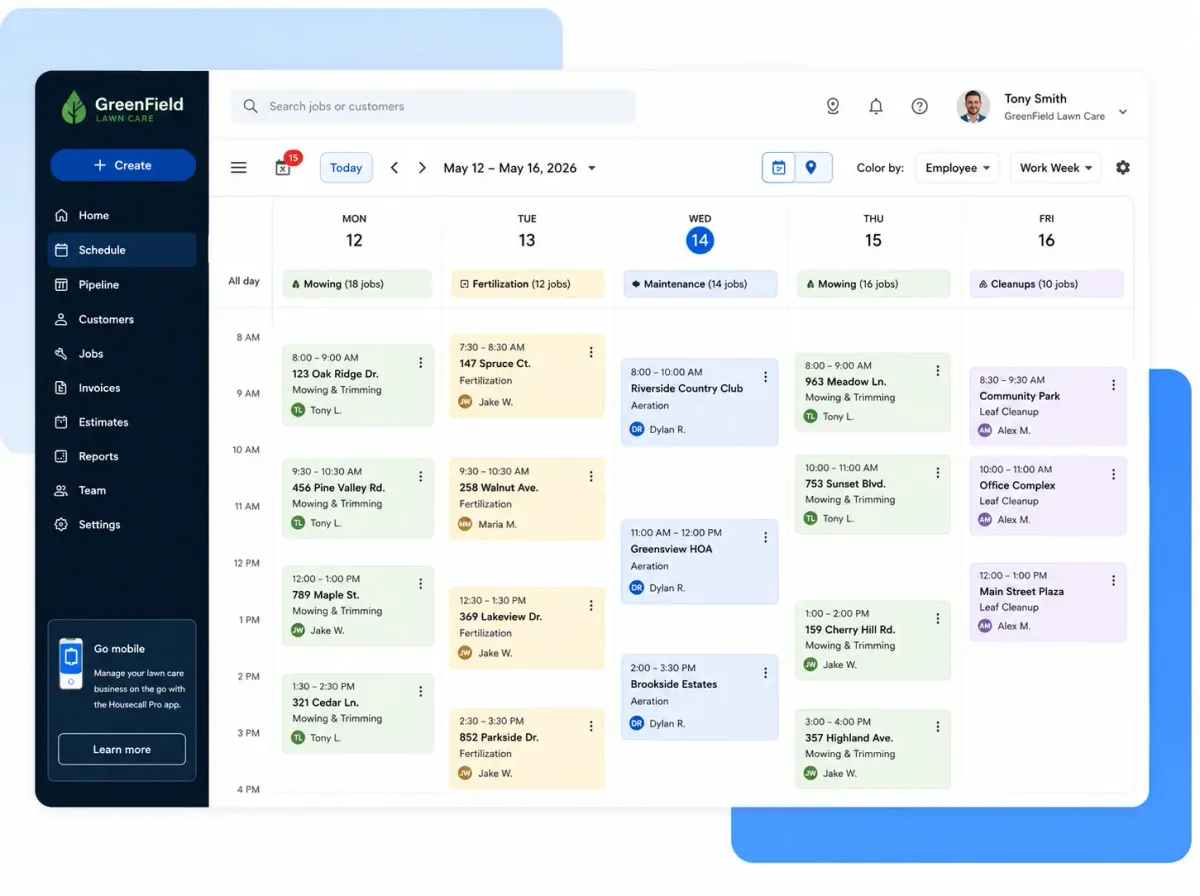
Workiz, on its April 2026 page, published Lite (free, up to 2 users), Kickstart ($225/mo annual, 3 users), Standard ($275/mo, 5 users, +$46 per user annual or $55 monthly), Pro ($325/mo, 5 users, +$54 per user annual or $65 monthly), and Ultimate (sales-quoted). Pro carried the Genius AI stack: Answering, Leads, Smart Messaging, Call Insights, Scheduling. The September page reorganized that. Lite and Kickstart are gone from the public page, Genius Leads and Genius Scheduling sit on Pro, service plans and the open API moved to Ultimate, and Genius Phone, Genius Answering, and Genius Marketing are each listed as sold separately.
So both platforms now sell their AI receptionist as an unpriced add-on. The difference that remains is the base plan, and there Housecall Pro publishes a number while Workiz asks you to book a demo.
The Seat Math at 3, 5, 8, and 12 Users
Housecall Pro is cheaper at every headcount in this table, and the gap only closes at 12 users if you put Workiz on Standard and give up the Genius features. Annual billing, base plan plus the seats you need, no add-ons, no processing fees. Workiz columns are its last published rates (April 2026); Workiz is sales-quoted as of September 2026.
| Crew size | Housecall Pro (Sept 2026) | Workiz Standard (last published, Apr 2026) | Workiz Pro (last published, Apr 2026) |
|---|---|---|---|
| 3 users | Essentials, $149 | $275 | $325 |
| 5 users | Essentials, $149 | $275 | $325 |
| 8 users | MAX, $299 | $275 + 3 × $46 = $413 | $325 + 3 × $54 = $487 |
| 12 users | MAX + 4 seats, $599 | $275 + 7 × $46 = $597 | $325 + 7 × $54 = $703 |
Workiz figures are the April 2026 published rates. Kickstart at $225 covers 3 users but had no QuickBooks sync and no Genius features, so I left it out. Housecall Pro figures verified September 10, 2026.
At 3 and 5 users, Housecall Pro costs about half. A three-tech plumbing shop pays $149 on Essentials with two open seats for the next hires. The same shop on Workiz Standard pays $275, or $325 with the Genius layer. Over a year that’s $1,512 to $2,112 more for Workiz, and Essentials already includes Instapay and QuickBooks, so you aren’t giving up much to save it.
At 8 users the crossover flips to MAX, and Housecall Pro is still $114 to $188 cheaper. HCP’s $100 overage on Essentials means seven users ($349) already costs more than MAX ($299), so an eight-person crew lands on MAX with the API, service plans, and the proposal tool included. Workiz at eight seats is $413 on Standard or $487 on Pro.
At 12 users the base plans converge and the add-ons decide it. HCP MAX with four extra seats is $599. Workiz Standard with seven extra seats is $597, a wash, but Standard has no Genius AI. Workiz Pro is $703. Past twelve, HCP grows at $75 a head and Workiz Pro at $54, so the per-seat curve favors Workiz somewhere north of 20 techs. At that size our ServiceTitan vs Housecall Pro comparison is the better read anyway.
One number neither company prints: whether HCP’s $75 and $100 overage rates change on month-to-month billing. The pricing page doesn’t say, and the table assumes they don’t. Ask before you add seats.
Dispatch and Scheduling
Workiz has the better dispatch board. Our field service scoring gives Workiz 4.6 on dispatch and scheduling against Housecall Pro’s 4.3, and the gap shows once you’re moving more than a handful of techs around a metro.
Workiz’s board is drag-and-drop with a smart-filter sidebar. Filter to only HVAC techs or only the morning shift, and bookmark the view. Linxup fleet GPS puts every truck on the map and surfaces the nearest available tech when an emergency call lands. The board enforces capacity, so it warns you before you book a 9 AM downtown job for a tech who’s on an 8 AM call 45 minutes away.
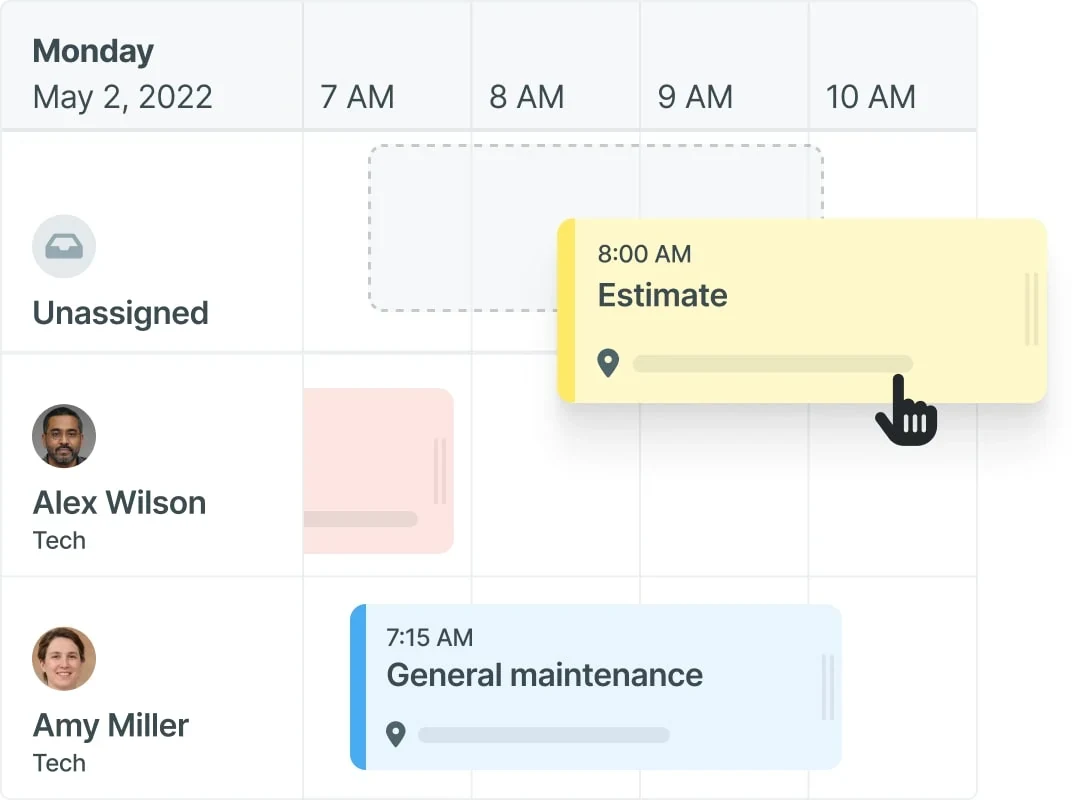
Housecall Pro’s calendar covers the same ground for a smaller crew. Drag-and-drop by tech or by area, day/week/month views, multi-tech assignment, and a route overlay with drive-time estimates. Full-day route sequencing runs through the Beeline Routes integration rather than natively. GPS tracking starts on Essentials. The “on my way” text with the tech’s photo is the feature HCP customers mention most, and it cuts the “where’s my guy” calls in a way you can measure.
Where HCP pulls ahead is recurring work. Recurring Service Plans (two tune-ups a year at $199, billed and rebooked automatically) are included on MAX and available as an add-on below it. Todd C. at Black Mountain Air, one of HCP’s published customers, put it plainly: “On our second year using Housecall Pro service contracts feature. It’s amazing how well it’s working for keeping repeat customers coming back.” On Workiz’s September page, service plans sit on Ultimate, the sales-quoted tier.
Edge: Workiz for daily dispatch at eight or more trucks. Housecall Pro if maintenance agreements are the backbone of the business.
AI Call Answering: Both Are Add-Ons Now
Neither platform includes its AI receptionist in a published plan price as of September 2026. That’s the biggest change from what we wrote about Workiz in April, and it moves this section from “Workiz wins” to “get both quoted.”
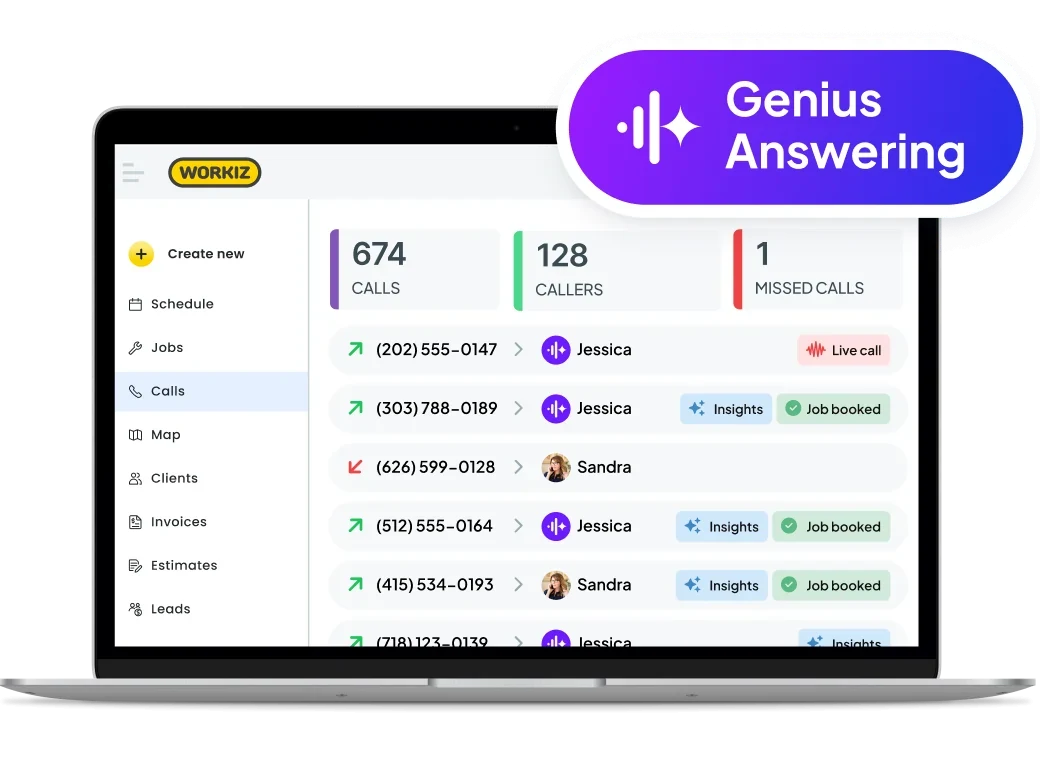
Workiz Genius Answering has been in production since December 2024. It answers in English, Spanish, or French, identifies returning customers from CRM history mid-call, asks the qualifying questions you scripted, books into the dispatch board using real availability, and sends you a transcript, a recording, and a summary. It handles three simultaneous calls and averages about two minutes per booking, per Workiz’s own data. Call Insights transcribes recorded calls and flags upsell opportunities; Smart Messaging drafts replies from customer history. In April all of this shipped inside Pro at $325 for five users with no per-call surcharge. Workiz’s current pricing page lists Genius Answering under add-ons as sold separately, with no price, and the Genius Answering feature page has no number either.
Housecall Pro’s CSR AI answers calls and website chat around the clock, references existing customer data, books straight into the HCP calendar, discloses that it’s AI, and offers a human transfer. It’s a paid add-on on every tier with no published price. Third-party estimates put it around $100 to $150 a month; treat that as a rumor until HCP quotes you. Analyst AI, Coach AI, and Marketing AI are included on all three plans and earn their keep for a 5 to 10 tech shop that wants plain-English answers from its own data, but none of them answer a phone.
The practical difference: Genius Answering has 21 months of production history and the deeper feature set, with multilingual answering, concurrent calls, and call insights tied to dispatch. CSR AI’s advantage is that HCP’s base plan is cheap enough that you can absorb an unpriced add-on and still come out under Workiz Pro. The yardstick for both quotes is Jobber’s AI Receptionist at a published $99 a month. If either vendor comes back well above that, our AI call answering category has standalone options from $24.95 that push bookings into HCP through Zapier.
It depends. Workiz if you want the more mature receptionist and you can get the add-on price in writing before the annual term. Housecall Pro if your missed-call problem is small enough that a $49 Rosie or a $24.95 Upfirst bolt-on covers it.
Payments and Financing
This round goes to Housecall Pro, and it’s the clearest win on the page.
Housecall Pro publishes its rates: card processing from 2.59%, ACH at 1%. Instapay adds 1% and puts card and ACH payouts in your account in about 30 minutes, weekends and holidays included, with a $0.75 charge on transactions under $75. Wisetack consumer financing sits inside the estimate. The homeowner applies from the phone, terms run from 0% for 24 months out to 84 and 120 months on bigger projects, and the contractor pays a flat 3.9% of the financed amount with no monthly fee. A $6,000 system replacement at $187 a month is an easier porch conversation than $6,000, and HCP’s version of that flow is the tightest in this price range.
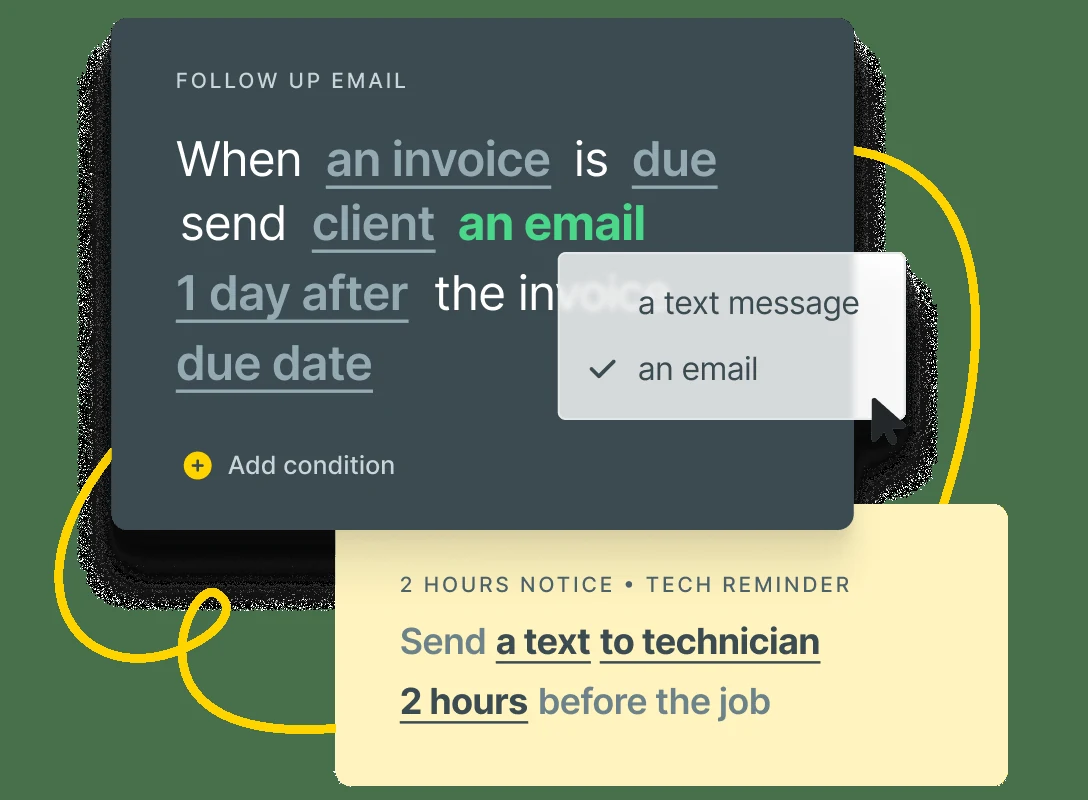
Workiz’s invoicing loop is good. Smart invoice rules generate and send the invoice when the job is marked complete and apply a late fee on a schedule you set. The tech collects by card, ACH, Apple Pay, Google Pay, or tap-to-pay at the truck, and Wisetack and Sunbit financing both show “as low as $X/mo” inline on the estimate. Louis A. F., a construction company president who moved from Housecall Pro to Workiz, wrote in a 5-star Capterra review: “Invoicing customers is very easy and can be sent via email and SMS texting which is a great feature.”
The gap is transparency and speed. Workiz Pay’s processing rates aren’t published anywhere public, and pricing complaints show up in its critical reviews. Oleksandr C., a consumer services owner, wrote in a 1-star Capterra review: “CRM + phone service costs around $400 per month…hidden fees at every step.” There’s no Instapay equivalent, so plan on standard settlement. On $50,000 a month in card volume, a half-point difference in rate is $250 a month, most of the plan price, and you can’t compare it until Workiz hands you a rate sheet.
Mobile App
Workiz has the edge if your crew carries Android. Housecall Pro’s app is rated 4.5 on the App Store and 3.2 on Google Play, and the Android complaints (address display bugs, slow loads on older phones, payment glitches, crashes mid-job) show up consistently in recent one- and two-star reviews. On iPhone, HCP’s app is polished, and the payment collection flow is the best part of it.
Workiz ships iOS and Android with feature parity, and its offline mode is one of the consistent praise patterns in Capterra reviews. Techs can view jobs and update status, photos, and notes in a basement or a metal-roofed warehouse, and it syncs when signal returns.
If every tech is on an iPhone, call it a tie. If half your trucks run Android, Workiz.
Integrations and the API
Housecall Pro has the longer list and the lower ceiling; Workiz has the shorter list and wants to be your only system.
HCP connects to QuickBooks Online and Desktop (Essentials and up), Gusto, CompanyCam, Beeline Routes, Force by Mojio, MeasureQuick, Profit Rhino, The New Flat Rate, On Call Air for HVAC install proposals, Google Local Services Ads, Thumbtack, Angi, Yelp, Mailchimp, CallRail, Podium, CHIIRP, and Zapier on every plan. The REST API and webhooks are MAX-only, so custom workflows cost $299 a month before developer time.
Workiz publishes 17 named integrations: QuickBooks Online (two-way), Zapier, CompanyCam, Reserve with Google (a Book button on your Business Profile that drops straight into the dispatch board), Wisetack, Sunbit, Linxup, Angi, Thumbtack, NiceJob, Mailchimp, JB Warranties, AnswerConnect, Nexa, and a few more. The open API is on Ultimate per the September page. What’s missing is any native hook into JobNimbus, GoHighLevel, HubSpot, or Salesforce. Workiz wants the CRM seat, and if your pipeline lives elsewhere you’re running two systems with Zapier glue.
For the standard service-trade stack of QuickBooks Online, CompanyCam, Wisetack, and Google, both cover it natively. HCP has the edge on flat-rate pricebook partners and HVAC install proposals. Workiz has the edge on Reserve with Google.
Support, Reviews, and the Trial
Housecall Pro’s September pricing page says all plans include “live phone and chat support,” with escalated phone support reserved for MAX. Contractor reports through 2025 described the lower tiers as chat-first, so test it during the trial rather than assuming. Capterra rates HCP 4.7 across 2,737 reviews, with ease of use at 4.6 and support at 4.7. One verified reviewer: “Housecall Pro is great for small business owners — gives me more time expanding the business.” Trustpilot tells a different story at 2.9 across 581 reviews, with billing disputes and cancellation friction as the dominant themes. Reddit threads about HCP keep coming back to one line: the pricing crept up faster than expected.
Workiz rates 4.4 on Capterra across 218 reviews, support at 4.3, and 4.6 on G2. The five-star pattern is the dispatch board and onboarding support. The one-star pattern is the built-in phone system: hold music with nobody on the line, and tickets that sit.
Trials: HCP gives you 14 days of MAX with no card. Workiz gives you 7 days with no card. Two weeks is enough to run real invoices, take an Instapay payment, and put a tech on the Android app. One week is enough to pressure-test the phone system and the dispatch board.
Pick by Trade
HVAC. Housecall Pro. Recurring Service Plans on MAX, On Call Air for equipment proposals, Wisetack terms out to 120 months, and Instapay for the Friday install. Workiz’s Trane and American Standard dealer-network partnership and the JB Warranties integration are real, and if after-hours calls are where you’re bleeding, Workiz with Genius Answering quoted is the alternative. For most install-and-maintenance HVAC shops, HCP’s payments and service plans matter more.
Plumbing. Housecall Pro for a 3 to 8 truck shop that lives on same-day money and financed water heaters. Workiz for a shop doing high-volume drain and emergency work where the dispatch board and nearest-tech routing are the daily bottleneck.
Electrical. Housecall Pro. Flat-rate pricebook, Profit Rhino and The New Flat Rate integrations, Wisetack on panel upgrades. Nothing in Workiz’s electrical story outweighs the price gap at 3 to 8 seats.
Locksmith. Workiz. Locksmiths appear in Workiz’s published case studies, the calls are routine enough that a scripted AI receptionist handles most of them, and nearest-tech dispatch matters when the job is a lockout. HCP doesn’t list locksmith as a target trade.
Garage door. Workiz. It’s a named Workiz trade with case studies, the call pattern is high-volume and repetitive, and the dispatch board earns its keep. HCP works for garage door but isn’t built around it.
Cleaning. Housecall Pro. Workiz says outright that it’s HVAC, plumbing, and electrical first and points cleaning and exterior-maintenance crews elsewhere. HCP lists cleaning as a fit, and the automated review requests and booking widget are what a cleaning company runs on. If you want AI bundled into a cheaper plan for a cleaning or pressure-washing crew, QuoteIQ ships it on a $29.99 tier.
At Your Headcount, the Math Says
At three to five seats, the math says Housecall Pro, and it isn’t close. Essentials is $149 a month; Workiz’s last published price for the same crew was $275 on Standard or $325 on Pro, so a Workiz quote would have to come in $126 to $176 under its own April 2026 rate card before the two even tie, and that’s before HCP’s published 2.59% card rate and Instapay enter the picture.
At eight seats, the math still says Housecall Pro. MAX is $299 with the API, service plans, and the proposal tool included. Workiz was $413 on Standard and $487 on Pro, so the quote needs a $114 to $188 discount to match. HCP plus a rumored CSR AI is $399 to $449, still under Workiz Pro’s old number.
At twelve seats, the math gets close enough that the AI quote decides it. HCP MAX with four extra seats is $599. Workiz Standard was $597 with no Genius layer, and Pro was $703. Add a $100 to $150 CSR AI to HCP and you’re at $699 to $749, which is a tie with Workiz Pro if, and only if, Workiz’s quote confirms Genius Answering is inside Pro the way it was in April. If Genius is quoted separately on top of $703, HCP wins again. Twelve seats with bundled AI answering is the one crossover on this page.
Past twenty, Workiz Pro’s $54 overage beats HCP’s $75 by $21 a head, but at that size the ServiceTitan vs Housecall Pro comparison is the read.
The picks by band: 1 to 2 users, HCP Basic at $59 if you never plan to add a seat, otherwise Jobber Core at $29. 3 to 7 users, Housecall Pro Essentials at $149 on the 14-day MAX trial. 8 to 11 users, Housecall Pro MAX at $299. 12 to 20 users, Workiz Pro, but only with a written quote that puts Genius Answering inside the plan at or under $700 for twelve seats; without that number in hand, stay on HCP MAX. If neither fits, the Housecall Pro alternatives page ranks five more options, and the field service management hub has the full category.