


The math that makes FieldPulse worth a serious look in 2026 isn’t the AI marketing copy — it’s the funding round, the customer-base growth rate, and the review-base scale. $50 million Series C closed August 11, 2025 led by Fulcrum Equity Partners with Catalyst Investors participating, bringing total funding to $79.2 million. 4x growth in the 21 months since the Series B (October 2023, $21M) and 100%+ year-over-year customer expansion. 2,537 verified G2 reviews averaging 4.8/5 — the largest review base of any FSM platform on the market — alongside 427 Capterra reviews at 4.6/5 with 4.7/5 specifically on customer service. The Operator AI voice dispatcher won the 2025 NECA Innovator Award. For a Dallas company founded in 2009 that’s been quietly compounding for 16 years, those are the operational signals that matter — and they’re more concrete than most FSM competitors can put on the table.
“Their backing validates what we’ve built and where we’re headed. This investment fuels growth while staying true to industry-leading support.” — Gabriel Pinchev, Founder and CEO, FieldPulse, in the August 11, 2025 Series C announcement
What this review covers: the actual 2026 pricing math (third-party-reported because FieldPulse doesn’t publish), how Operator AI and Chat AI compare against Workiz Genius Answering and ServiceTitan Atlas AI, what makes ClearPath the workflow module reviewers single out, the integration map that’s broader than any FSM competitor on accounting + suppliers + GoHighLevel, what 427 Capterra and 2,537 G2 reviewers actually say (including the bug-and-sync complaints worth pressure-testing), how FieldPulse stacks against Workiz for service trades and against ServiceTitan for enterprise HVAC, the Series C-funded 2026 roadmap, and which contractor segments should be requesting a demo today versus picking a different platform.
Why a $50M Series C and 100%+ YoY Growth Matter More Than the AI Marketing
Most FSM platforms in 2026 are running an AI feature page and calling it a strategy. FieldPulse is doing something different — and the funding history tells the story.
$79.2M total funding · 4x growth in 21 months since Series B · 100%+ YoY customer expansion · 16 years compounding without burning the brand or shipping the wrong product
Dallas, TX. CEO Gabriel Pinchev. Bootstrapped early years building product without VC dilution.
Reece Group, Superseed Ventures, Apple Core Holdings. Set the platform up for the AI build-out that followed.
Fulcrum Equity Partners (lead) + Catalyst Investors. 4x growth in 21 months. Capital deployed for AI + customer success.
FSM market projected to hit $11B+ by 2032 at 12% CAGR. FieldPulse positioned to capture multi-trade share.
For comparison: Workiz raised $40M Series C (Lead Edge Capital) bringing them to ~$53M total. ServiceTitan went public December 2024 with much larger capital base. FieldPulse is the SMB-tier competitor with the freshest growth funding.
The capital signal matters because the FSM category has a real divergence forming in 2026: incumbents (ServiceTitan, Housecall Pro, Jobber) are protecting market share with steady feature releases, while challengers (Workiz, FieldPulse) are racing to build the AI layer that defines the next platform generation. FieldPulse’s Series C explicitly funds AI product development, and the Operator AI 2025 NECA Innovator Award plus the Chat AI launch confirm that capital is hitting product, not just office space.
For a multi-trade contractor evaluating FSM in 2026, the relevant question isn’t “does this platform have AI?” — every FSM has an AI bullet point now. The relevant question is “is this platform funded enough to ship the next two AI generations without a forced acquisition or feature regression?” Series C-stage SaaS with 100%+ YoY growth answers yes; pre-Series-A AI startups in the same category don’t.
What FieldPulse Actually Does (and Why Multi-Trade Operations Pick It)
The simplest framing: FieldPulse is a multi-trade field service management platform that handles scheduling, dispatch, work orders, customer management, estimates, invoicing, payments, project management, and reporting in one workflow — with an AI layer (Operator AI + Chat AI + Field Intelligence) on top.
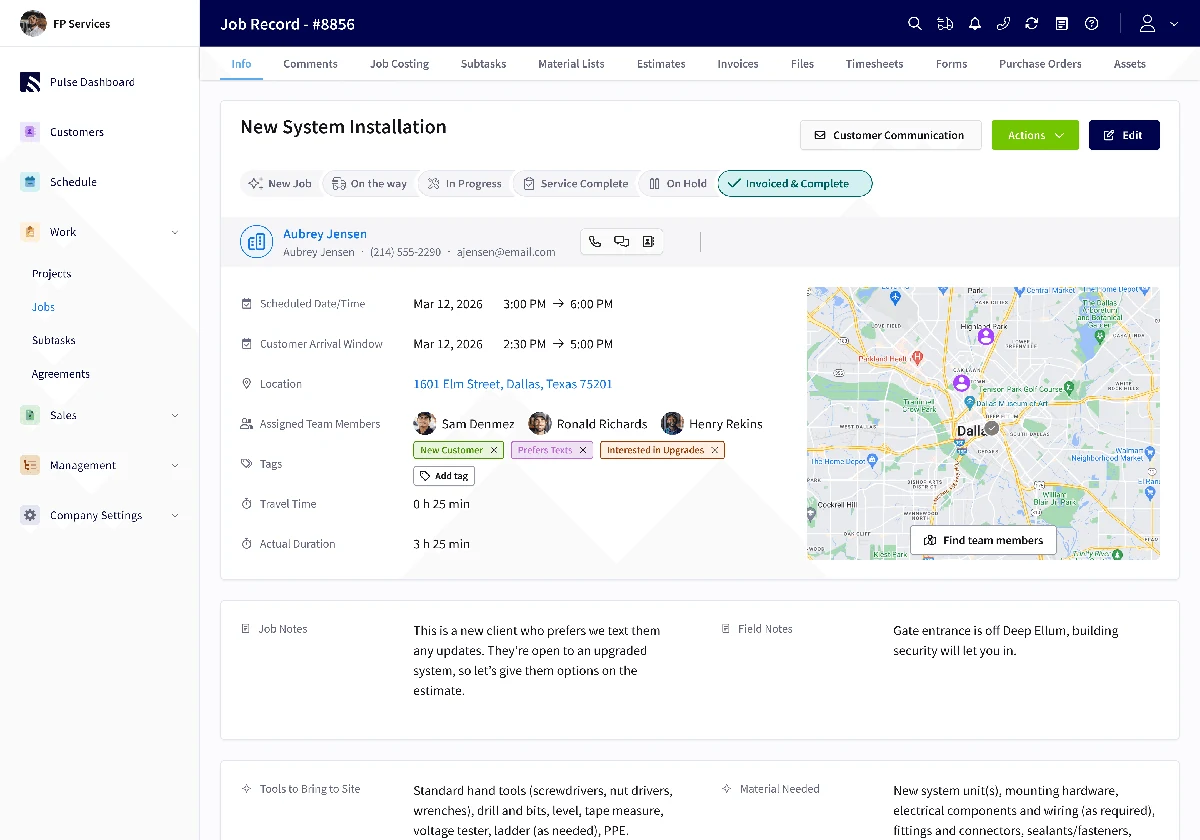
The trade-mix breadth is the structural differentiator. ServiceTitan is HVAC, plumbing, and electrical at $1M+ revenue with implementation gating. Workiz is HVAC, plumbing, electrical, garage door, and appliance repair at SMB scale. Housecall Pro is residential service trades. Jobber is the simplest broadest-trade option. FieldPulse is the only platform at this price point genuinely serving the long tail of trades — septic, glass, senior care, junk removal, fence installation, landscape construction, fire protection — alongside the core HVAC/plumbing/electrical mix.
The customer roster on the homepage tells the story without marketing copy: Fair Comfort Solutions (HVAC), Frith Plumbing, Hargis Electric, Bill’s Superior Electric, Quality Septic, Glass Guru (glass), Every Step Senior (senior care), Custom Millwright Services, Mobile Recall Team, Southside Grave and Vault. That’s a wider trade spread than any single FSM competitor publishes — and the platform’s customizable workflows + custom forms + ClearPath process modules are specifically built so non-mainstream trades can configure FieldPulse to match their operational reality without forcing them into an HVAC-shaped template.
For multi-trade operations running, say, plumbing plus drain cleaning plus septic services under one roof — or HVAC plus electrical plus solar — FieldPulse is the editorially defensible pick because no single competitor handles that breadth as well at this price point.
What FieldPulse Costs in 2026 (And Why You Have to Ask Sales)
Pricing transparency is FieldPulse’s biggest weakness in the category as of April 2026 — and worth being completely clear about before you go any further.
FieldPulse does NOT publish pricing on its own pricing page. These rates come from third-party aggregators (Softabase, Research.com, FieldCamp.ai). Verify directly during your sales conversation before signing.
Real-world math: 5-tech HVAC operation on Professional = 5 × $90 = $450/mo base + add-ons (Operator AI, Chat AI, VoIP, payment fees through Square at 2.9%). Conservatively $700-$900/mo all-in. Versus Workiz Pro, last published (April 2026) at $325/mo flat for 5 users with Genius Answering sold separately; Workiz is sales-quoted since 2026.
Add-on modules carry separate pricing and are not publicly disclosed: Operator AI voice receptionist, Chat AI website chatbot, Engage VoIP business phone system, Fleet Tracking (estimated $30/vehicle/month), Sales Suite (pricebook + proposals), and 24/7 Dispatcher all stack on top of the base subscription. One Capterra reviewer reported spending over $1,000 in add-ons after expecting basic functionality (calling, texting, emailing) to be bundled — that’s the kind of friction worth knowing about before signing.
Two implications worth pressure-testing during the sales conversation:
First: per-user pricing scales differently than flat-base pricing past 5 techs. A 5-tech shop on Professional pays approximately $450/month base. A 15-tech shop pays $1,350/month base — versus Workiz Pro at $325 + (10 × $54) = $865/month on its last published (April 2026) rates; Workiz is sales-quoted since 2026. FieldPulse becomes meaningfully more expensive than Workiz at the upper end of the SMB scale; the trade-off is broader trade flexibility and the larger review base.
Second: there’s no free trial as of April 2026 — a structural disadvantage versus Workiz (7-day no-credit-card), Jobber (14-day), and Housecall Pro (14-day). You commit to the platform before testing real workflows. The practical workaround: schedule a longer demo, ask for sandbox access, and explicitly request multi-year pricing commitments in writing to address the post-trial price-increase pattern that some critical reviewers flag.
Operator AI: The 24/7 Voice Receptionist That Won the 2025 NECA Innovator Award
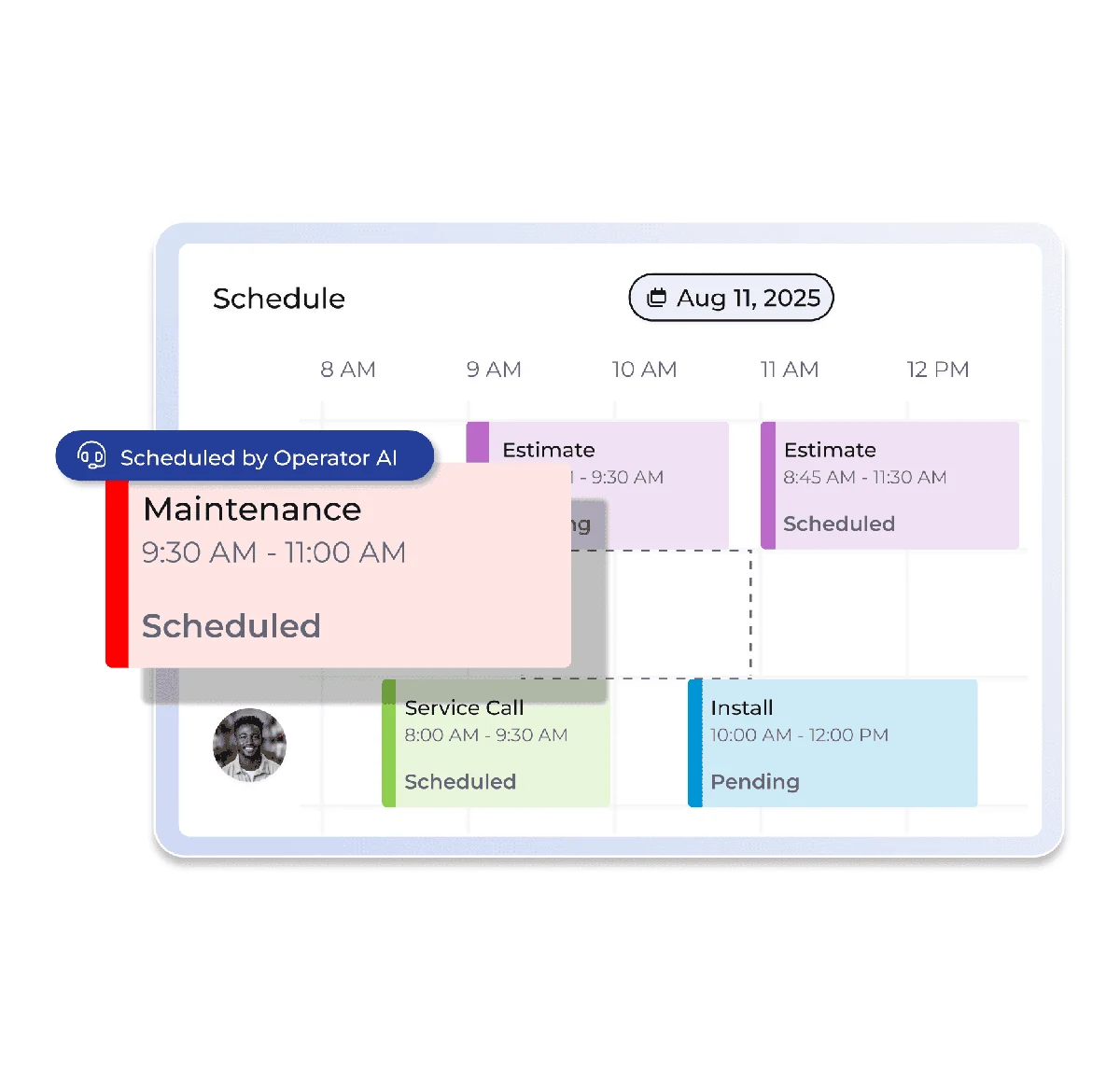
Operator AI is FieldPulse’s flagship AI feature and the centerpiece of the 2025 product expansion. The NECA (National Electrical Contractors Association) recognition is meaningful — NECA is the trade association for the electrical contracting industry, and “Innovator Award” recognition for an AI dispatcher targeting their member base reflects real operational validation rather than vendor marketing.
How it works on a live inbound call: the call hits your FieldPulse number, Operator AI picks up if your team can’t (after-hours, weekends, breaks, declined calls, lunch), identifies the customer in CRM history if they’ve called before, asks the qualifying questions you scripted (trade type, urgency, address, scope), suggests two or three appointment slots from real-time technician availability, books the slot the customer picks, and sends SMS/email confirmations to the assigned tech. Job lands in the FieldPulse dispatch board ready for execution.
The two differentiators versus Workiz Genius Answering:
30+ language support — Operator AI handles Spanish, Mandarin, Vietnamese, Korean, Tagalog, Russian, Polish, German, French, Portuguese, Arabic, Hindi, and more. Workiz Genius supports English, Spanish, and French only. For operations serving polyglot urban markets — Houston, Los Angeles, New York, Toronto, Miami — the language coverage is the difference between booking the call and losing it to whoever calls next.
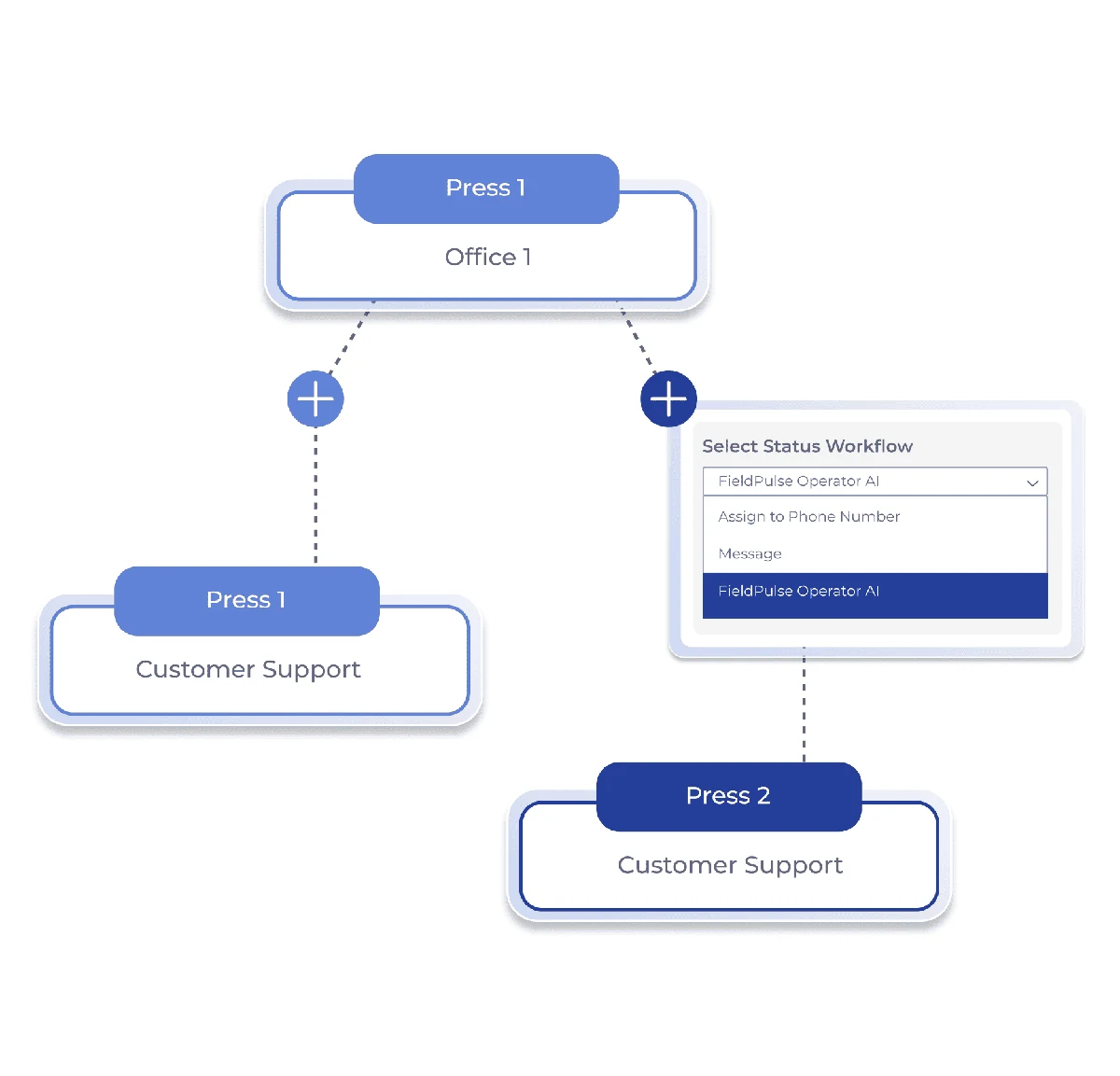
Customizable phone tree workflows — you build “Press 1 for emergencies, 2 for billing questions, 3 for new bookings, 4 for existing customers” routing logic in minutes through the FieldPulse interface. Workiz Genius handles routing through script logic but doesn’t expose explicit IVR-style phone trees as cleanly.
Smart urgent-keyword routing — configurable triggers for “burst pipe,” “no heat,” “broken AC,” “gas leak,” “electrical fire” prioritize over routine inquiries automatically. For service trades where emergency response time directly correlates with whether the customer calls a competitor next, this is the kind of operational discipline that’s hard to replicate manually.
Where Workiz pulls ahead — Genius Answering launched December 2024 versus Operator AI’s later 2025 launch. The Workiz AI has roughly 14 months of production maturity, more customer-deployed call volume, and more refined edge-case handling visible in customer reviews. FieldPulse Operator AI is genuinely strong but less battle-tested.
Chat AI and Field Intelligence: The Rest of the AI Stack
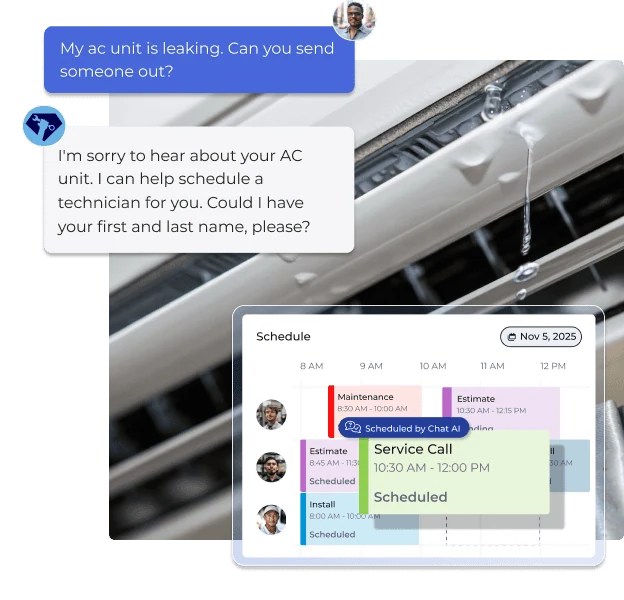
Chat AI is the website-side companion to Operator AI — same 30+ language support, same FieldPulse calendar integration, same automated handoff to human staff or Operator AI when conversations get complex. The brand-pulled visual styling is the underrated detail: the chatbot automatically matches your website’s logo and color scheme, so customers don’t see a generic “Hi, I’m a chatbot” widget that breaks brand experience. For shops where the website is the primary lead source — especially residential service trades where homeowners Google “HVAC repair near me” and click the first result — this captures bookings that would otherwise become voicemail rolls or competitor wins.
Field Intelligence is FieldPulse’s broader AI analytics module, currently positioned as a parent category for Operator AI + Chat AI + automated reporting and call summary features. The Series C announcement specifically calls out AI product development as a capital deployment target, so expect Field Intelligence to expand meaningfully through 2026 — likely into AI-powered job costing, predictive scheduling, dynamic pricing, and tech-side workflow assistance.
ClearPath isn’t AI, but it’s the workflow module that gets singled out across customer reviews as the differentiator. ClearPath is a guided process designer that walks field techs through standardized job phases — discovery → diagnosis → quote → approval → execution → invoice → payment — with configurable steps per trade or job type. For multi-trade operations where you can’t expect every tech to remember every standard procedure, ClearPath enforces the operational discipline that prevents $500 jobs from becoming $50 jobs because the tech skipped the upsell conversation.
The Schedule Board, Dispatch, and Mobile App Field Techs Actually Open
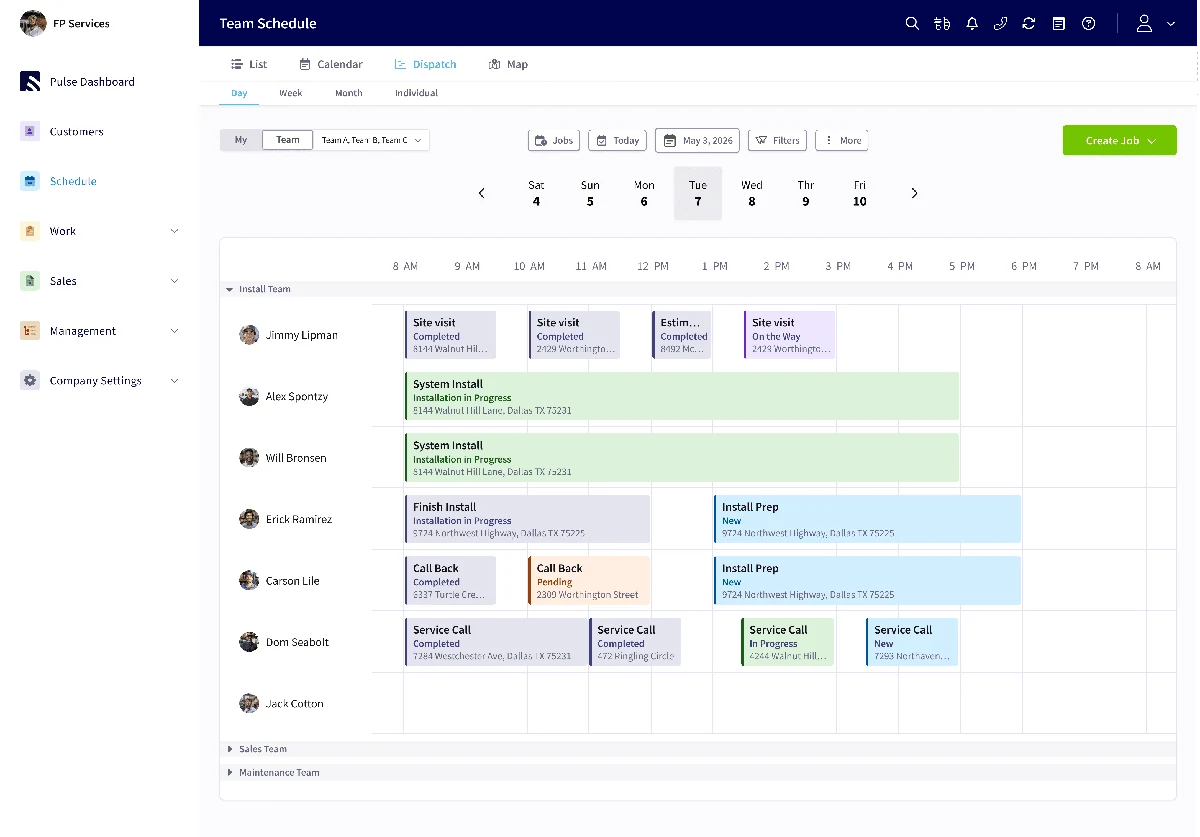
Field service software lives or dies on two interfaces: the dispatcher’s schedule board and the field tech’s mobile app. FieldPulse’s dispatch board does the standard set well — drag-and-drop reassignment, multi-day weekly views, technician swim lanes, color-coded job types, GPS tracking via Azuga integration, capacity-aware double-book prevention, automated customer ETA texts. Nothing groundbreaking versus Workiz or Housecall Pro, but everything functional and reliable.
The mobile app is where Capterra reviewers report the strongest experience — 96% positive sentiment specifically on field tech tools, the highest sub-score in the platform. ClearPath workflows surface on the phone the same way they surface on desktop, so a field tech walking into a basement service call gets step-by-step guidance: confirm equipment, photograph existing condition, run diagnostic, build estimate from pricebook, present good/better/best, collect signature, generate invoice, take payment via Square, mark job complete, sync to QuickBooks Online. The whole loop runs from the phone without driving back to the office.
Where mobile complaints cluster: Capterra critical reviews flag “unreliable syncing and connectivity” in 88% of negative-sentiment patterns — typically around mobile-to-desktop data integrity after returning from offline mode and around QuickBooks Desktop sync specifically (QuickBooks Online sync is more reliable per reviewer feedback). These aren’t deal-breakers — the 4.6/5 average reflects the app working well most of the time — but they’re real workflow notes worth pressure-testing during the sales conversation. Ask specifically about sync reliability under high job volume, photo upload speed on weak cell connections, and QuickBooks Desktop sync if that’s your accounting platform.
Payments, FieldPulse Capital, and the Square-Only Caveat
The payment processing limitation is the most actionable item to know before you sign — because it affects everything downstream.
FieldPulse routes all payment processing through Square as of April 2026 — no native Stripe option, no direct ACH at processor-published rates. Square charges 2.9% + $0.30 per transaction for cards (in line with industry standard) but limits your negotiating room compared to Stripe’s volume-based custom pricing for shops processing $30K+/month in card volume. For service trades doing $500K+/year in card processing, the rate spread between Square retail rates and Stripe negotiated rates can be 0.3-0.5% — which equals $1,500-$2,500/year in margin.
Where FieldPulse compensates is on the financing side: native Wisetack integration handles consumer financing for $500-$25,000 jobs at the standard 3.9% transaction fee, Acorn Finance integration adds a 30+ lender marketplace for loans up to $100,000, and FieldPulse Capital is FieldPulse’s own financing product for working capital and equipment financing for the contractor businesses themselves. Combined, the financing stack is competitive — though Workiz matches it at lower base subscription cost.
The invoice builder is solid — branded templates, line-item flexibility, automated late-fee triggers, recurring billing for service plans, automated payment reminders, two-way QuickBooks Online sync (the broadest accounting integration coverage in the FSM category, including QuickBooks Online + Desktop + Xero + MYOB + QuickBooks Time). The mobile invoicing flow lets field techs generate, send, and collect payment from the truck without driving back to the office, which is the workflow that defines fast-cash operations.
The Integration Map — Where FieldPulse Wins and Where It Doesn’t
This is the area where FieldPulse genuinely outperforms most FSM competitors.
Native HighLevel + QB Online/Desktop + Xero + MYOB beats every direct FSM competitor on the accounting and marketing-automation side. Stripe gap and CRM-coexistence gap are the material weaknesses.
- → QuickBooks Online · two-way sync
- → QuickBooks Desktop (sync flagged as buggy)
- → Xero · two-way
- → MYOB (Australia)
- → QuickBooks Time
- → HighLevel/GoHighLevel · rare for FSM
- → Mailchimp · Marketing 360
- → NiceJob · CHIIRP · Signpost
- → Angi Leads · XAPPAI · Free2Grow
- → CompanyCam
- → Google Calendar
- → Azuga Fleet Tracking
- → HazardCo (Australia)
- → Wisetack consumer financing
- → Acorn Finance · 30+ lender marketplace
- → FieldPulse Capital · own financing
- → Square (sole payment processor)
- → Reece (US + ANZ)
- → Winsupply Costbook
- → City Electric Supply
- → The Granite Group
- ✗ Stripe · JobNimbus · ServiceTitan
- ✗ Salesforce · HubSpot · Pipedrive
- ✗ Smith.ai · Reserve with Google · AnswerForce
The native HighLevel integration is the underrated competitive advantage — most FSM competitors (Workiz, HCP, Jobber) do not offer native GoHighLevel sync, forcing Zapier glue or migration. For shops running GHL marketing automation on top of FSM operations, FieldPulse is the cleanest stack.
The native HighLevel/GoHighLevel integration deserves specific attention because it’s genuinely rare in the FSM category. GoHighLevel is the dominant marketing automation platform for service-trade contractors as of 2026 — it’s where the marketing ecosystem (lead-gen funnels, email/SMS sequences, AI Voice receptionist, reputation management, scheduling links) lives for most aggressive-growth contractor operations. Most FSM competitors force a Zapier glue layer to connect FSM to GHL; FieldPulse ships native sync. For shops running GHL on top of FSM (the dominant 2026 contractor stack pattern), FieldPulse + GHL is a meaningfully cleaner architecture than Workiz/HCP/Jobber + GHL via Zapier.
The accounting integration breadth is the second material competitive advantage — QuickBooks Online + QuickBooks Desktop + Xero + MYOB covers the four dominant accounting platforms for North American contractors. Workiz natively syncs only QuickBooks Online; Jobber syncs QuickBooks Online + Xero; FieldPulse covers all four. For shops on Xero (common among smaller operations and Canadian/Australian markets) or MYOB (Australian standard), this matters.
The CRM-coexistence gap is the material weakness. No native integration with JobNimbus, ServiceTitan, AccuLynx, Salesforce, HubSpot, or Pipedrive means FieldPulse wants to BE your CRM rather than layer on top. If your sales pipeline already lives in JobNimbus or GHL standalone, the path forward is migration or Zapier glue.
What 427 Capterra and 2,537 G2 Reviewers Actually Say
The 2,537-review G2 base at 4.8/5 is genuinely the largest validated review footprint in the FSM category, and the 427 Capterra reviews at 4.6/5 hold up as a second independent data source. Sub-scores break down: 4.5 ease of use, 4.7 customer service, 4.4 features, 4.5 value for money. Customer support specifically (4.7/5) is the strongest sub-score and consistently the most-praised dimension across critical review patterns.
The strongest five-star pattern across both platforms: streamlined intuitive workflow (92% positive sentiment per Capterra’s tag analysis), responsive in-app chat support (93% positive), and field-tech mobile tools (96% positive). The most-cited individual review themes are “easy onboarding,” “comprehensive feature set,” and “support team responsiveness.”
Named verifiable customer testimonials from FieldPulse’s published case studies:
“Before FieldPulse, it took me four to eight hours for one quote. With FieldPulse now, I’d say about four to eight minutes.” — Sal Gutierrez, Owner, Fair Comfort Solutions (HVAC), in Fair Comfort Solutions case study
“The online platform has helped us tremendously with everything from reporting to communication, and we love the easy-to-use CRM system. You folks had everything in one bundle for a great price.” — Heather Aila, Office Secretary, Qualified Plumbing LLC (Keaau, Hawaii — 11-25 employees), in Qualified Plumbing case study
“[FieldPulse delivers] pinpoint accuracy with crystal-clear visibility on active jobs.” — Andy Rhinefort, 3rd-generation owner, Rhinefort Co (HVAC, Burleson TX, founded 1940s, 80+ years operating), in Rhinefort Co case study
The dominant critical patterns are real and worth pressure-testing. Capterra tag analysis shows “recurring bugs and glitches” appears in roughly 47% of critical reviews and “unreliable syncing and connectivity” appears in roughly 88% of negative-sentiment reviews. Specifically: QuickBooks Desktop sync gets flagged as “buggy” repeatedly across multiple reviews; mobile-to-desktop data integrity after offline mode is the second most-common technical complaint; and one Capterra reviewer reported spending “over $1,000 in add-ons” expecting basic functionality (calling, texting, emailing) to be in the base plan.
What’s notably absent from critical reviews: complaints about the Operator AI dispatcher accuracy or Chat AI conversation quality. Those features get consistent praise even from 3-star reviewers who had other issues. The 4.6/4.8 ratings reflect a genuinely strong core product with two specific operational weaknesses (sync reliability and pricing transparency) that you should validate during your sales conversation before signing an annual contract.
FieldPulse vs Workiz vs ServiceTitan vs Jobber: The 2026 Multi-Trade FSM Decision
All four are 4.5+ rated and each owns a distinct lane. The right pick depends on trade mix, scale, AI maturity needs, and willingness to commit before a free trial.
| Dimension | FieldPulse | Workiz | ServiceTitan | Jobber |
|---|---|---|---|---|
| Trade flexibility | Broadest (HVAC + plumb + elec + septic + glass + senior care + junk + landscaping) | HVAC + plumb + elec + garage + appliance | HVAC + plumb + elec primary | All trades, light depth |
| Starting price | ~$65/user/mo (sales-quoted) | Sales-quoted (last pub. $225/mo) | $245/tech/mo | $39/mo Core |
| Free trial | No (demo only) | 7 days, no CC | No (demo only) | 14 days |
| Native AI receptionist | Operator AI (NECA Award) · 30+ langs | Genius (Dec 2024 · 14mo mature) · EN/ES/FR | Atlas AI Voice (Sept 2025) | Limited |
| Native HighLevel integration | Yes (rare for FSM) | No (Zapier only) | No | Yes (Sept 2025) |
| Accounting integrations | QB Online + Desktop + Xero + MYOB | QB Online only | QB Online + Intacct | QB Online + Xero |
| Payment processor | Square only (no Stripe) | Multi-processor + Wisetack/Sunbit | ServiceTitan Pay | Jobber Payments + Wisetack |
| Total funding | $79.2M ($50M Series C Aug 2025) | ~$53M total | Public (NASDAQ:TTAN Dec 2024) | $120M (Summit Partners) |
| G2 review base | 2,537 reviews · 4.8/5 (largest in FSM) | ~600 · 4.6/5 | 325 · 4.3/5 | ~890 · 4.5/5 |
| Capterra rating | 4.6/5 · 427 reviews | 4.4/5 · 218 reviews | 4.4/5 · ~325 reviews | 4.5/5 · 1,440 reviews |
The honest answer: no single FSM dominates. Match the platform to your trade mix, scale, and AI maturity tolerance. FieldPulse wins on multi-trade flexibility + integration breadth. Workiz wins on AI maturity + free trial (pricing sales-quoted since 2026). ServiceTitan wins enterprise. Jobber wins simplicity.
FieldPulse wins decisively when: you run multi-trade operations (HVAC + plumbing + electrical + septic, or HVAC + glass + senior care, or any other unusual trade combination), you need GoHighLevel native integration (rare in FSM), you run Xero or MYOB accounting (Workiz lacks both), and you’re willing to commit before a free trial. The 2,537-review G2 base validates the platform genuinely works at scale.
Workiz wins when: you run HVAC/plumbing/electrical at 3-25 techs, you want native AI dispatcher with 14 months of production maturity (Genius launched Dec 2024 vs Operator AI’s later 2025 launch), you need a 7-day free trial before committing, and you want flat-base tiers rather than per-user scaling (sales-quoted since 2026; last published April 2026 at $225-$325/mo for 3-5 users). Genius Answering is sold as a separate add-on, and the free Lite tier was dropped in 2026.
ServiceTitan wins when: you run $1M+ revenue, 10+ techs, dedicated office staff to absorb the 3-6 month ramp. Marketing Scorecard, pricebook depth, and Atlas AI enterprise capabilities pay back at scale.
Jobber wins when: you’re solo or under 10 techs across mixed residential service trades. $39-$149/mo with 14-day trial, broadest trade reach with simplest UX.
The platforms aren’t substitutes; they’re niches. Run the FieldPulse demo if multi-trade flexibility + GHL integration matter; run a parallel Workiz free trial because the AI maturity + free-trial advantage is real; and decide based on which platform’s UX matches your team’s working style and which trade mix fits your operation.
The 2026 Roadmap: Where the Series C Capital Goes
The August 2025 Series C announcement explicitly committed capital deployment to three areas: AI-driven product development, platform customization depth, and customer success expansion. Each has visible 2026 implications worth understanding.
AI product development trajectory:
- Operator AI maturity — already launched, NECA Award won, 30+ language support live; expect deeper customer-history-aware responses and tighter dispatch integration through 2026
- Chat AI expansion — already live, brand-pulled visual styling shipping; expect proactive chatbot triggers, abandoned-conversation recovery, and deeper Operator AI handoff coordination
- Field Intelligence module deepening — currently the parent category for AI features; expect AI-powered job costing, predictive scheduling, dynamic pricing recommendations, and tech-side workflow assistance to land progressively through 2026
- Likely 2026-2027 expansion — autonomous tech-side workflows (“Hey FieldPulse, write up this job” voice commands), AI-powered marketing source attribution, and predictive maintenance scheduling for service-plan customers
Platform customization depth — the second capital deployment target — likely lands as deeper ClearPath workflow flexibility, more custom field types, multi-location-specific configurations, and trade-specific template libraries for the long tail of trades (glass, septic, senior care) where FieldPulse already serves customers but doesn’t yet ship pre-configured templates.
Customer success expansion — the third target — addresses the “post-trial price increase” and account-management complaints that show up in critical reviews. Expect more dedicated implementation specialists, longer onboarding programs, and clearer multi-year pricing structures as the customer success org scales with the customer base.
The realistic timeline:
- Today (April 2026): Operator AI + Chat AI + Field Intelligence + ClearPath all live; integration map at 25+ partners; 4.8/5 G2 across 2,537 reviews
- Mid-late 2026: Field Intelligence expansion lands; deeper AI-powered analytics; more customizable workflow templates
- 2027: Likely autonomous tech-side AI (“Hey FieldPulse” voice on mobile); predictive scheduling and dynamic pricing
- 2027-2028: Probable enterprise features as platform pushes upmarket toward ServiceTitan-class scale
This is editorial extrapolation from Series C execution velocity, not commitments FieldPulse has made publicly. Actual sequence depends on engineering velocity and customer demand signals.
Who Should Use FieldPulse
Multi-trade operations running 3-30 techs across HVAC + plumbing + electrical + septic + glass + senior care + junk removal or any other unusual combination — this is the editorially defensible sweet spot. No single competitor handles trade-mix breadth at this price point. The customizable workflows + ClearPath modules + multi-location management let you configure FieldPulse to serve trades that don’t fit standard FSM templates.
Operations on Xero or MYOB accounting — these are common among smaller operations, Canadian markets, and Australian markets. FieldPulse natively syncs both, which Workiz does not (QuickBooks Online only).
Shops running GoHighLevel marketing automation alongside FSM operations — the native HighLevel integration is genuinely rare in the FSM category and means GHL marketing data flows directly into FieldPulse customer records without Zapier glue. This stack pattern is increasingly common for aggressive-growth contractor operations and FieldPulse is the cleanest FSM partner.
Operations needing 30+ language voice receptionist — Operator AI’s language coverage is the differentiator. For shops in Houston, Los Angeles, New York, Toronto, Miami, or any market with significant Spanish + Mandarin + Vietnamese + Korean + Tagalog + Russian customer bases, the language coverage is the difference between booking the call and losing it.
Long-tail service trades — septic, glass, senior care, junk removal, fence installation, fire protection, custom millwright, mobile recall, grave/vault services. FieldPulse explicitly serves these on its homepage with verifiable customer logos; ServiceTitan and Workiz don’t.
Shops where the largest validated review base matters in evaluation — 2,537 G2 reviews at 4.8/5 is genuinely the strongest sample-size validation in the FSM category, and matters for buyers who weight peer-validation heavily.
Contractors prioritizing customer support quality — FieldPulse’s 4.7/5 Capterra customer service sub-score is the strongest in the SMB FSM category, and consistently the most-praised dimension across reviews.
Who Should NOT Use FieldPulse (and What to Use Instead)
Solo operators and 1-2 person crews under $300K revenue — at sales-quoted per-user pricing with no free trial, the math is harder than Jobber Core at $39/mo. Use Jobber for that scale (Workiz dropped its free Lite tier in 2026 and is sales-quoted now).
Anyone who needs to validate before signing — FieldPulse offers no free trial as of April 2026. If pre-purchase validation is non-negotiable, run Workiz (7-day no-credit-card), Jobber (14-day), or Housecall Pro (14-day) trials first.
Operations needing transparent published pricing — sales-gated quoting with reported post-trial increases is a real friction; Contractor Foreman at $49-$332/mo with published pricing and Price Lock Guarantee is a defensible alternative for multi-trade construction operations.
HVAC-only operations under $1M revenue — Workiz (sales-quoted since 2026; last published $225-$325/mo flat) with mature Genius AI (14 months in production, sold as a separate add-on) is purpose-built for HVAC/plumbing/electrical at this scale and was cheaper on its last published rates; confirm on a quote.
Operations needing Stripe payment processing — FieldPulse routes payments through Square only as of April 2026. If Stripe is non-negotiable, Housecall Pro or Jobber are better fits.
Insurance restoration roofers — FieldPulse doesn’t have purpose-built features for Xactimate scope, supplements, or insurance claim workflow. Use JobNimbus or AccuLynx.
Custom home builders and high-end remodelers — FieldPulse’s dispatch and service-call workflow doesn’t map to construction project management. Use Buildertrend or BuilderPad.
Operations using JobNimbus, ServiceTitan, or AccuLynx as system of record — FieldPulse wants to BE your CRM, and lacks native integration with these platforms. You’ll either fully migrate or run two systems with Zapier glue.
Operations doing $5M+ revenue with 25+ techs in HVAC/plumbing/electrical — at this scale ServiceTitan’s Marketing Scorecard, pricebook depth, and Atlas AI enterprise features pay back the higher cost.
Highly emotional residential service trades (water damage restoration, biohazard, slab leaks) where the first call’s tone matters — Operator AI is structured-script AI; layer Smith.ai or Ruby Receptionists in front for the human-empathy first-touch on those specific use cases.
The Bottom Line: Best Multi-Trade FSM in 2026
FieldPulse is the most defensible multi-trade field service platform on the market in April 2026 — the funding ($79.2M total, $50M Series C), the customer-base scale (100%+ YoY growth, 2,537 G2 reviews at 4.8/5), the AI stack (Operator AI with 2025 NECA Innovator Award, Chat AI with 30+ language support, Field Intelligence module), the integration breadth (broadest accounting + supplier coverage in FSM, native GoHighLevel integration), and the trade-mix flexibility (HVAC + plumbing + electrical + septic + glass + senior care + long-tail trades) all line up. The 16-year operating history out of Dallas is the structural credibility signal that pre-Series-A AI startups in the same category can’t match.
The constraints to be clear about: pricing is fully sales-gated with no published rates and no free trial, payment processing routes through Square only with no Stripe option, basic communication features (calling, texting, emailing) require paid add-ons that some users report stacking past $1,000 in surprise costs, “recurring bugs and glitches” appears in 47% of critical Capterra reviews with “unreliable syncing” in 88% of negative-sentiment patterns, and per-user pricing scales meaningfully more expensive than Workiz’s flat-base structure past 5 techs (on Workiz’s last published rates; it’s sales-quoted since 2026). None of these are dealbreakers for the right operation; they’re product-stage realities that need to factor into your evaluation.
For multi-trade operations doing $300K-$5M in annual revenue with 3-30 techs across genuinely diverse trade mixes — this is the editorially defensible FSM bet of 2026 and the one that delivers the broadest trade flexibility with the deepest accounting + GoHighLevel integration. Request a demo and pressure-test specifically: get written pricing for your tech count and add-on stack, ask about year-two price escalation policy, validate QuickBooks sync reliability if QB is your accounting platform, and confirm the AI features match your specific call volume and language requirements.
For HVAC-only shops, solo operators, contractors needing transparent pricing or free-trial validation, restoration roofers chained to Xactimate, custom home builders, JobNimbus/ServiceTitan-as-system-of-record operations, or anyone whose primary need is enterprise-grade dispatch depth — different platforms (Workiz, Jobber, JobNimbus, ServiceTitan, Buildertrend) earn the recommendation.
The category is consolidating around AI-native multi-trade FSM whether FieldPulse specifically wins or not. The right question for any service-trade contractor evaluating FSM in 2026 isn’t “should we use AI?” — it’s “which AI-forward FSM is mature enough for our trade mix and willing to commit to multi-year pricing without surprise increases?” For multi-trade operations with the breadth FieldPulse handles, FieldPulse is the clearest answer in 2026.