


There’s a structural reason FieldEdge keeps showing up in HVAC FSM evaluations even when it doesn’t show up in the AI-dispatcher conversations: it’s been doing this longer than anyone else. Founded in 1980 as the first-ever service management software company, now owned by Xplor Technologies via the Clearent merger, with 45 years of HVAC, plumbing, and electrical service-trade focus and a Carrier preferred vendor relationship that no FSM competitor has matched. The Capterra base shows 4.2/5 across 306 verified reviews — the lowest in the FSM-primary cluster but with the strongest customer service sub-score (4.4/5) of any direct competitor.
That heritage shapes both the pitch and the catches you need to know about — and worth being clear about both before you book a demo.
What this review covers: the actual 2026 pricing math (FieldEdge doesn’t publish, third-party aggregators consistently report ~$100-$125 per user per month plus $500-$2,000+ setup fees), how Coolfront flat-rate pricebook bundles the HVAC repair pricing library that’s industry-standard at this point, the MarketingEdge service-agreement automation that’s the flagship workflow for membership programs, Proposal Pro Good-Better-Best bidding from the 2022 Enterprise Selling Solutions acquisition, the dispatch board for multi-truck operations, the Carrier preferred vendor status and what it actually means, the QuickBooks-first integration architecture (including the structural prerequisite that employees must be created in QuickBooks before FieldEdge), what 306 Capterra reviewers say about the bug velocity and sales overselling patterns, how FieldEdge stacks against ServiceTitan and Workiz and Jobber for HVAC operations, and which contractor segments should be looking at different platforms entirely.
The 45-Year HVAC Heritage (And Why It Still Matters)
FieldEdge’s 1980 founding date is the structural context for understanding everything else about the platform — the strengths and the catches.
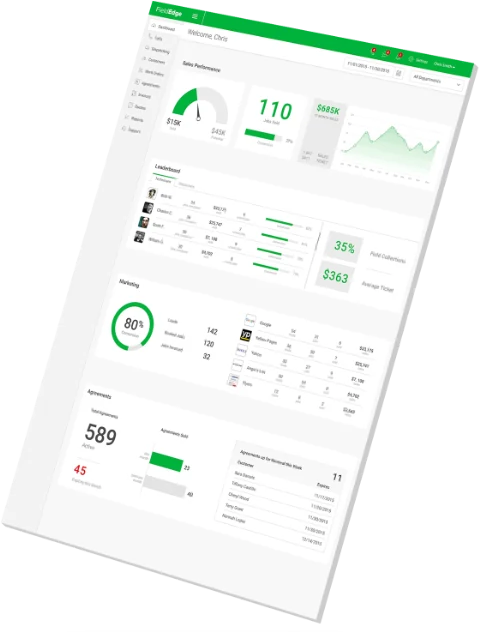
What 45 years buys you operationally: the institutional knowledge of how HVAC, plumbing, and electrical shops actually run day-to-day. The dispatch board is built around multi-truck operations because that’s how established residential service companies operate. The pricebook is HVAC-vertical-specific because the founders spent decades watching contractors lose margin on flat-rate quoting. The service-agreement automation exists because membership program revenue is 30-50% of annual revenue for established HVAC shops and recurring billing matters more than dispatch optimization at that scale.
What 45 years doesn’t buy you: AI features. FieldEdge has no native AI dispatcher, no AI receptionist, no autonomous booking — and there’s no announced 2026 AI roadmap. The trade-off is real: stability and HVAC-vertical depth versus modern AI velocity. Workiz Genius Answering launched December 2024 with 14 months of production runtime. FieldPulse Operator AI won the 2025 NECA Innovator Award. ServiceM8 Phone Agent launched September 2025. FieldEdge is competing on heritage and HVAC-specific tooling rather than AI maturity.
The ownership context matters: FieldEdge was acquired by Advent International and merged with Clearent in March 2018. Clearent then merged with TSG to form Xplor Technologies. FieldEdge now operates inside Xplor’s Field Services division alongside Service Autopilot (green industry FSM), Wintac, and Coolfront. The portfolio context creates both stability (Xplor is a public-market-aware infrastructure company) and feature-velocity drag (FSM products inside large public-portfolio acquisitions tend to ship slower than Series-C-stage standalone competitors).
For shops where 45 years of HVAC focus is the structural comfort signal that matters most, FieldEdge’s heritage is the editorially defensible reason to evaluate it. For shops where AI velocity matters more, the heritage is the reason FieldEdge isn’t the right pick.
What FieldEdge Costs in 2026 (Real Numbers from Third-Party Sources)
Pricing transparency is a real friction point — FieldEdge doesn’t publish, so the numbers below come from third-party aggregators that report consistent ranges.
FieldEdge does NOT publish pricing on its own pricing page. These rates come from ITQlick, HVAC Software Hub, FieldCamp.ai, and reported contractor data. Verify directly during your sales conversation.
The pricing structure has three implications worth understanding before you sign.
First: per-user economics scale linearly. A 10-tech operation (6 field + 4 office) runs 6 × $125 + 4 × $100 = $1,150/month base. A 20-tech shop runs ~$2,300/month. The flat-base unlimited-user models from ServiceM8 ($149-$349/mo flat) and Service Fusion ($208-$533/mo flat) become dramatically cheaper at scale.
Second: setup and onboarding costs are real. Third-party sources report $500-$2,000 standard setup, with ITQlick reporting some implementations reaching $2,000-$10,000 for small businesses and $20,000+ for enterprise. The 5-week mandatory onboarding is built into every implementation. Add-on costs reportedly stack: Advanced Reporting ~$49/month, Inventory Management ~$39/month, additional mobile licenses ~$25/month per technician.
Third: there’s no free trial as of April 2026. FieldEdge explicitly refuses to offer one because onboarding requires direct team involvement. The practical workaround: get specific feature commitments in writing before signing, especially around Coolfront flat-rate inclusion and Proposal Pro access. Capterra critical reviewers consistently cite sales-team overselling — pressure-test feature claims aggressively during the demo conversation.
The Coolfront Flat-Rate Pricebook (HVAC’s Industry-Standard Pricing Engine)
This is the structural feature that genuinely differentiates FieldEdge from every modern FSM competitor — and worth understanding before anything else about the platform.
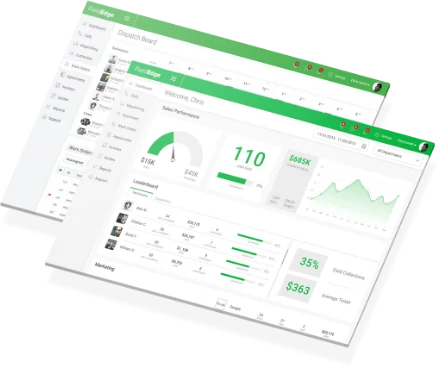
Coolfront is the flat-rate pricing app that Clearent acquired in 2022 and integrated into FieldEdge as the bundled pricebook engine. The library ships thousands of pre-built HVAC, plumbing, and electrical repair line items priced for Good-Better-Best presentation in the field. Each line item includes labor time, material cost, and the markup math that produces the customer-facing flat rate — built around how HVAC contractors actually quote at the kitchen table.
Why this matters operationally: residential HVAC service work is dominated by flat-rate quoting because hourly billing creates customer pushback and undercuts margin. Building a flat-rate pricebook in-house takes years and requires deep institutional knowledge of HVAC repair pricing. Coolfront has done that work — and FieldEdge bundles it. Workiz, FieldPulse, ServiceM8, Service Fusion, and Jobber require contractors to build their own pricebooks or integrate third-party flat-rate libraries (Profit Rhino is the common alternative). FieldEdge ships it native.
The Good-Better-Best workflow is the upsell mechanism most HVAC shops standardize on for kitchen-table close. Tech presents three repair options at three price points (e.g., capacitor replacement only at $485, capacitor + start kit at $625, full preventative tune-up bundle at $845). Customer self-selects the price point that matches their decision-making, which materially raises average ticket size. FieldEdge’s integration with Coolfront makes this workflow native to the mobile app rather than requiring tech-side estimation math.
The catch worth knowing: Coolfront’s flat-rate pricing reflects 2022-era benchmarks at the time of Clearent’s acquisition. Material costs, labor rates, and market pricing have shifted meaningfully since then. FieldEdge ships the pricebook updates on Premier and Elite tiers, but contractors with deep market-specific pricing knowledge often customize the library — which is supported but adds setup time during onboarding.
For established HVAC shops where flat-rate quoting depth is core to the operating model, Coolfront’s integration with FieldEdge is genuinely the structural advantage that justifies the platform versus modern competitors.
Service Agreement Automation: The Flagship MarketingEdge Workflow
If Coolfront is FieldEdge’s flat-rate pricebook differentiator, MarketingEdge is the service-agreement automation flagship — and worth being specific about because it’s where established HVAC shops actually generate platform-justifying ROI.
MarketingEdge handles automated email and SMS to customers, service-agreement renewal reminders, membership program billing, recurring maintenance scheduling, and what FieldEdge calls “a playbook to sell more service agreements” with documented case-study results. The published productivity claims — average ticket of $371 with 7 sold, 30% optimized marketing spend, 138% ROI in first year — are specific enough to verify against your operation rather than generic vendor marketing.
Why service agreement automation matters specifically for HVAC: membership programs are typically 30-50% of annual revenue for established residential HVAC operations. A 500-customer service-agreement base at $15-$25/month equals $90,000-$150,000 in recurring revenue per year — and the renewal mechanism is the highest-leverage operational lever in the business. FSM platforms that don’t automate renewal reminders, membership billing, and scheduled maintenance dispatch leave that revenue on the table.
The competitive context: ServiceTitan has the deepest enterprise service-agreement workflow but at enterprise pricing. Workiz supports recurring service plans but it’s not a flagship workflow. ServiceM8 handles recurring jobs but doesn’t market service-agreement specifically. Service Fusion lists service agreements as add-on functionality. FieldEdge’s MarketingEdge is the most-marketed service-agreement automation in the SMB FSM segment — not because the underlying capability is dramatically different, but because the playbook documentation, case-study results, and HVAC-specific framing are tuned for the buyer who’s already running a membership program and needs the operational layer to scale it.
For HVAC shops where service-agreement membership revenue is meaningful, MarketingEdge is the editorially defensible reason to evaluate FieldEdge over modern competitors.
Proposal Pro: Good-Better-Best Bidding from the 2022 ESS Acquisition
Proposal Pro is the third structural feature worth understanding — added to FieldEdge after Xplor Technologies acquired Enterprise Selling Solutions LLC (ESS) in 2022 and integrated their Good-Better-Best proposal engine into the platform.
What it does: generates professional Good-Better-Best proposals at the kitchen table with the three-tier pricing model that maximizes upsell rates. Customer sees the comparison clearly, understands the value progression, and self-selects the tier that matches their decision-making. FieldEdge’s documented data shows average ticket of $371 with 7 sold per Proposal Pro session — meaningfully higher than single-quote presentations.
Why this matters for HVAC operations: Good-Better-Best proposals materially raise close rates and average ticket size on residential service work. The psychology is well-documented in sales literature — when given three options, customers default to the middle option roughly 60% of the time, and when given only one option, they’re more likely to delay or comparison-shop. The proposal engine that automates this is the difference between a 35% close rate and a 55% close rate on residential repair quotes.
The competitive context: Housecall Pro ships Sales Proposal Tool with Good-Better-Best built in. Workiz supports proposal templates but doesn’t market the three-tier framework. ServiceTitan has Proposal Pro features at enterprise pricing. Most other FSMs don’t ship structured Good-Better-Best workflow. FieldEdge’s Proposal Pro is the dedicated three-tier proposal engine in the SMB segment — bundled into the platform rather than charged as a separate subscription, which materially changes the unit economics.
For established HVAC shops where kitchen-table close rates and average ticket size are the operational levers that matter most, the combination of Coolfront flat-rate pricing + Proposal Pro Good-Better-Best is the editorially defensible structural pitch.
The Dispatch Board and Mobile App for Multi-Truck Operations
The dispatch and mobile-app capabilities are what FieldEdge’s daily users actually live in — and worth being specific about because the 4.4/5 customer service score reflects how the product holds up after the sales conversation ends.
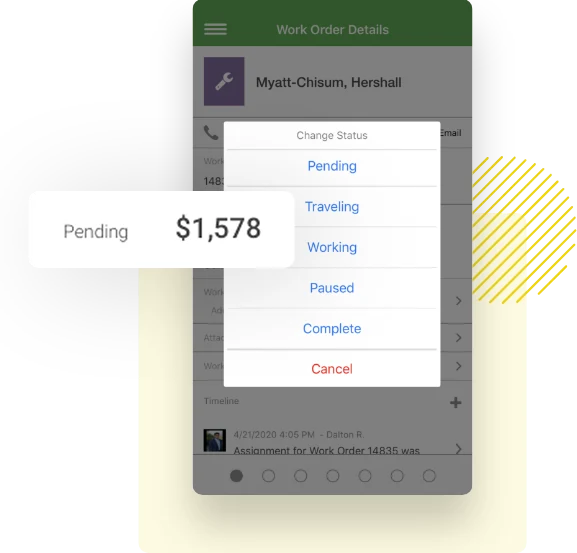
Dispatch board capabilities: drag-and-drop scheduling across multiple trucks, GPS tracking with real-time tech locations, skill-based assignment (assign the right tech for the right job based on certifications and tool inventory), customer history accessible from the dispatch view, and capacity-aware scheduling that prevents double-booking. The 88% positive sentiment on dispatch-and-scheduling tools across the 306-review Capterra base reflects a working dispatch experience — not best-in-FSM but functional and reliable for the multi-truck operations FieldEdge targets.
Mobile app capabilities: technicians update work orders from the field, capture photos, add notes, generate service recommendations, present Coolfront flat-rate pricing, run Proposal Pro Good-Better-Best workflows, collect signatures, and process payments via integrated card processing. iOS and Android both supported. One Capterra reviewer notes 80% paperwork reduction, which is the kind of specific productivity claim worth verifying against your operation.
Where the mobile app earns critical reviews: persistent bugs and glitches show up across 55% of negative-sentiment Capterra reviews. The bug pattern isn’t catastrophic (the platform works most of the time) but it’s the dominant complaint and worth pressure-testing during the demo. The QuickBooks sync specifically gets flagged in critical reviews — multiple reviewers cite sync glitches and the structural prerequisite that employees must be created in QuickBooks first before FieldEdge.
Real-world contractor productivity claims from FieldEdge’s published case studies: ~20 hours/week saved on technician paperwork, 75% reduction in reporting time, 50% cut in accounting spend via QuickBooks integration, 30% optimized marketing spend, 138% ROI in first year. These aren’t generic vendor metrics — they’re trackable operational levers that you can verify or falsify against your specific operation post-implementation.
Carrier Preferred Vendor Status: What It Actually Means
The FieldEdge × Carrier preferred vendor relationship is a structural credibility signal worth understanding because no other FSM has it.
What “preferred vendor” actually means: Carrier is one of the largest HVAC manufacturer brands in North America (alongside Trane, Lennox, Goodman, and Daikin). Carrier dealer-network shops are franchise-style HVAC operations that distribute Carrier equipment and service Carrier brand systems. The preferred-vendor status means Carrier recommends FieldEdge in dealer onboarding materials, training programs, and Carrier-network business development resources.
What it doesn’t mean: native software-level integration with Carrier equipment diagnostic systems, Carrier-specific pricebook automation beyond what Coolfront ships, or unique technical capability for Carrier dealers versus other HVAC contractors. The relationship is operational and channel-level rather than software-level.
Why this matters competitively: ServiceTitan doesn’t have a manufacturer-preferred-vendor relationship at this level. Workiz announced a Trane and American Standard partnership in February 2025 (similar dealer-network operational positioning, smaller manufacturer footprint). FieldPulse lists supplier integrations like Reece (plumbing distributor) but no HVAC manufacturer relationships. FieldEdge’s Carrier status is the deepest manufacturer-aligned relationship in the FSM category — which matters specifically for Carrier dealer-network shops evaluating platforms but is a wash for non-Carrier HVAC operations.
For Carrier dealer-network operations specifically, the preferred vendor status is the structural reason to evaluate FieldEdge over alternatives. For HVAC shops that don’t service Carrier equipment, the relationship is a credibility signal but not a deal-driver.
Integrations: QuickBooks-Deep, Stack-Narrow Outside HVAC Manufacturer Relationships
The integration architecture is meaningfully narrower than modern competitors — and worth being specific about because it’s the structural catch alongside the no-AI-features gap.
Coolfront flat-rate + Proposal Pro + MarketingEdge are bundled internally. QuickBooks integration is structural prerequisite. Outside that core, the native ecosystem is meaningfully sparser than FieldPulse or Workiz.
- → QuickBooks Online · bi-directional
- → QuickBooks Desktop · bi-directional
- → Required prerequisite for employee mgmt
- → Coolfront flat-rate pricebook
- → Proposal Pro Good-Better-Best
- → MarketingEdge service agreements
- → Xplor Pay credit card processing
- → Carrier preferred vendor status
- → Operational/channel-level only
- → Not software-level integration
- ✗ Xero · MYOB · Sage
- ✗ CompanyCam
- ✗ Wisetack · Sunbit · Hearth
- ✗ GoHighLevel · Mailchimp · ActiveCampaign
- ✗ JobNimbus · ServiceTitan · AccuLynx
- ✗ Salesforce · HubSpot · Pipedrive
- ✗ Smith.ai · Ruby · AnswerForce
- ✗ Reserve with Google · Apple Calendar deep
- ✗ Zapier (limited)
For comparison: FieldPulse ships 25+ native integrations including HighLevel, Xero, MYOB, CompanyCam, Wisetack. Workiz ships 17 including CompanyCam, Wisetack, Reserve with Google. ServiceM8 ships triple platinum accounting (QB + Xero + MYOB). FieldEdge's Coolfront and Proposal Pro depth doesn't compensate for the broader ecosystem gap.
The structural implication: FieldEdge is built for shops where the stack is QuickBooks + Coolfront + MarketingEdge + Carrier dealer-network credibility. For shops with broader integration needs — CompanyCam for photo documentation, Wisetack for consumer financing on estimates, GoHighLevel for marketing automation — FieldPulse, Workiz, or ServiceM8 deliver materially more native integration coverage.
The QuickBooks structural prerequisite is worth being explicit about: you cannot create new employees in FieldEdge without first setting them up in QuickBooks as W2 employees. Capterra reviewers cite this as a real workflow constraint, especially for shops running mixed W2 + 1099 contractor labor. If you’re not already on QuickBooks or you’re not committed to staying on QuickBooks, FieldEdge is fundamentally not the right platform — the architecture assumes QuickBooks is the financial spine.
What 306 Capterra Reviewers Actually Say
The customer base validates the platform genuinely works for established HVAC operations — and the review patterns are clear once you read the data honestly.
Capterra: 4.2/5 across 306 verified reviews with sub-scores of 4.1 ease of use, 4.4 customer service, 3.9 features, 3.9 value for money. The 4.4 customer service sub-score is the strongest dimension and meaningfully ahead of Workiz (4.3), Service Fusion (4.3), and ServiceM8 (4.5). The 3.9 features and value sub-scores are the weakest in the FSM-primary cluster — reflecting the no-AI-features gap and the sales-quoted pricing friction.
The dominant five-star pattern: efficient dispatch and scheduling tools (88% positive sentiment), responsive support team (89% positive), customizable feature set (92% positive), easy-to-use interface for established users.
“I’ve had the best experience with FieldEdge. Anytime I have issues, their representatives are quick to respond and help.” — Amy J., Office Manager, Construction (Capterra reviewer)
“Easy to use. Great support. The best.” — Anne Marie A., Owner, Construction (Capterra reviewer)
“Overall my experience was satisfactory. I was pleased with how it performed and it was relatively easy to use.” — Chris M., Lead Service Technician, Mechanical/Industrial Engineering (Capterra reviewer)
“Good starter software. Simple design. I liked the photos of materials and the mobile app simplicity.” — Wayne G., Owner-Operator, Electrical/Electronic Manufacturing (Capterra reviewer)
The dominant critical pattern clusters around three operational concerns. First, persistent software bugs and glitches show up in 55% of negative-sentiment reviews — not catastrophic but the dominant complaint pattern.
Second, sales-team overselling during the buying process:
“My experience is not good. The system does not do what was promised. I will not recommend them.” — Joshua M., Owner, Construction (1-star Capterra review)
“Misrepresented what their platform could do. Hard to navigate for technicians and office staff.” — Lisa A., Office Manager, Consumer Services (1-star Capterra review)
Third, the QuickBooks structural prerequisite: multiple reviewers cite the requirement to create employees in QuickBooks before FieldEdge as workflow friction, especially for shops with significant 1099 contractor labor.
What’s notably absent from critical reviews: complaints about Coolfront flat-rate pricing (consistently praised) or service-agreement automation (the flagship workflow that drives platform adoption). The 4.2/5 average reflects a working platform with three specific operational concerns worth pressure-testing extensively during the sales conversation given the no-free-trial policy.
FieldEdge vs ServiceTitan vs Workiz vs Jobber: The HVAC FSM Decision
All four target HVAC operations at different scales and architectures. Match your team size, AI maturity needs, and accounting platform to the right pick.
| Dimension | FieldEdge | ServiceTitan | Workiz | Jobber |
|---|---|---|---|---|
| Founding · Heritage | 1980 (oldest in category) | 2007 · NASDAQ:TTAN | 2015 · Lead Edge Capital | 2011 · Summit Partners |
| Starting price | ~$100/user/mo (sales-quoted) | $245/tech/mo | Sales-quoted (last pub. $225/mo) | $39/mo Core |
| 5-tech monthly cost | ~$575/mo + setup | $1,225-$1,500/mo + impl | $325/mo flat (last published) | $129+/mo |
| Free trial | No (demo only) | No (demo only) | 7 days, no CC | 14 days |
| Native AI receptionist | No (no AI features) | Atlas AI (Sept 2025, enterprise) | Genius (Dec 2024 · 14mo mature) | Limited |
| HVAC-specific tooling | Coolfront + Proposal Pro + Carrier preferred vendor | Pricebook + Marketing Scorecard | Trane partnership · trade-tuned | Generic, multi-trade |
| Service agreement workflow | MarketingEdge (flagship) | Enterprise membership module | Recurring service plans | Recurring jobs |
| QuickBooks coverage | QB Online + Desktop (REQUIRED) | QB Online + Intacct | QB Online only | QB Online + Xero |
| Capterra rating | 4.2 · 306 reviews · 4.4 customer service | 4.4 · 325 reviews | 4.4 · 218 reviews | 4.5 · 1,440 reviews |
The honest answer: no single FSM dominates HVAC in 2026. FieldEdge wins on Coolfront flat-rate depth + service-agreement automation + Carrier vendor status. ServiceTitan wins enterprise scale. Workiz wins AI maturity + free trial. Jobber wins simplicity + cross-trade flexibility.
FieldEdge wins decisively when: you run an established HVAC, plumbing, or electrical operation 5-50 techs on QuickBooks accounting where Coolfront flat-rate pricebook depth and MarketingEdge service-agreement automation matter more than AI features. The Carrier preferred vendor status adds extra credibility for Carrier dealer-network shops specifically.
ServiceTitan wins when: $5M+ revenue, 25+ techs, dedicated office staff for the 3-6 month ramp. Marketing Scorecard, pricebook depth, Atlas AI, and enterprise dispatch (Dispatch Pro) pay back at scale.
Workiz wins when: HVAC/plumbing/electrical at 3-25 techs needs the most mature AI dispatcher (Genius Answering shipped December 2024 with 14 months of production runtime), 7-day no-credit-card trial, and flat-base tiers rather than per-user scaling (sales-quoted since 2026).
Jobber wins when: solo or under 10 techs, broadest trade reach, simplest UX, 14-day trial, and you don’t need HVAC-specific flat-rate or service-agreement depth.
Who Should Use FieldEdge
Established HVAC, plumbing, and electrical shops 5-50 techs on QuickBooks — this is the editorially defensible sweet spot. The Coolfront flat-rate pricebook + Proposal Pro Good-Better-Best workflow + MarketingEdge service-agreement automation combination is the structural advantage for established residential service operations.
Carrier dealer-network shops — the FieldEdge × Carrier preferred vendor status is the deepest manufacturer-aligned relationship in the FSM category. For Carrier dealers specifically, the channel-level credibility matters.
Operations where flat-rate pricebook depth is a daily operational priority — Coolfront’s library of pre-built HVAC and plumbing repair line items priced for Good-Better-Best presentation is genuinely best-in-class for HVAC kitchen-table close.
Shops where service-agreement membership programs are 30-50% of annual revenue — MarketingEdge’s automated renewal reminders, billing automation, and recurring maintenance scheduling pays back for membership-heavy operations.
Operations where customer service responsiveness matters more than feature velocity — the 4.4/5 customer service sub-score reflects 45 years of established support infrastructure inside the Xplor Technologies portfolio.
Shops that are committed to QuickBooks as the financial spine — the integration depth is genuinely deep, and the structural prerequisite that employees must be created in QuickBooks aligns naturally for shops already running QuickBooks-first operations.
Who Should NOT Use FieldEdge (and What to Use Instead)
Solo operators and 1-3 tech shops — the per-user pricing math doesn’t work at solo scale. Use ServiceM8 Free or Jobber Core instead (Workiz dropped its free Lite tier in 2026).
Anyone who needs to validate before signing — FieldEdge has no free trial. Run Workiz (7-day no-CC), Jobber (14-day), Housecall Pro (14-day), or ServiceM8 (14-day) trials first.
Operations needing modern AI dispatcher capability — FieldEdge has no native AI receptionist. Workiz Genius, FieldPulse Operator AI, and ServiceM8 Phone Agent all ship autonomous AI receptionists.
Operations on Xero, MYOB, or non-QuickBooks accounting — FieldEdge requires QuickBooks as a structural prerequisite. Use Jobber (Xero native), FieldPulse (Xero + MYOB native), or ServiceM8 (triple platinum: QB + Xero + MYOB).
Shops with significant 1099 contractor labor — FieldEdge requires employees to be built in QuickBooks as W2 first. For mixed W2 + 1099 crews, the workflow friction is real.
Operations dependent on CompanyCam, Wisetack, GoHighLevel, or Reserve with Google integrations — none are native to FieldEdge. Workiz has CompanyCam + Wisetack + Reserve with Google; FieldPulse uniquely has GoHighLevel native.
Roofing-only operations and insurance restoration — FieldEdge has no Xactimate scope or insurance claim workflow. Use JobNimbus or AccuLynx.
Custom home builders and high-end remodelers — FieldEdge’s HVAC-vertical workflow doesn’t map to construction project management. Use Buildertrend or BuilderPad.
Multi-trade operations beyond HVAC + plumbing + electrical — FieldEdge’s pricebook and service-agreement architecture is purpose-built for those three trades. For septic, glass, senior care, or junk removal, FieldPulse markets the long-tail trades better.
Operations doing $5M+ revenue with 25+ techs — at this scale ServiceTitan’s Marketing Scorecard, pricebook depth, and Atlas AI enterprise features pay back the higher cost.
Shops that prioritize bug-fix velocity — Capterra critical reviewers cite persistent bugs as the dominant complaint pattern. If responsive bug fixing matters, ServiceM8 (Sept 2025 product update) or FieldPulse ($50M Series C funding velocity) ship faster.
Highly emotional residential service trades (water damage restoration, biohazard, slab leaks) where the first call’s tone matters — FieldEdge has no AI receptionist. Layer Smith.ai or Ruby Receptionists in front for human-empathy first-touch on those use cases.
The Bottom Line: 45 Years of HVAC Focus, with Honest Tradeoffs
FieldEdge is the 45-year-old HVAC FSM that’s competing on heritage and HVAC-vertical depth rather than AI velocity — and in 2026, the question is whether the structural strengths outweigh the structural catches for your specific operation. Founded in 1980 as the first-ever service management software company, now owned by Xplor Technologies via the Clearent merger, with 306 verified Capterra reviews averaging 4.2/5 and the strongest customer service sub-score (4.4/5) in the FSM-primary cluster.
The structural strengths are real and worth specifically considering. Coolfront flat-rate pricebook is genuinely industry-standard for HVAC repair pricing — bundled into FieldEdge rather than charged separately. MarketingEdge service-agreement automation is the flagship workflow for HVAC membership programs, with documented 138% first-year ROI per FieldEdge’s case-study data. Proposal Pro Good-Better-Best bidding from the 2022 Enterprise Selling Solutions acquisition raises kitchen-table close rates and average ticket size. The Carrier preferred vendor relationship is the deepest manufacturer-aligned status in the FSM category. The dispatch board and mobile app handle multi-truck residential HVAC, plumbing, and electrical operations reliably for the 5-50 tech sweet spot.
The constraints to be clear about are equally real. Pricing is fully sales-gated at approximately $100-$125 per user per month plus $500-$2,000+ setup fees and 5-week mandatory onboarding. No free trial as of April 2026. No native AI dispatcher or AI receptionist — a structural gap versus Workiz Genius Answering, FieldPulse Operator AI, and ServiceM8 Phone Agent. QuickBooks is a structural prerequisite (employees must be created in QuickBooks before FieldEdge). Capterra critical reviewers consistently flag persistent software bugs (55% negative sentiment) and sales-team overselling during the buying process. The integration ecosystem outside QuickBooks and HVAC manufacturer relationships is materially sparser than FieldPulse (25+ native integrations including HighLevel, Xero, MYOB, CompanyCam, Wisetack) or Workiz (17+ including CompanyCam, Wisetack, Reserve with Google).
For established HVAC, plumbing, and electrical shops 5-50 techs on QuickBooks where Coolfront flat-rate depth and MarketingEdge service-agreement automation matter more than AI features — this is the editorially defensible FSM pick of 2026, despite the no-free-trial friction and the bug-velocity concerns. Request a demo at fieldedge.com and pressure-test specifically: get written feature commitments before signing (Capterra critical reviewers consistently cite sales overselling), validate the QuickBooks sync handles your specific accounting workflow, confirm Coolfront pricebook is included rather than billed separately, and verify the platform’s roadmap addresses bug velocity and AI features in 2026-2027.
For solo operators, anyone needing free-trial validation, operations needing modern AI dispatcher capability, shops on Xero or MYOB accounting, businesses with significant 1099 contractor labor, operations dependent on CompanyCam/Wisetack/GoHighLevel integrations, insurance restoration roofers, custom home builders, multi-trade operations beyond the core three trades, $5M+ enterprise HVAC operations 25+ techs, or shops where AI features factor into evaluation — different platforms (Workiz, FieldPulse, ServiceM8, Jobber, JobNimbus, ServiceTitan, Buildertrend) earn the recommendation.
The category is moving toward AI-native FSM regardless of where FieldEdge lands in 2026 — but Coolfront flat-rate depth and Carrier vendor credibility are real structural advantages for the right operation. The question isn’t whether FieldEdge is the best FSM (it’s not, by Capterra ratings or AI features). The question is whether it’s the right FSM for established HVAC operations where 45 years of vertical-specific institutional knowledge outweighs modern AI velocity — and for a meaningful slice of HVAC contractors who want exactly that, the answer is yes.