


Sixty percent of homeowners who land on a roofing contractor’s website leave without ever making contact. Most contractor sites still ask visitors to fill out a form and “hear back within 24 hours” — except in 2026, when 40% of roofing contractors are already using AI to capture leads in the first sixty seconds and another 36% are planning to roll it out, the homeowner who waited 24 hours for a callback already booked the contractor down the street whose chatbot answered immediately.
That’s the gap RoofD AI is trying to close — not by building a precision estimator that competes with Roofr on measurement accuracy or XBuild on bid speed, but by sitting on your website as a 24/7 AI sales chatbot that detects the homeowner’s roof from satellite imagery, walks them through a guided conversation, drops a price range from your actual pricing, raises financing the moment they hesitate, and captures their contact info conversationally — even if they bail before the final estimate. Free tier with no card, $99/mo Starter for unlimited leads with native CRM webhook routing into eight platforms, $199/mo Pro for done-for-you setup. This is the lowest-friction, lowest-risk way for a residential roofing contractor to test whether AI lead capture actually moves the needle on their specific website traffic.
What this review covers: the conversational mechanic that makes the chatbot fundamentally different from a static estimate widget, how the satellite estimate math actually works (and where the accuracy ceiling is), the integration map for plugging into your existing CRM stack, a per-dimension breakdown of why the platform scored 3.8/5 against the AI Estimating dimensions and what that score actually reflects, the honest comparison versus Roofle, and which contractor segments should be installing the free tier today versus waiting for the platform to mature.
“The difference between a passive widget and a conversational AI is the difference between a contact form and a salesperson.” — RoofD AI’s own positioning, from the Roofle vs Roofr vs RoofD AI comparison on roofdai.com — vendor framing, but it’s the right mental model for evaluating the product
What Actually Happens When a Homeowner Lands on Your RoofD AI-Equipped Site
Walk through the homeowner’s experience first, because the rest of this review depends on understanding what the chatbot is doing in real time.
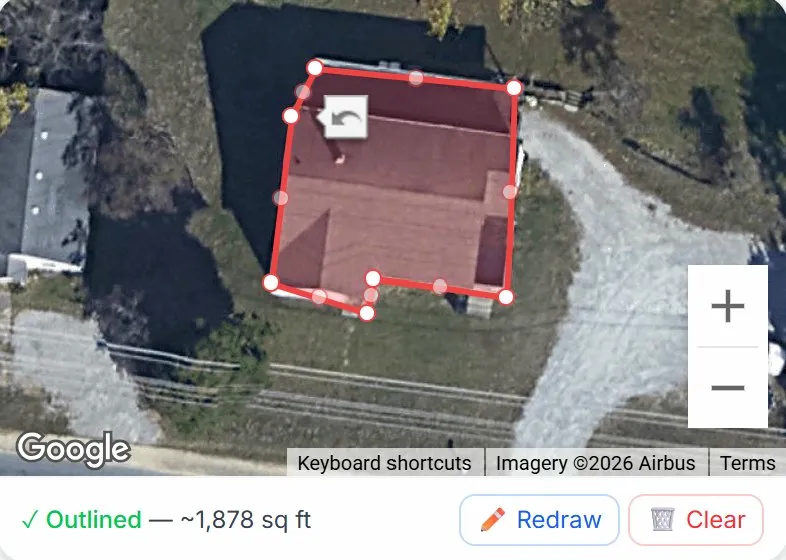
A homeowner lands on your contractor website — let’s say from an Angi click, a Facebook ad, or organic search. Instead of scrolling past a “Get a Free Quote” form, the RoofD AI chatbot opens in the corner with your branding and a question:
Bot: “Hi, I’m Mike’s AI assistant. Looking for a roof replacement quote? I can give you an instant range right now — what’s the property address?”
The homeowner types the address. The bot pulls Google Maps satellite imagery, drops a draggable polygon over the roof, and shows the auto-detected footprint with a square-footage readout (the live UI shows things like “Outlined — ~1,878 sq ft”). The homeowner can adjust the polygon if the auto-detection missed an attached garage or a pop-out, then confirm.
Bot: “Got it — about 1,900 square feet of roof. Are you thinking architectural shingles, premium impact-resistant, or you’re not sure yet?”
The homeowner picks. Behind the scenes, the bot is applying your contractor-configured slope multiplier (1.15x for low slope, 1.30x for steep, etc.), your per-square pricing for the selected shingle brand, and your waste factor — all numbers you set during onboarding. The homeowner sees a price range a few seconds later: “Based on the address and your shingle preference, you’re looking at roughly $14,000-$17,500 installed.”
Then the lead capture happens — and this is where most contractors miss what makes RoofD AI different from a passive widget.
The bot doesn’t wait until the end to ask for contact info. It captures the homeowner’s name, phone, and email conversationally throughout the chat. By the time the price range appears, you already have a partial lead in your dashboard — even if the homeowner closes the tab without finishing.
If the homeowner hesitates after seeing the price, the bot proactively raises financing: “Want to see what monthly payments would look like? We work with Hearth, Synchrony, and a few others — quick soft-pull pre-qual.” The financing pitch fires consistently because it’s wired into the conversational flow, not dependent on a salesperson remembering.
When the chat completes (or the homeowner bails), the lead — name, address, satellite outline, square footage, shingle preference, price range, and full conversation transcript — webhooks into your CRM. We’ll dig into the integration list later in this review.
The Lead Capture Mechanic Most Contractors Underestimate
This is the single most important architectural decision in the platform, and it’s the reason RoofD AI outperforms a basic estimate widget on residential website traffic.
The Conversational Capture Mechanic
Why Partial Leads Are the Whole Point
A static form captures 100% of completed submissions and 0% of bouncers. A conversational AI captures named partial leads from homeowners who never reach the final step — that's the lift.
Static "Get a Quote" Form
The 1990s default
- →Captures lead info only when homeowner hits Submit at the end
- →Zero data on homeowners who started filling it out and bailed
- →Typical residential conversion: 1-2% of website visitors
- →"Hear back within 24 hours" — by then, your competitor already called
RoofD AI Conversational Capture
Name and contact mid-chat
- →Captures name, phone, and email throughout the conversation — not at the end
- →Bouncers who got a price range but didn't finish still appear in your dashboard
- →Captures the roof outline, square footage, and shingle preference on partial leads
- →Lead webhooks to your CRM in real time — call them back in 5 minutes, not 24 hours
Conversational capture is an architectural advantage, not a feature. Static widgets and form-style instant quotes are operating from a worse baseline structurally.
The math contractors care about: at 1,000 monthly visitors and a 1-2% form-conversion rate, a static contact form delivers 10-20 leads. Layer a conversational AI chatbot on top and the partial-lead capture turns the 95-98% of bouncers — homeowners who got their estimate range but never hit Submit — into named leads with phone numbers. Even capturing 3-4% of those bouncers brings you another 30-40 leads per month from traffic that previously went dark.
That’s the lift industry research keeps citing when it talks about AI lead capture in roofing. The mechanic isn’t magic — it’s just that asking for contact info conversationally beats demanding it on a form, and capturing data mid-chat beats waiting until the end. RoofD AI’s specific implementation is unusually clean for an entry-priced product.
How the AI Estimates a Roof It’s Never Seen
The estimate math is real. It’s not a trick number. But understanding the precision ceiling matters before you treat the output as anything more than a homeowner-facing budget tool.
Three components feed every RoofD AI estimate:
-
Satellite outline detection. The bot pulls Google Maps and Airbus imagery for the entered address, runs an AI roof-detection model to draw the polygon, and reports square footage. The footprint is single-pitch precision — it gives you the roof outline as if it were a flat 2D shape, not a per-pitch detection with hip/valley/ridge awareness. The homeowner can adjust corners if the auto-detection missed an attached garage.
-
Slope multiplier and waste factor (your contractor settings). During onboarding, you set the slope multiplier (e.g., 1.15x for low slope, 1.30x for moderate, 1.50x for steep) and the waste factor (typically 10-15% on residential replacement). The AI applies these to the satellite footprint to derive an estimated installed-roof square count. Note that the slope multiplier is your assumption, not a per-pitch detection — if the actual roof has mixed pitches, you’ll get a single multiplier averaged across the whole footprint.
-
Your per-square pricing and shingle catalog. You configure your installed price per square for each shingle brand (GAF, Owens Corning, CertainTeed) during setup. The bot multiplies the estimated squares by the homeowner’s selected brand pricing, applies waste factor, and produces a price range with reasonable upper and lower bounds.
Output: a homeowner-facing price range like “$14,000-$17,500 installed for architectural shingles.” Not a precise number. Not bid-ready. But — and this is the important part — anchored to your actual cost structure, not a generic industry-average template.
This is the right design choice for a lead-qualification tool. A homeowner who sees a generic $8,000-$30,000 range learns nothing useful about your shop. A homeowner who sees $14,000-$17,500 anchored to your pricing learns whether the project is in their budget — and qualifies themselves before they take up an in-home estimator’s time.
What the estimate is NOT:
- Not a replacement for EagleView, Hover, or Roofr’s measurement reports. Those products deliver per-pitch detection with documented accuracy benchmarks (EagleView publishes 98.77% accuracy against ground-truth measurements) and are what you bid against. RoofD AI’s outline is for setting expectation, not bidding.
- Not a per-pitch waste calculator. A complex roof with multiple pitches, valleys, and dormers will have higher actual waste than a simple gable. Your contractor-configured waste factor smooths this, but the AI doesn’t detect complexity.
- Not an insurance-claim scope. No Xactimate line items, no ESX file, no adjuster-friendly format. Insurance restoration roofers should stay with Xactimate or pair with Roofr’s Verisk-certified ESX export.
The accuracy ceiling is “good enough to qualify intent and set budget expectation.” That’s exactly what a lead-capture tool needs. It’s not what a precision estimator needs.
In-Chat Financing: The Closing Tool Most Roofers Leave on the Table
This is the feature most contractors skim past in product comparisons, and it’s a real difference-maker in the conversion math for a residential lead-capture tool.
When a homeowner sees a $14,000-$17,500 price range and hesitates, the typical website experience is: they close the tab and start comparing. RoofD AI’s conversational AI catches the hesitation moment and proactively raises financing — using your configured financing partners, with your preferred messaging, every single time the trigger fires.
Supported financing partners in the conversational flow:
- GreenSky — major contractor financing platform, fast in-chat soft-pull
- Service Finance — long-tenured roofing-friendly lender
- Hearth — purpose-built contractor financing with pre-qual flow
- Synchrony — major retail financing with broad approval breadth
- Custom partners — your own configured lenders with custom messaging
The mechanic matters because financing is the close that turns budget-anchored homeowners into committed leads. Standalone financing tools like Hearth and Wisetack ship excellent contractor-facing portals — but they only fire when the salesperson remembers to mention financing. RoofD AI’s chatbot fires it consistently every time, in the exact words you wrote, without depending on human discipline.
This is the sales mechanic that closes hesitant buyers in the residential roofing replacement segment, and it’s wired into the chat flow rather than bolted on as a contractor dashboard feature. The homeowner sees the financing pitch as part of the conversation, not as a separate “click here for financing” button — which is the difference between a 1% click-through and a 15-25% conversion lift on hesitant buyers.
What RoofD AI Costs in 2026 (And Why the Free Tier Is the Real Test)
Pricing is the single biggest competitive moat RoofD AI has against the broader AI estimating category. Three tiers, no credit card on the bottom, no annual lock on the middle.
2026 Published Pricing
Free Forever, Then $99 or $199/Month
No setup fees on Free or Starter. 7-day free trial on paid tiers. Pro adds done-for-you setup, dedicated account manager, and monthly performance review.
Free · No card needed
$0
/mo forever
3 leads/mo cap
- ✓ AI chatbot + satellite detection
- ✓ Instant estimate calculator
- ✓ Custom branding + embed script
- ✓ Email notifications
- ✗ CRM integration
- ✗ Lead export
Starter · 7-day trial
$99
/month
Unlimited leads
- ✓ Everything in Free
- ✓ Unlimited viewable leads
- ✓ Full conversation history
- ✓ CSV/Excel/PDF export
- ✓ CRM webhook (Make/Zapier)
- ✓ 2 team members · email support
Pro · 7-day trial
$199
/month
Done-for-you setup
- ✓ Everything in Starter
- ✓ CRM setup by RoofD AI team
- ✓ Dedicated account manager
- ✓ Done-for-you bot configuration
- ✓ 3 team members · priority support
- ✓ Monthly performance review
No annual discounts published. No per-lead overage charges on Starter or Pro. The Pro upcharge buys human setup labor, not a feature unlock — most contractors land on Starter and self-serve the bot configuration.
The economic argument writes itself: at typical residential roofing replacement margins ($2,000-$4,000 gross profit per job), one extra closed job per month from previously-missed website traffic covers the entire Starter subscription several times over. The free tier removes the buying risk entirely — install it, run your existing website traffic through it for 30 days, count the captured leads versus the ones you would have missed under a static form.
This is structurally different from how the rest of the AI estimating category prices: Beam AI requires a five-figure annual contract with no free trial, XBuild requires a credit card for the trial and is sales-led on tier pricing, Roofle’s base RoofQuote PRO is $5,500/year or $350/month plus $2,000 setup with sales-led demo only. RoofD AI is the only product in the category with a free-forever tier and an unlimited-leads tier under $100/month. That pricing position is the platform’s strongest competitive moat.
Where RoofD AI Plugs Into Your Stack: 8 Native CRM Integrations
This is where the platform genuinely differentiates from cheaper chatbot competitors. Eight native CRM connections plus webhook routing through Make and Zapier covers the contractor mainstream — and the integration ships on the $99 Starter tier, not gated behind Pro.
Native CRM & Platform Integrations
Where RoofD AI Sends Captured Leads
Real-time webhook routing on Starter and Pro. Lead metadata — name, address, satellite outline, square footage, shingle preference, price range, and full conversation transcript — flows automatically.
Sales CRM
HubSpot
Contact + deal stage
Enterprise CRM
Salesforce
Lead object + custom fields
Universal Glue
Zapier + Make
Everything else
NOT native as of April 2026: Jobber, Housecall Pro, Roofr CRM, QuickBooks, CompanyCam. Use Zapier or Make for these.
The two integrations that matter most for the residential roofing contractor segment we cover are JobNimbus (the dominant roofing CRM) and GoHighLevel (the marketing-and-sales-automation CRM that’s eating the residential contractor space). Both are native, both ship on Starter, both deliver leads with full metadata into the right pipeline stage automatically.
If you’re still picking between JobNimbus and GoHighLevel as your primary CRM and trying to figure out which one to point RoofD AI at, our JobNimbus vs GoHighLevel comparison covers the practical differences for residential roofers in detail. The short version: JobNimbus is purpose-built for roofing operations and the integration depth is naturally roofing-aware; GoHighLevel is a marketing automation platform with stronger campaign and follow-up automations on top of the CRM. RoofD AI integrates well with both — your CRM choice should be driven by your operational model, not the chatbot integration.
If you’re running Jobber as your primary CRM and weighing it against GHL, the Jobber vs GoHighLevel comparison covers that decision. Jobber is not a native RoofD AI integration target as of April 2026 — you’d route through Zapier — which is workable but adds a small middle layer. The cost is minimal but worth knowing about during evaluation.
For phone-side coverage, RoofD AI is web-only — it doesn’t answer calls. If your operation is closer to phone-driven than web-driven, layer Smith.ai on top: Smith.ai handles the phone leads with a live-receptionist hybrid, RoofD AI handles the web leads with the conversational chatbot, and the two route into the same CRM pipeline. That’s the cleanest two-tool stack for residential roofers serious about 24/7 lead capture without sinking a five-figure annual budget into either.
The integration depth is the second-strongest point in RoofD AI’s competitive position after pricing. Most entry-priced AI chatbots ship with one or two native integrations and expect you to Zapier the rest. RoofD AI’s eight-platform native list covers most of the residential contractor mainstream out of the box.
How RoofD AI Scores on Each AI Estimating Dimension
This is the section that explains the 3.8/5 rating in detail — because the score is honest but the dimensional fit needs context to read correctly. RoofD AI is being scored against the AI Estimating category dimensions, and some dimensions reward what RoofD AI is built to do (speed, onboarding, pricing) while others penalize the deliberate design choices that make it a lead-capture tool rather than a precision estimator.
Per-Dimension Scoring · 3.8/5 Overall
Why the Score Lands Where It Does
RoofD AI is honestly scored against AI Estimating dimensions. The dimensional fit is imperfect — the product is fundamentally an AI sales chatbot — but the score reflects the truth of what it does relative to what the category measures.
AI Estimate Accuracy
3.0/5
Weight: 22% · Highest in category
Single-pitch satellite outline plus contractor-set slope multiplier produces a homeowner-facing price RANGE — fit for lead qualification, not bid-grade. Dimension penalizes by design; the product wasn't built for bid accuracy.
Speed to Estimate
5.0/5
Weight: 15%
Under 60 seconds from address entry to priced range. Faster than every other product in the AI estimating category. This is RoofD AI's structural strength.
Takeoff Integration
3.0/5
Weight: 15%
Handles its own simplified satellite "takeoff" — but doesn't integrate with EagleView, Hover, or Roofr for precision measurement handoff. Fine for lead capture; structural gap if you want bid-grade output downstream.
CRM/FSM/Accounting Integration
4.5/5
Weight: 15%
Eight native CRM connections (AccuLynx, JobNimbus, ServiceTitan, GHL, HubSpot, Salesforce, Buildertrend, Zapier) on the $99 Starter tier. Genuinely strong for an entry-priced tool — Beam AI has zero, XBuild has very few.
Trade Coverage
2.5/5
Weight: 13%
Roofing replacement only — by design. No siding, gutters, decks, fencing, commercial. Dimension rewards multi-trade breadth; RoofD AI is intentionally narrow.
Pricing & Value
4.5/5
Weight: 12%
Free-forever tier (3 leads/mo) and $99/mo unlimited. Lowest entry pricing in the AI estimating category by a wide margin — Beam AI starts at $8K/year.
Onboarding & Time-to-First-Estimate
5.0/5
Weight: 8%
Single embed script, ~5 minute setup, AI Website Scanner auto-fills your business profile from your existing pages. Free tier means zero risk to test. Lowest onboarding friction in the entire AI estimating category.
Weighted overall: 3.8/5. Strengths in speed, onboarding, pricing, and integrations. Honest weaknesses in accuracy and trade coverage are by design — RoofD AI is a lead-capture tool with estimating as a hook, not a bid-grade estimator.
The 3.8/5 score is what happens when a product is genuinely excellent at its actual job (24/7 AI lead capture for residential roofing websites) but is being measured against dimensions that include precision estimating. The score is honest. The dimensional fit is imperfect. The right reading is: strong product in its lane, lane is narrow on these dimensions.
When the AI Agents category gets fully built out on Contractor ToolStack with category-specific dimensions (lead-qualification quality, conversational AI capability, partial-lead capture, financing integration), RoofD AI’s score against those dimensions is likely meaningfully higher because they actually reflect what the product is built to do.
RoofD AI vs Roofle: Two Lead-Magnet Models, One Choice
These are the two products residential roofers actually compare when they’re choosing an AI website lead-capture tool. The framing matters because they solve overlapping problems with very different architectures.
Roofle is the established residential lead-magnet widget — form-style instant quote with deep aerial measurement integration (EagleView, GAF QuickMeasure, GeoSpan ordering native inside the platform), in-platform financing through ContractorLoan PRO, 10 native CRM integrations, and a five-year track record with named case studies. Pricing is $350/month plus $2,000 setup, OR $5,500/year. SalesRabbit acquired Roofle in January 2026 and the platform is becoming the e-commerce layer of a unified Find/Quote/Build stack. Sales-led demo only — no free tier on the core product.
RoofD AI is the newer conversational AI chatbot — chat-style interaction with conversational lead capture (partial leads included), satellite roof outline detection, contractor-configured pricing math, in-chat financing handoff, and 8 native CRM integrations. Pricing starts at $0/month free (3 leads cap) and scales to $99/month unlimited or $199/month done-for-you. New product, no public Capterra/G2 review base yet, no published roadmap.
The decision frame for a residential roofing contractor:
-
You have 1,000+ monthly website visitors, you want measurement-grade aerial reports as part of the workflow, you have budget for $5,500/year, and you want a deeper feature set tied into a unified Find/Quote/Build platform → Roofle is the more defensible long-term pick. The case study base is real (TrueWorks Roofing in Houston scaled $2.9M to $4.3M ARR primarily on Roofle leads), the integration depth runs further into the workflow (native EagleView ordering means you go from website lead to bid-grade measurement inside one platform), and the SalesRabbit acquisition gives the product a real product-velocity tailwind for 2026-2027.
-
You have 200-1,000 monthly visitors, you want zero buying risk, you’re comfortable using EagleView or Roofr separately for precision measurement, and the conversational chatbot model fits your sales philosophy better than a form widget → RoofD AI is the right call. The free tier removes evaluation risk entirely, the conversational capture mechanic captures partial leads that a form-style tool misses, and the upgrade math closes within the first month at typical residential margins. You sacrifice the unified Find/Quote/Build platform story but gain pricing flexibility.
-
You want both → there’s no rule against running RoofD AI on the homepage as an entry-point chatbot and pointing high-intent traffic to a Roofle-style instant-quote workflow on a dedicated landing page. Some shops do exactly this — chatbot for cold traffic, instant quote for warm traffic. The integration target (your CRM) is the same, so leads consolidate cleanly. Most residential operations don’t need this complexity, but it’s a viable architecture for high-volume shops.
Both products are roofing-only. Both serve residential replacement primarily. Neither will help you on commercial work, insurance restoration scopes, or non-roofing trades.
What the Industry Is Saying About AI Lead Capture in Roofing
RoofD AI itself doesn’t have a meaningful Capterra or G2 review base yet — it’s a 2026 launch and the product is too new for crowdsourced sentiment to have built up. But the broader category — AI lead capture and conversational chatbots for roofing contractors — has well-documented adoption signals worth knowing about before evaluating any specific tool.
“Roofing contractors lose an estimated 60% of website visitors who leave without making contact.” — Industry research summarized in AI roofing software adoption coverage, aggregated across multiple lead-capture platform studies
That 60% bounce rate is the entire economic argument for AI chatbots in roofing. It’s the gap between the homeowners who arrived on your site interested enough to visit and the homeowners who actually got captured as leads — and it’s where RoofD AI, Roofle, and the broader category are competing for share.
“40% of roofing contractors are already using AI, and another 36% are planning to implement it soon.” — Roofing Contractor magazine, April 2026 industry adoption survey
This is the adoption curve — 76% of roofing contractors either using or planning to use AI in 2026. The contractors who roll it out earlier in the curve get the lead-capture lift before the competitors in their market get there. The contractors who wait until it’s table stakes lose the early-mover advantage.
Tier 3 community sentiment — RoofD AI’s own materials cite that “Jeff Woods Construction & Roofing in Tennessee use tools like RoofD AI specifically because homeowners in their market research contractors at all hours.” The named-contractor reference is from RoofD AI’s own marketing, so it’s vendor-attributed Tier 3 rather than independent Tier 1, but it’s directionally consistent with the broader pattern of residential roofers in 2026 needing 24/7 web coverage to stay competitive on inbound leads.
What’s missing as of April 2026 — no published Capterra reviews, no G2 reviews, no Reddit r/roofing thread density, no major trade-publication editorial coverage of RoofD AI specifically. The contractors using it are early adopters by definition. This will fill in over 2026-2027 as the customer base matures, but it’s a real evaluation gap right now and one of the reasons the free tier matters so much — you get to validate the platform on your own traffic instead of relying on third-party testimony that doesn’t yet exist.
Who Should Add RoofD AI to Their Site Today
Residential roofing contractors with 200+ monthly website visitors where the math closes fast: at 1-2% baseline form conversion, you’re capturing 2-4 leads/month from website traffic; layering RoofD AI’s conversational capture on top adds another 5-15 partial leads from bouncers, and one extra closed job at typical residential margins covers the $99/mo Starter subscription several times over.
Roofers who want zero buying risk on their first AI tool — the free-forever tier (3 leads/mo cap, no card) is the most contractor-friendly evaluation path in the entire AI estimating category. Install it on a Tuesday, run your traffic through it for 30 days, and decide on facts instead of marketing claims.
Shops running JobNimbus, GoHighLevel, AccuLynx, ServiceTitan, HubSpot, Salesforce, or Buildertrend as the system of record — native webhook integration ships on Starter, lead metadata flows automatically, no Zapier glue needed. The integration breadth at this price point is unusual and worth taking advantage of.
Contractors who want financing built into the lead-qualification conversation — the in-chat handoff to GreenSky, Service Finance, Hearth, Synchrony, or your custom partners fires consistently every time a homeowner hesitates on price, which is the closing mechanic most roofers leave on the table when they rely on a salesperson to remember to mention financing.
Operations where the website is genuinely a lead source — if you’re driving Angi clicks, Facebook ads, or organic search to the site and the bounce rate is the bottleneck, RoofD AI directly addresses that bottleneck. If your traffic is mostly referrals from past customers (low intent to comparison-shop online), the chatbot has less to work with.
Roofers who want to layer web AI on top of phone AI — pair RoofD AI for the website with Smith.ai for the phones, both routing into the same CRM pipeline, and you’ve got 24/7 coverage on both inbound channels for under $300/month combined. This is the cleanest two-tool stack for residential roofers serious about not missing inbound leads.
Who Should Skip RoofD AI (And What to Use Instead)
Insurance restoration roofers writing primarily Xactimate scopes — RoofD AI’s homeowner-facing range output is retail-replacement framing, not adjuster line-by-line scope language. Stay with Xactimate native or pair with Roofr’s Verisk-certified ESX export for the insurance workflow.
Multi-trade general contractors and residential remodelers — RoofD AI is roofing-only and doesn’t cover siding, decks, windows, fencing, gutters, or any adjacent trades. Look at Roofr for roofing+light remodeling crossover, or wait for XBuild’s eight-trade expansion (currently shipping roofing only, with concrete, painting, HVAC, plumbing, and others on the post-Series A roadmap).
Commercial roofing contractors — the entire estimate logic is built for residential shingle replacement (GAF, Owens Corning, CertainTeed). Commercial TPO/EPDM/metal assemblies don’t fit the model. Look at Beam AI for commercial multi-trade takeoffs ($8K-$25K/year per trade license) or stay with traditional commercial estimating tools.
Roofers who actually need precision estimating, not lead capture — if your goal is to replace Roofr, Roofle, or XBuild with a single-tool precision-estimate workflow, RoofD AI is structurally wrong for that job. Its accuracy ceiling is homeowner-pre-qual, not bid-grade. Use the right tool for precision estimating and let RoofD AI do its actual job (lead capture).
Solo operators without meaningful website traffic — even the free tier needs inbound web visitors to qualify. If you’re running entirely on referrals, door-knocking, or paid lead-gen platforms (Angi exclusive leads, HomeAdvisor, Networx), the chatbot has little to work with. A Smith.ai phone receptionist or your CRM’s existing follow-up automations are a closer fit to your actual lead flow.
Contractors locked into Jobber or Housecall Pro as the CRM system of record — neither is a native RoofD AI integration as of April 2026, so you’d route through Zapier, which is workable but adds a small middle layer. Not a deal-breaker, but worth knowing during evaluation. If you’re still picking your CRM, the Jobber vs GoHighLevel comparison is the right place to start — GHL is a native RoofD AI target, Jobber is not.
Operations needing a dedicated contractor-facing mobile app — RoofD AI ships a web-only contractor dashboard. If your office manager or sales lead reviews captured leads from their phone all day, a tool with a native iOS/Android contractor app (like JobNimbus or Jobber) is a closer fit for the lead-management side, and RoofD AI sits beneath it as the capture layer.
Verdict: A Specialized AI Salesperson That Estimates as a Hook
RoofD AI is the most defensible free-tier entry into AI lead capture for residential roofing contractors in April 2026 — and it’s the only product in the broader AI estimating category with a free-forever tier that lets a contractor test on real website traffic before signing anything. The conversational capture mechanic captures partial leads that static forms miss entirely, the integration breadth on the $99 Starter tier is unusually strong for an entry-priced tool, and the in-chat financing handoff is a closing mechanic most roofers leave unused when they rely on humans to mention it.
The honest framing: this is fundamentally an AI sales chatbot with estimating built in as the conversational hook, not a precision estimator with chat features bolted on. The 3.8/5 score against AI Estimating dimensions is fair — speed, onboarding, pricing, and integrations all score strong, while accuracy and trade coverage score lower because the dimensions are measuring something the product wasn’t built to do. When the AI Agents category on Contractor ToolStack gets the dedicated dimensional rebuild it deserves later in 2026, RoofD AI’s score against those dimensions is likely meaningfully higher.
For residential roofing contractors with any meaningful website traffic, the install math is hard to argue with: free tier removes the buying risk, the conversational mechanic genuinely outperforms static forms on partial-lead capture, the integration set covers the contractor mainstream, and the financing handoff closes hesitant buyers who would otherwise bounce. The right move for most residential roofers reading this in 2026 is install the free tier today, point your existing website traffic at it for 30 days, and let the data tell you whether to upgrade to Starter — not the marketing copy.
For commercial roofers, multi-trade GCs, insurance restoration shops, contractors needing precision estimating, or operations where the website isn’t a real lead source, this isn’t the right tool — but for the specific use case it’s built for, RoofD AI is the strongest free-tier option in the AI lead-capture space, and the ceiling on the platform’s specific lane is genuinely high.
The category is moving fast in 2026. Free tiers like RoofD AI’s exist precisely because vendors expect mass contractor adoption of AI lead capture inside the next 18 months and they’re competing for early installs. The contractors who roll it out before their direct competitors do are the ones capturing the asymmetric advantage — once the entire residential roofing market is running AI chatbots, the lift normalizes and the differentiator disappears. Right now, in April 2026, the asymmetric advantage is still on the table.
Reviewed by Steven Risher — Louisiana tradesman and software reviewer. This review is research-based; updated when product changes or new customer data warrants. See how we review for our methodology.