


If you’ve been comparing scheduling tools long enough to have an opinion about Calendly, the relevant question about Acuity isn’t whether it’s a good product — it’s whether the things Acuity does that Calendly doesn’t are worth giving up the things Calendly does that Acuity doesn’t. The answer for most contractors is “it depends on what you sell.”
Acuity has been owned by Squarespace since April 23, 2019 — Squarespace’s first-ever acquisition, closed when Acuity had 45 employees and roughly 130,000 customers. Five years on, the product is heavier than Calendly, more shaped for service businesses that take paid deposits, and considerably less aggressive on AI. The plan rename in early 2026 retired the old Emerging / Growing / Powerhouse tier names in favor of Starter, Standard, and Premium — same feature gates, cleaner naming. The Capterra rating averages 4.8/5 across 5,744 verified reviews, the single highest validated rating in the scheduling category as of May 2026.
This review covers what specifically makes Acuity different from Calendly for contractor use cases — the intake-form depth that ships on the cheapest paid tier, the membership and package workflows that are uniquely useful for service-plan contractors, the AI gap (Acuity has zero native AI features in 2026 versus Calendly’s three new AI features shipped between December 2025 and April 2026), the integration map for the contractor stack, and the support-quality complaint pattern that’s worse than Calendly’s. Plus an honest read on which contractor segments should pay for Acuity instead of Calendly, and which should stick with their FSM’s built-in scheduling.
What Acuity Is Built For (And It’s Not What Calendly Is Built For)
The fastest way to understand Acuity is by what it does that Calendly explicitly doesn’t.
Acuity vs Calendly · The Three Things That Actually Differentiate
Acuity Wins on Three Workflows. Calendly Wins on Three Other Workflows.
Same product category, different specializations. Both score 4.0/5 in our scheduling methodology. The asymmetric strengths are the editorial point.
Acuity Wins When
- →You sell paid-deposit consults — $50 design consult, $199 inspection deposit, $100 estimate fee. Native intake-form depth on Starter; Calendly gates equivalents to Teams.
- →You run recurring service plans — HVAC tune-up memberships, monthly lawn care, quarterly pest, biweekly cleaning. Memberships + packages with auto-billing on Standard.
- →Your books are on QuickBooks or FreshBooks — both ship native; bookings auto-create invoices. Calendly has neither natively.
Calendly Wins When
- →AI matters in the field — AI Notetaker GA December 2025, MCP Server March 2026 for ChatGPT/Claude. Acuity has zero native AI.
- →You want to start free — Calendly Free is permanent, no time limit. Acuity Starter is $16/month annual minimum.
- →Your stack runs HubSpot or Salesforce — both native on Calendly Standard/Teams. Acuity supports neither natively.
For contractors who match neither side cleanly, the pricing-comparison math at typical scale: Acuity Standard 5 seats = $1,620/year vs Calendly Standard 5 seats = $600/year. The 2.7x premium has to be earned by the workflows above.
The asymmetric profile is the whole story. Acuity is the product Squarespace bought to anchor service-business scheduling specifically — the legacy customer base is gym owners, fitness instructors, salons, therapists, and design-build consultancies that take paid bookings with intake forms. That same shape happens to fit a meaningful slice of trade contractor work — design-build GCs, remodelers selling design consults, restoration scoping with paid-deposit inspections, lawn-care companies running monthly memberships, pest contractors running quarterly programs.
What Acuity isn’t built for: the multi-tech dispatch use case (Workiz, ServiceTitan, Jobber handle that), the AI-aware scheduling use case (Calendly handles that), and the FSM-integrated stack use case (no native Jobber, Housecall Pro, or ServiceTitan connection — Zapier glue only).
The Customer-Facing Booking Page
This is what every Acuity customer sees first, and what 5,744 Capterra reviewers consistently single out as the win.
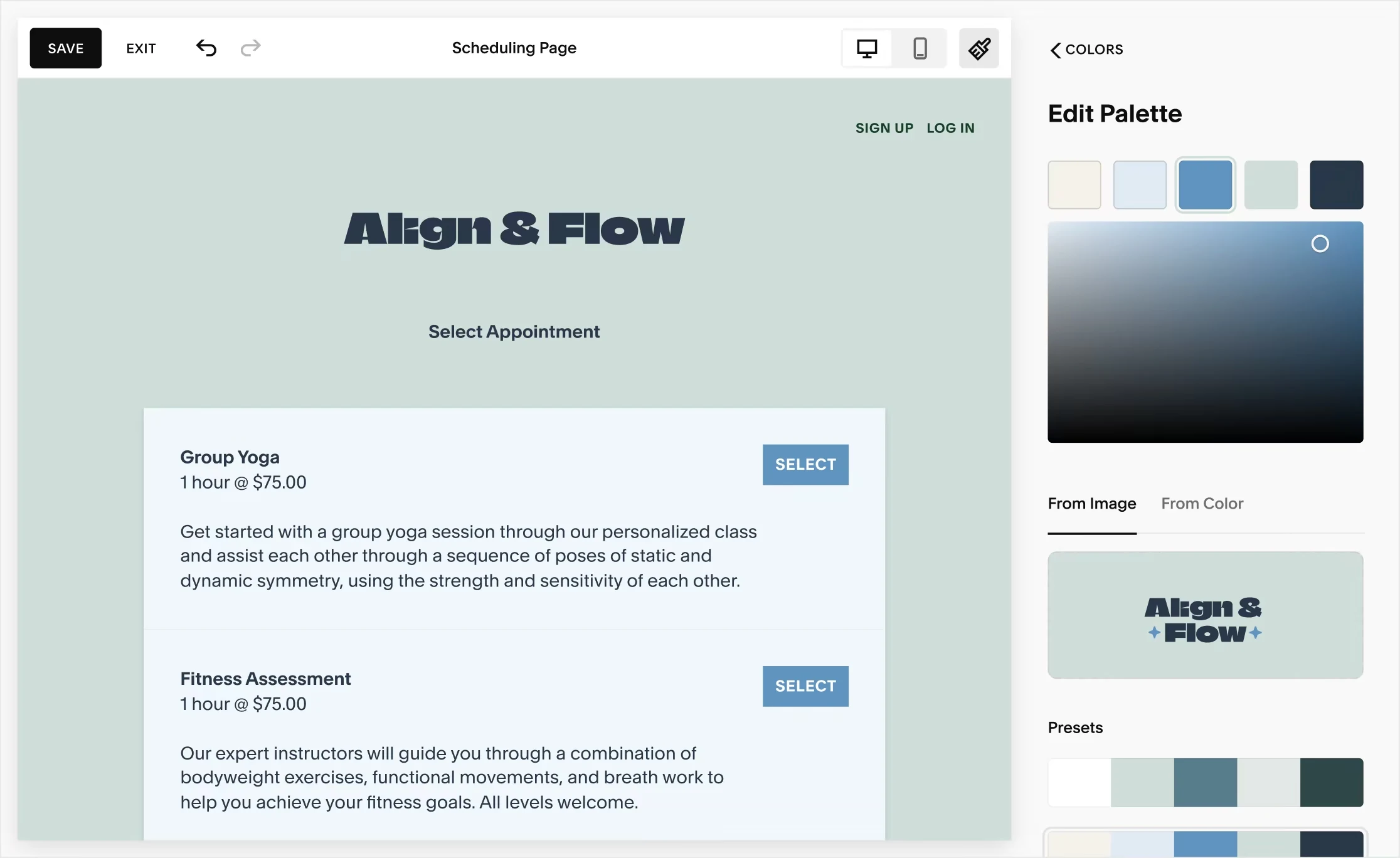
The mechanic is similar to Calendly’s at a high level: define an appointment type, set your hours, embed the booking widget on your site, customer picks a slot, fills the intake form, optionally pays a deposit, and lands on your calendar. The execution differences matter at the margins.
Branded booking pages: Acuity’s page customization runs deeper than Calendly’s at equivalent tiers. Custom colors, custom fonts (since the September 2025 Refresh that brought shared Squarespace design tokens), custom CSS on Premium tier. The “remove Powered by Acuity” branding option ships on Premium ($49/month annual). Calendly’s white-labeling lives on Teams or higher.
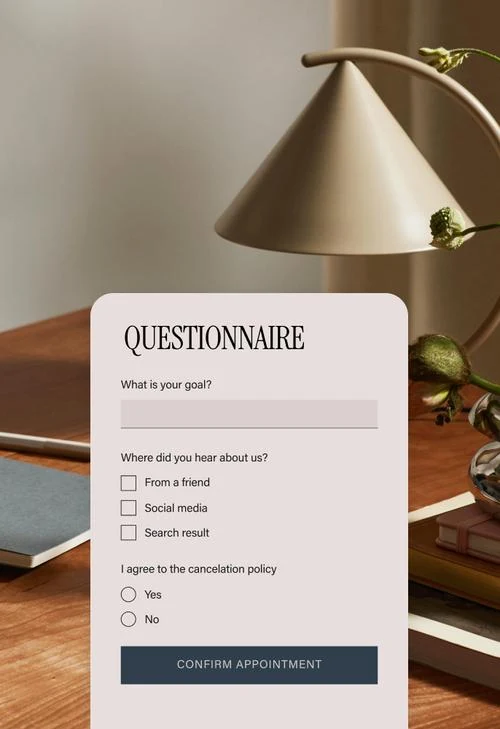
Intake forms with conditional logic: This is where Acuity’s lower-tier ceiling really differs. On Starter ($16/month annual), an HVAC company can set up an intake form like “What system are we servicing? [Furnace / Heat pump / Mini-split / Boiler]” and have the next field branch based on the answer (“If furnace: How old is the unit? If heat pump: Indoor or outdoor compressor issue?”). Calendly’s equivalent functionality lives on the Teams tier at $16/seat/month — same dollar floor for a single user but worse math at multi-seat scale.
Payment on booking: Native Stripe, Square, and PayPal on every paid tier. Tipping support, vaulted-card storage, coupon codes, gift certificates. The Starter tier’s payment-on-booking is what makes Acuity’s $16/month entry point genuinely useful for trades that sell paid consults.
Reminders: Email reminders ship on Starter; SMS reminders are gated to Standard at $27/month annual. SMS is non-negotiable for any trade contractor — text messages reduce no-shows by 40-60% versus email — so the realistic Acuity floor for contractor use is Standard, not Starter. Worth knowing before you sign.
The Three 2026 Tiers (Starter, Standard, Premium)
Acuity renamed its plans early in 2026. The same feature gates moved over to cleaner names — Emerging is now Starter, Growing is now Standard, Powerhouse is now Premium. Verified May 2 2026 against acuityscheduling.com/signup.php.
2026 Pricing · Verified May 2 2026
Three Published Tiers · No Free Plan · 7-Day Trial Only
Annual billing saves 20% versus monthly. Tier names changed in early 2026 — feature gates unchanged.
Starter · Solo Use
$16
/mo · annual
1 calendar · Email reminders only
Intake forms with conditional logic · Stripe/Square/PayPal · Zoom/Meet · QuickBooks · Calendar sync · Mobile app
Standard · Contractor Floor
$27
/mo · annual
6 calendars · SMS reminders global
Memberships + packages · Group classes · Gift certificates · Subscription billing · Recurring revenue workflow
Premium · Branded + Custom
$49
/mo · annual
36 calendars · HIPAA/BAA
Remove "Powered by Acuity" · Custom CSS · Public API access · Multi-timezone per staff · Advanced analytics
Real cost math: solo Standard $324/year · 5-staff Standard $1,620/year · 10-staff Premium $5,880/year. Compared against Calendly Standard 5 seats at $600/year, Acuity is roughly 2.7× the price for the same seat count — but the package/membership and intake-form workflows that drive that gap can't be replicated on Calendly without bolt-on tools.
The pricing structure has two friction points worth understanding before you swipe.
Starter is technically usable but Standard is the realistic contractor floor. The Starter tier ships everything except SMS reminders, packages, memberships, and group classes. SMS reminders aren’t optional in 2026 — text messages reduce no-shows by 40-60% versus email per industry data, and contractors lose customers if booking confirmations don’t get read. Plan to land on Standard at $27/month annual, not Starter at $16/month.
No free tier means no zero-risk testing. Calendly’s Free plan lets you run real customer bookings indefinitely. Acuity’s 7-day free trial is short enough that you’ll be making your buy/skip decision before you’ve handled a full week of real-world appointment patterns. Plan to extend your evaluation timeline by 2-3 weeks if you’re being careful.
The AI Question (And Why Acuity Doesn’t Really Have One)
This is the biggest single editorial argument for Calendly over Acuity in 2026, and it’s worth being explicit about.
Acuity has zero native AI features as of May 2 2026. No AI scheduling assistant, no Notetaker, no Model Context Protocol server, no AI-powered routing, no predictive scheduling. The product page at acuityscheduling.com lists no AI capabilities. The Squarespace product page at squarespace.com/scheduling lists none. The help documentation surfaces no AI features.
Squarespace’s parent-company AI product, Beacon AI, launched September 30, 2025 as part of the Squarespace Refresh 2025 release. Beacon handles SEO scanning across Squarespace sites, AI Product Composer for the e-commerce product, the AIO (AI Overview) Scanner that audits how a Squarespace site reads to AI search engines, and AI-powered email subject-line generation. None of those features extend into Acuity’s scheduling logic. There’s no Beacon-powered availability optimization, no AI-driven appointment routing, no AI-generated intake form questions, no AI-summarized booking analytics.
The contrast with Calendly is stark. Between December 2025 and April 2026, Calendly shipped:
- AI Notetaker (GA December 8-15 2025) — records, transcribes, and summarizes Zoom/Meet/Teams meetings with action items, available on every paid tier
- MCP Server (GA March 12 2026) — Model Context Protocol endpoint at https://mcp.calendly.com/ that lets ChatGPT and Claude check availability, create one-time booking links, and reschedule meetings via natural language
- AI Assistant “Callie” (Private Beta April 24 2026) — conversational search across meeting history
Three features in five months. Acuity has shipped none. There’s no public Acuity AI roadmap as of May 2026.
For contractors who care about AI maturity in their scheduling tool, this is the structural disqualifier for Acuity. For contractors who don’t — who view their scheduling tool as a deterministic booking link that doesn’t need AI — the absence is an editorial neutral. The TechRadar review of Acuity in 2024 characterized it as “frozen” under Squarespace ownership: incremental polish, no expansion into adjacent product categories. The 2026 evidence supports the same read.
The Integration Audit (How Acuity Stacks Up Against Calendly)
This is where the contractor-stack evaluation gets specific. Acuity’s integration breadth is meaningful but materially smaller than Calendly’s, and the contractor-FSM intersection is a friction point on both.
Native vs Zapier · Where Each Wins
Acuity Owns Payments + Books. Calendly Owns CRM + AI.
Both lose at the FSM/CRM-for-trades intersection — Jobber, HCP, ServiceTitan, JobNimbus all bridge through Zapier on either platform.
Acuity Wins (Native)
- ✓Square as a payment processor (Calendly Zapier-only)
- ✓QuickBooks auto-creates invoices on paid bookings
- ✓FreshBooks native invoice automation
- ✓Squarespace deep — embedded Scheduling block, shared design system
- ✓Zoho CRM (the only native CRM Acuity ships)
Calendly Wins (Native)
- ✓HubSpot on Standard+, Salesforce on Teams+
- ✓Microsoft Teams auto-attached on every plan
- ✓Smith.ai deep two-way via Scheduling API (Acuity is link-based)
- ✓Claude + ChatGPT via the MCP Server (Mar 2026)
- ✓Microsoft Dynamics 365 + Marketo + Pardot at higher tiers
Both lose for the contractor-FSM stack — Jobber, Housecall Pro, ServiceTitan, JobNimbus, AccuLynx are Zapier-bridged on either platform. GoHighLevel is one-way native on Calendly, Zapier-only on Acuity. The Acuity Zapier path to Jobber + JobNimbus has a documented one-way bug on rescheduling — pressure-test before relying on it.
The honest read: Acuity wins on payment + accounting depth (native Square, native QuickBooks, native FreshBooks — all Calendly gaps). Calendly wins on CRM + AI breadth (HubSpot, Salesforce, Microsoft Teams, MCP Server, native API Smith.ai — all Acuity gaps). Both lose at the contractor-FSM intersection — Jobber, HCP, ServiceTitan, JobNimbus all require Zapier on either platform.
The one specific Acuity advantage worth highlighting for any contractor running QuickBooks: paid bookings auto-create QuickBooks invoices natively. The Calendly equivalent is a Zapier zap that costs $19.99-$49/month on top of Calendly’s subscription. For solo contractors and small operations on QuickBooks, that’s roughly $240-$600 of annual Zapier cost that Acuity bundles into the base subscription.
The Sub-Score Breakdown
Acuity is scored against the same eight scheduling dimensions as every other product on the Scheduling hub, and the asymmetric profile here is interesting — different shape than Calendly’s despite the same overall 4.0/5 final score.
Where Acuity wins on dimension scoring:
- Self-Booking & Customer-Facing Pages — 4.8/5 — branded booking pages with deeper customization than Calendly at equivalent tiers. Conditional-logic intake forms ship on Starter ($16/mo annual). Calendly is at 5.0/5 here, edging out Acuity on raw simplicity, but Acuity’s depth wins for paid-deposit consults.
- Recurring Service Plans — 3.5/5 — packages, memberships, and subscription billing for HVAC tune-up programs, lawn-care contracts, pest control, cleaning subscriptions. Calendly scores 2.5/5 on this dimension; the gap is specifically the membership/package workflow Acuity ships natively.
- Calendar & Daily Usability — 4.7/5 — heavier than Calendly’s interface but more capable; multi-staff scheduling, group classes, package tracking. Trade-off of complexity for depth.
Where Acuity loses on dimension scoring:
- Multi-Tech Dispatch & Routing — 1.5/5 — same as Calendly. Acuity is a customer-facing scheduler, not a crew dispatch system. Workiz, ServiceTitan, Jobber all score 4.4-4.6/5 here.
- Integrations — 4.0/5 — meaningful but smaller than Calendly’s 4.7/5. No native HubSpot, Salesforce, Microsoft Teams; Smith.ai is link-based not API. The native QuickBooks and FreshBooks edge is real but doesn’t fully offset the broader CRM gap.
- Pricing & Value — 3.8/5 — no free tier. Standard at $27/mo annual is dramatically more expensive than Calendly Standard at $10/seat — and the 7-day free trial limits zero-risk evaluation. The package/membership workflow value justifies the premium for shops that use it; for shops that don’t, Calendly wins on price.
- Mobile Reliability — 4.5/5 — solid native iOS and Android apps; Capterra reviewers rate the mobile experience favorably; not as field-hardened as Housecall Pro (5.0/5) or ServiceM8 (4.8/5).
What 5,744 Capterra Reviewers Actually Say
Acuity’s Capterra base is concentrated in service businesses — gyms, fitness instructors, massage therapists, salons, alternative-medicine practitioners — with a thinner contractor-industry slice than Calendly’s. The patterns translate to contractor consult-booking workflows clearly, even where the explicit trade label doesn’t appear.
Kevin R. — Accountant, Logistics & Supply Chain (2-10 employees) — 5 stars (Capterra)
“I love that clients can book themselves online, it automatically adjusts for time zones, and it sends reminders, which saves me so much time and reduces no-shows.”
Cassidy W. — Massage Therapist & Owner, Health/Wellness/Fitness (1-2 yrs use) — 5 stars (Capterra)
“I love the options to personalize and embed in my website.”
Tyla J. — Fitness Coach, Health/Wellness/Fitness (6-12 mo use) — 4 stars (Capterra)
“It is very user friendly for both the user on the back end and the client/customer.”
Hannah K. — VP, Marketing & Advertising (11-50 employees) — 4 stars (Capterra)
“since Acuity was acquired recently, it makes you re-log into your account like every half hour and it is VERY annoying.”
Joanna Y. — Owner, Alternative Medicine (2+ yrs use) — 2 stars (Capterra)
“Don’t recommend if you plan to grow … YOU ARE ON YOUR OWN. NO PHONE SUPPORT.”
The dominant patterns across the 5,744-review base: 97% positive sentiment overall with the top three strengths cited consistently as self-service client booking with measurable no-show reduction, customizable embedded booking pages with branded scheduling links, and clean calendar sync with auto-time-zone adjustment. The dominant complaints cluster around three issues: email-only support with slow response times (cited across multiple critical reviews), no free tier (with several core features gated to higher plans), and the frequent forced re-login post-Squarespace acquisition.
For contractor relevance specifically: the workflow patterns that drive Acuity’s reviewer love — paid deposits, intake forms, recurring memberships, branded booking pages — map cleanly onto contractor consult-booking. A design-build GC selling $100 design consults, an HVAC company selling annual tune-up memberships, a lawn-care operation selling monthly subscription packages, a restoration scoper charging a $199 inspection deposit — these are all use cases the Acuity reviewer base has validated repeatedly. Direct construction-industry reviewers exist (Rebecca C., Design and Sales Manager, Construction industry, on Capterra) but the base is thinner than the adjacent-vertical evidence.
Where Acuity Wins for Contractor Use
The honest segmentation of where Acuity is the right call versus where Calendly or an FSM is the right call:
Acuity is the right pick when:
- You sell paid-deposit consults — design-build GCs, restoration scoping, custom remodelers, paid inspections. The intake-form-plus-deposit workflow on Starter ($16/mo annual) is what Acuity is structurally best at.
- You run recurring service plans with auto-billing — HVAC tune-up memberships, monthly lawn care, quarterly pest, biweekly cleaning, biannual gutter contracts. Standard tier ($27/mo annual) ships memberships and packages with automated recurring billing. Calendly cannot model this workflow.
- Your books are on QuickBooks or FreshBooks — native invoice automation on every Acuity tier; Calendly requires Zapier (+$19.99-$49/month).
- Your marketing site is on Squarespace — Acuity’s Scheduling block embeds natively, design system shared since the September 2025 Refresh. No other scheduler delivers this depth on a Squarespace site.
- You take medical-adjacent customer data in intake forms — restoration scoping with sensitive home details, accessibility consults that touch HIPAA-relevant scope, dental office build-outs. HIPAA/BAA compliance ships on Premium tier ($49/mo annual).
- You need Square as a payment processor specifically — Acuity ships native Square; Calendly doesn’t.
Where Acuity Is Not the Right Call
The where-not-to-use list is substantial because Acuity’s specialization is genuinely narrow.
Acuity is not the right pick when:
- AI features matter — Acuity has zero. Calendly is the standalone scheduler with the AI investment (Notetaker, MCP Server, Callie).
- You need a free tier to test on real customers — Calendly Free is permanent; Acuity’s only path is the 7-day trial then $16/mo Starter.
- You run multi-tech dispatch with skill-based routing — HVAC/plumbing/electrical at 5+ techs needs Workiz, ServiceTitan, or Jobber Connect+. Acuity is built for individual or class booking, not crew assignment.
- You’re already on GoHighLevel — GHL ships its own Calendly-class scheduler; the Acuity Zapier-bridge adds friction without value.
- You want native HubSpot, Salesforce, Pipedrive, or Microsoft Teams — none ship native on Acuity; all ship native on Calendly at the appropriate tier.
- You depend on Smith.ai for AI receptionist booking — Smith.ai + Calendly is native API; Smith.ai + Acuity is link-based (operationally close but architecturally weaker).
- Your FSM ships its own customer booking widget — Jobber Connect+, Housecall Pro Basic+, GoHighLevel all ship customer-facing booking. Adding Acuity creates two booking widgets and two calendars to maintain.
- You’re running construction PM with multi-week phase scheduling — Buildertrend or Procore handles Gantt-based phase scheduling that Acuity can’t model.
- You’re committing to Apple-native + iCloud-only operations — ServiceM8 is the iOS-native FSM that handles scheduling alongside dispatch, payments, and accounting in one Apple-ecosystem-native product.
What Changed in 2025-2026
Three updates from the last twelve months are worth flagging for contractors evaluating Acuity in May 2026.
The September 30, 2025 Squarespace Refresh (source) brought the shared design system between Squarespace sites and Acuity booking pages — your booking page can now pick up your Squarespace site’s typography, color palette, and styling automatically, without manual configuration. Worth knowing only if you actually run both products; for non-Squarespace contractors, no functional change.
The 2026 plan rename retired Emerging / Growing / Powerhouse in favor of Starter / Standard / Premium. Same feature gates, cleaner names. The Starter at $16/mo annual remains the cheapest entry; Standard at $27/mo annual remains the realistic contractor floor; Premium at $49/mo annual unlocks HIPAA, custom CSS, and the API.
Squarespace Payments launched September 2025 — but explicitly NOT for Acuity customers. Acuity continues to use Stripe, Square, and PayPal. If you’re on Squarespace and expected unified payment processing across your site and your scheduling, you’ll be running multiple payment processor accounts. That’s a decision point during evaluation if it matters to your bookkeeping.
No leadership changes, no acquisitions, no AI announcements in the same window. Founder Gavin Zuchlinski stayed on as VP of Acuity at Squarespace post-acquisition; the product direction has been characterized by TechRadar as deliberately “frozen” — incremental polish rather than expansion.
The Verdict
Here’s the honest read on Acuity. It’s a deliberately narrow product that’s been polished for almost twenty years, and Squarespace hasn’t messed with it much since the 2019 acquisition. The intake forms run deep on the cheapest paid tier, the package-and-membership workflow is the only one in the scheduling category that can actually run a monthly lawn-care subscription or an HVAC tune-up program with auto-billing, and the QuickBooks integration is native — none of which Calendly can match. The 4.8 Capterra rating is earned, not inflated.
The absences are real too. No AI in 2026. No free tier. No native HubSpot or Salesforce. No Microsoft Teams. The Zapier path to Jobber has a documented bug. Customer support is email-only and slow.
Buy Acuity if you sell paid-deposit consults, run recurring service plans, or already keep your books on QuickBooks. Skip it if you want to start free, care about AI in your scheduling tool, or you’re already on GoHighLevel — GHL has its own scheduler and Acuity just adds friction. The product is deliberately narrow, which means it’s either exactly right or pretty wrong for what you’re trying to do. Match the workflow before you sign.