


There’s a quiet workhorse in the FSM category that’s been running production deployments while everyone else races to ship AI dispatchers — Service Fusion. Founded in 2014, acquired by EverCommerce in December 2020, now serving 6,500+ customers and 40,000+ active users with 5+ million jobs created annually and a 95.7% CSAT score. The platform isn’t trying to win the AI race. It’s trying to win the unit economics at scale, with unlimited users on every plan and flat-rate pricing that becomes meaningfully cheaper than Workiz, FieldPulse, or ServiceTitan past 5 techs.
That’s the real Service Fusion story in 2026 — and it’s worth understanding before you compare feature lists, because the platforms aren’t competing on the same axis.
What this review covers: the actual 2026 pricing math (Service Fusion publishes rates, unlike FieldPulse which doesn’t), how ServiceCall.ai compares against the modern AI dispatchers shipping from Workiz and FieldPulse (spoiler: it doesn’t, and that’s important), what the dispatch grid and mobile app actually deliver, the QuickBooks integration that genuinely earns its reputation, the integration ecosystem catches worth knowing about, what 308 Capterra reviewers actually say (including the operational concerns that show up across critical reviews), how Service Fusion stacks against the broader FSM category, what EverCommerce ownership means for feature velocity, and which contractor segments should be looking elsewhere.
The Unlimited-User Pricing Argument (And Why It Wins at Scale)
This is the structural differentiator that defines Service Fusion’s place in the 2026 FSM market — and it’s worth understanding before anything else.
2026 Published Pricing · Verified April 2026
Three Tiers · Unlimited Users · Flat Monthly Rate
Annual billing rates shown. Save 15% versus monthly billing. No annual contract required — month-to-month available on every tier. No free trial.
Starter
$208
/mo annual
Unlimited users · $245/mo monthly billing
Scheduling · dispatching · customer management · basic invoicing · mobile app · GPS tracking
Plus · Most Popular
$325
/mo annual
Unlimited users · $382/mo monthly billing
Adds: estimate creation · advanced reporting · customer notifications · job photo uploads
Pro
$533
/mo annual
Unlimited users · $627/mo monthly billing
Adds: full feature set · priority support · advanced workflows · API access
Real-world math at 10 techs on Plus = $325/mo flat = $3,900/year. Versus FieldPulse Pro at 10 techs (~$900/mo = $10,800/yr). Versus Workiz Pro at 10 techs ($595/mo = $7,140/yr on last published April 2026 rates; sales-quoted since 2026). Versus ServiceTitan Essentials (~$3,250-$4,000/mo + $10K-$25K implementation = $39K-$48K/yr).
The math advantage isn’t subtle. At 10 techs, Service Fusion Plus is roughly 36% cheaper than Workiz Pro (on Workiz’s last published April 2026 rates; it’s sales-quoted since 2026) and 64% cheaper than FieldPulse Professional. At 15 techs, the gap widens further (Service Fusion stays at $325/mo flat while Workiz scaled to $325 + 10×$54 = $865/mo on those rates and FieldPulse scales to ~$1,350/mo). At 25 techs, Service Fusion is still $325/mo flat while every per-user competitor multiplies linearly.
The catch worth being honest about: Service Fusion’s add-on stack carries separate pricing that isn’t published publicly. Job Photo Uploads, Inventory Management, Job Costing, Custom Documents, eSign Documents, Customer Web Portal, Progressive Billing, Recurring Invoicing, ServiceCall.ai, and GPS Fleet Tracking are all listed as add-ons rather than included in the base tier. Practical recommendation: request a written total-cost quote with your specific add-on stack before signing — the published $208/$325/$533 numbers are starting points, not all-in pricing.
The other catch: there’s no free trial as of April 2026. Sales-led demo only. The month-to-month flexibility on every plan partially mitigates the no-trial friction (cancel anytime if it’s not working), but committing without testing is unusual versus Workiz (7-day no-credit-card), Jobber (14-day), and Housecall Pro (14-day).
What Service Fusion Actually Does
The simplest framing: Service Fusion is a 12-year-old field service management platform that handles scheduling, dispatching, customer management, estimates, invoicing, payments, mobile field operations, and basic reporting in one workflow — with ServiceCall.ai for VoIP and call tracking, Service Fusion Payments via Stripe for in-field card processing, and deep QuickBooks integration as the structural advantage.
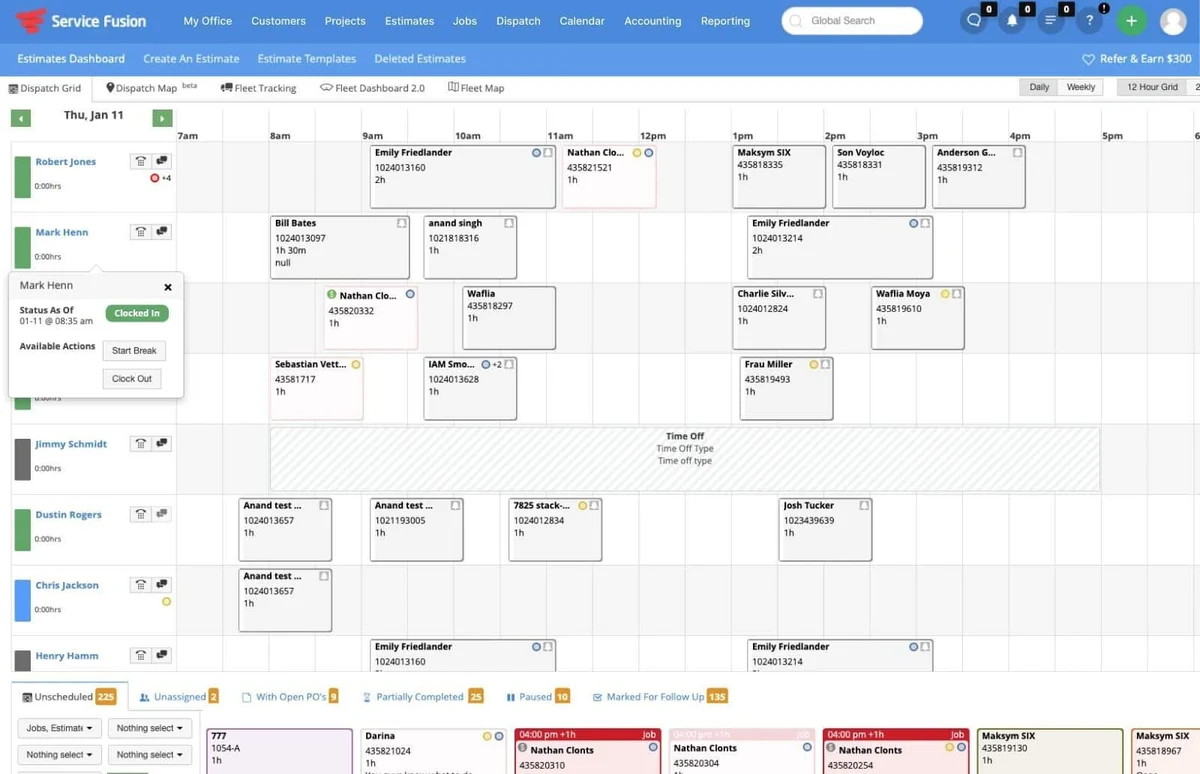
The trade coverage is broad — 25+ industries explicitly listed: HVAC and refrigeration, plumbing, electrical, appliance repair, locksmith, garage door, roofing, painting, cleaning services, solar, landscaping, irrigation, security, equipment repair, restoration, pest control, and more. The platform isn’t built to lean into any specific trade the way JobNimbus is roofing-first or ServiceTitan is HVAC/plumbing/electrical-centric — Service Fusion is a multi-trade workhorse with QuickBooks at the center of its operational architecture.
The customer roster on the homepage and reviews page tells the story: Mac HVAC, Atlanta Air Authority, Elk River Heating & A/C, Freedom Heating & Air Conditioning, Carl’s Quality Cooling and Heating, Air & Aero Heating and Cooling, Gwyn Electrical/Plumbing/Heating/Cooling, Reliant Electrical Service, HD Roofs, Smart Watering Systems. That’s a genuinely diverse trade roster with named contractors operating real businesses.
What it’s not: Service Fusion isn’t trying to be the AI-native FSM of 2026. It’s not racing Workiz on Genius Answering maturity or FieldPulse on multi-language Operator AI. It’s not trying to win the GoHighLevel marketing-stack integration race. It’s a stable, established platform optimized for shops that value flat-rate pricing, deep QuickBooks integration, and a dispatch grid that just works — and that’s a defensible niche even in 2026.
ServiceCall.ai: The 2022 VoIP Layer (And What It’s Not)
The AI question matters because it’s the dimension where the FSM category is moving fastest in 2026 — so let’s be specific about what Service Fusion delivers and what it doesn’t.

ServiceCall.ai is Service Fusion’s built-in VoIP plus call-tracking product, launched in 2022. The feature set is solid for what it is: instant local or toll-free number acquisition, call recording with playback, voicemail transcription delivered to inbox, marketing source attribution that ties calls to specific ad campaigns and job records, Ring-a-Tech routing (customers reach techs without exposing personal cell numbers), call queues to prevent voicemail rolls during peak hours, custom business-hours routing, and the ServiceChat.ai widget for converting website visitors via text-me-back conversations.
What it isn’t: an autonomous AI receptionist. There’s no Jessica picking up after-hours calls and booking jobs into the dispatch board without human involvement. There’s no smart routing of urgent keywords like “burst pipes” or “no heat” to emergency-priority techs. There’s no native multi-language voice support. The AI in “ServiceCall.ai” is primarily transcription and call analytics — the actual answering still requires your office staff or a human-staffed answering service.
Why this matters in 2026: Workiz Genius Answering launched December 2024 and has 14 months of production maturity. FieldPulse Operator AI won the 2025 NECA Innovator Award and supports 30+ languages. Both platforms ship genuine autonomous AI receptionists that book jobs into the calendar at scale. Service Fusion ships a 2022-era VoIP product. The gap is real, and worth pressure-testing if AI dispatcher capability factors into your evaluation.
The defensible Service Fusion AI workflow: layer a human-staffed answering service on top of Service Fusion (Nexa is their published partner; Smith.ai or Ruby Receptionists work as alternatives) to handle inbound call answering, then use ServiceCall.ai for call recording, transcription, marketing attribution, and Ring-a-Tech routing of qualified calls to techs. That’s a workable architecture — it’s just not the same architecture as a native AI dispatcher and won’t deliver the same after-hours coverage economics.
The Dispatch Grid: Why Service Fusion’s Reviewer-Favorite Feature Earns Its Reputation
The dispatch grid is what most Service Fusion reviewers actually credit as the won-me-over feature when describing the platform. AI gets the headlines in the FSM category right now; the dispatch grid does the daily work.
Drag-and-drop everywhere. Reassign a 9 AM HVAC call from Tech A to Tech B by dragging the appointment block. Drag the corner to extend duration. Filter the grid by tech, by trade type, by route, by date range. The visual layout color-codes by job type — green for installs, yellow for service calls, red for emergencies — and the filtering persistence in the URL means dispatchers can bookmark “morning HVAC” and “afternoon plumbing” as separate views.
GPS fleet tracking is built in with driver behavior monitoring (speeding, hard braking, idling) — useful operationally for safety compliance and fuel efficiency at fleet scale. Real-time tech locations surface on the dispatch board, and the system suggests “nearest available tech” assignments for emergency calls.
Capacity-aware scheduling prevents double-booking. The grid won’t let you schedule two jobs for the same tech at the same time, and warns you when you try to book a 9 AM downtown appointment for a tech currently on an 8 AM job 45 minutes away. That’s the kind of operational discipline a busy dispatcher relies on but doesn’t think about until it breaks.
Customer notifications fire automatically from grid events. Appointment confirmation texts, on-the-way ETAs, post-job review requests — all configurable per workflow. The text templates are customizable per trade.
The dispatch grid doesn’t reach ServiceTitan Dispatch Pro depth — ServiceTitan still owns the multi-day route optimization story for 30+ tech enterprise operations — but for the 5-25 tech SMB scale Service Fusion targets, the dispatch experience is genuinely competitive with Workiz and FieldPulse and frequently the specific feature reviewers cite as the reason they stayed on platform.
The Mobile App: Where the Capterra Cons Cluster
Field service software lives or dies on the tech’s phone, and Service Fusion’s mobile app is where the Capterra critical reviews concentrate.
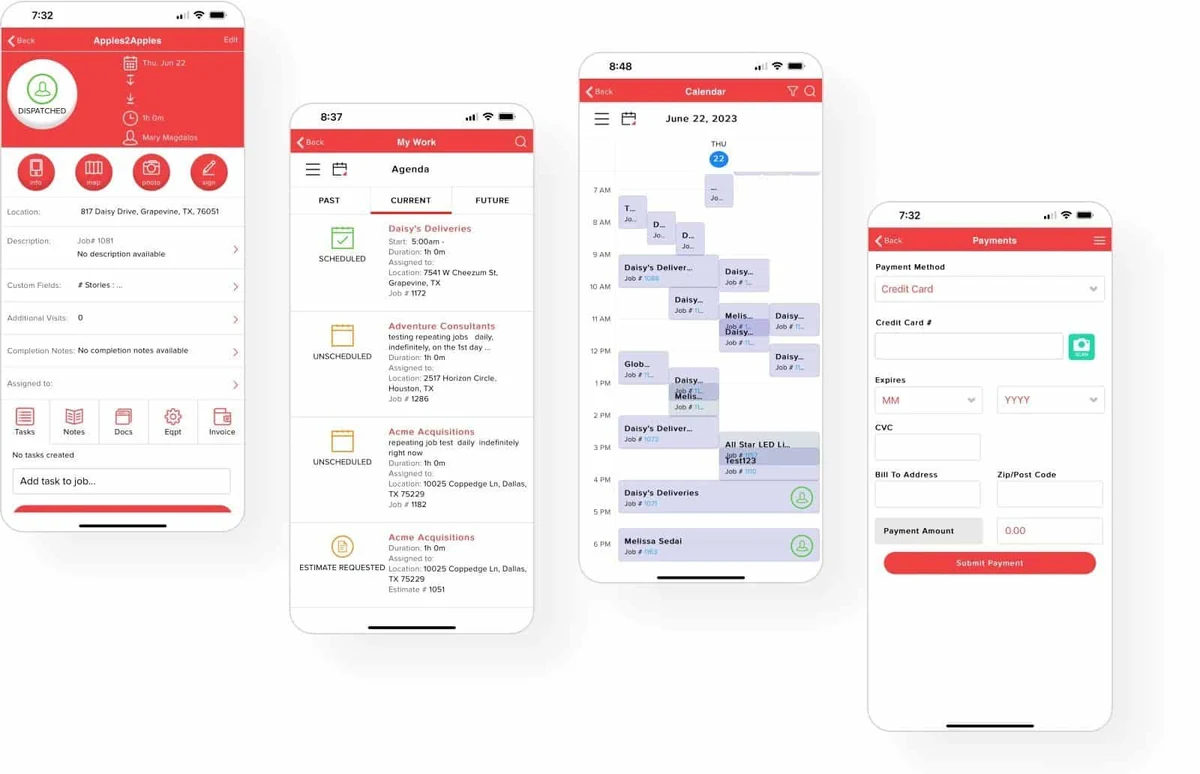
iOS and Android are both in active development with feature parity. Techs get job details on the phone, customer history and notes, contactless eSignature capture, mobile invoice generation, in-field payment collection via Service Fusion Payments and the Stripe M2 reader, photo attachment to job records, and push notifications for new assignments and dispatch changes.
The functional pieces work. Jacob McConnaughy at Mac HVAC: “The mobile app for our techs saves the office staff tons of hassle.” Jeff Vance at Gwyn Electrical: “Ability to view operations remotely; notes, photos valuable.” Spencer Oborn at Reliant Electrical: “Job status tracking helps teams work faster.”
Where the mobile app earns critical reviews is the consistency layer. The Capterra cons cluster around three patterns: “limited offline mobile functionality” (the app reportedly degrades meaningfully when cell service drops, where Workiz’s offline mode handles weak signal more gracefully); “system glitches and downtime” (intermittent rather than systemic, but worth knowing about); and “calendar visibility and interface scaling issues” (the dispatch view that works well on desktop sometimes feels cramped on phones).
The 4.3/5 ease-of-use score and 96%-positive sentiment on field tech tools (per Capterra’s tag analysis) reflect the app working well in normal conditions for most operators. The critical 8% sentiment is concentrated specifically around offline reliability and high-load sync — pressure-test those during the demo if you operate in spotty-cell-service markets or run high job volume per tech.
Invoicing, Payments, and the QuickBooks Integration That Genuinely Sells the Platform
The QuickBooks integration is the most-praised single feature across the entire 308-review Capterra base — and it’s worth being specific about why it matters.
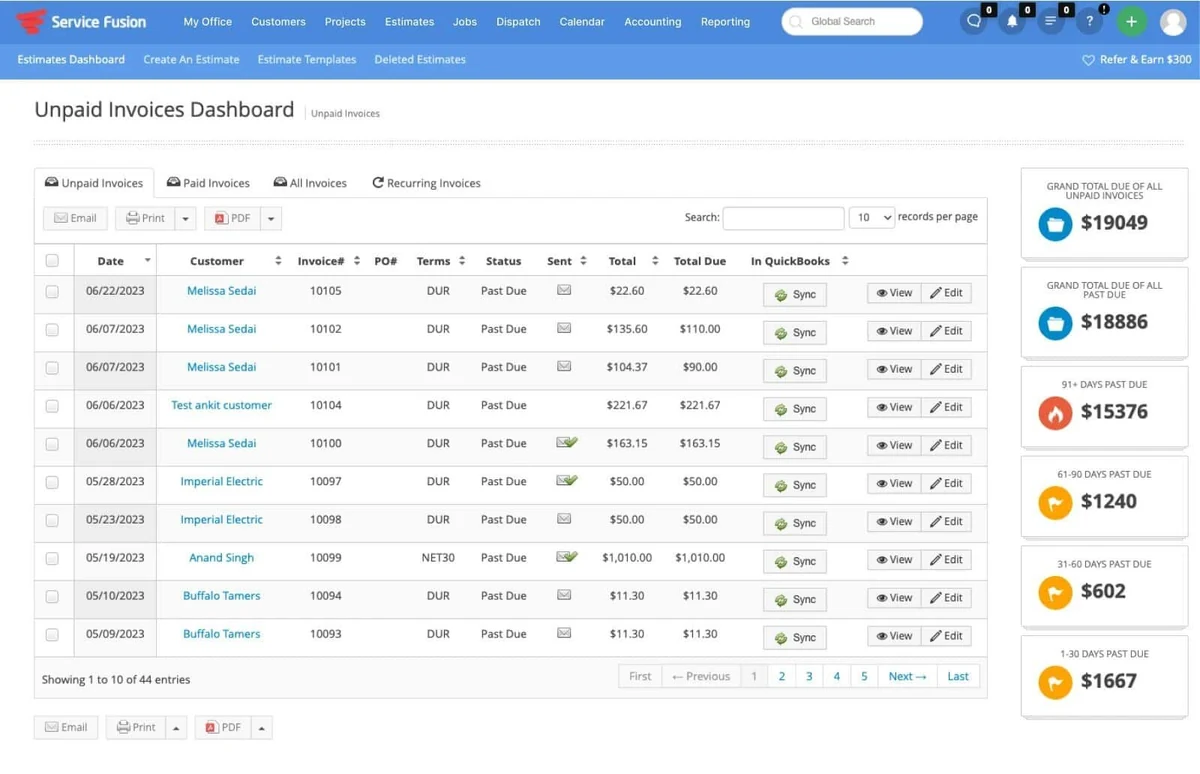
Service Fusion is an official QuickBooks Solution Provider with bi-directional native sync covering QuickBooks Online, QuickBooks Desktop, QuickBooks Online Advanced, and QuickBooks Enterprise. The sync handles customers, products, services, job deposits, invoices, and payments — meaning data flows automatically in both directions instead of requiring manual exports or third-party reconciliation tools.
What this looks like in daily workflow: a tech generates an invoice on the mobile app at the customer’s house, the customer signs and pays via Stripe M2 reader, the payment hits the merchant account same-day, the invoice and payment both flow into QuickBooks within minutes. The accounting team doesn’t re-key anything. The whole loop closes without manual intervention.
Why this matters operationally: contractor accounting on QuickBooks (the dominant pattern in service trades) typically loses 5-10 hours per week to manual reconciliation between FSM platforms and accounting software. Service Fusion’s deep native sync genuinely eliminates that overhead. Sheri Merkling at Elk River Heating & A/C: “We like the perfect syncs with QuickBooks, a real plus.” Jereme Townsend at Atlanta Air Authority specifically cites “QuickBooks integration is pretty good” alongside reasonable pricing as the reasons for staying on platform.
Service Fusion Payments runs on Stripe at standard rates (2.9% + $0.30 per transaction for cards, predictable for ACH) with no Service-Fusion-specific markup. The Stripe M2 reader supports Apple Pay, Google Pay, swipe, tap, and chip transactions. This is meaningfully better than Workiz Pay (rates not publicly published) on transparency, and gives Service Fusion an honest payment processing story.
The financing piece routes through Acorn Homeowner Financing per the help center — a 30+ lender marketplace for $1K-$100K homeowner loans. It’s not Wisetack native (which is a meaningful gap for shops competing on financing-on-the-estimate close rates) but it’s a workable alternative.
The catches worth knowing: invoice templates are functional but less customizable than FieldPulse or Housecall Pro. Recurring billing and progressive billing are listed as add-ons rather than included in base tiers. eSign Documents is also an add-on. Budget the add-on stack honestly.
Integrations: The Sparse Native Ecosystem Is the Editorial Catch
This is the area where Service Fusion most clearly trails the modern FSM competitive set — and worth being completely clear about.
Service Fusion Integration Map · April 2026
QuickBooks-Deep · Stack-Narrow Outside Accounting
Native QuickBooks coverage is best-in-FSM (4 versions). Native ecosystem outside accounting is sparse. Most non-accounting connections are partner add-ons or Zapier-mediated.
Native · Accounting (Best in FSM)
- → QuickBooks Online · bi-directional
- → QuickBooks Desktop · bi-directional
- → QuickBooks Online Advanced
- → QuickBooks Enterprise
Native · Payments & Comms
- → Stripe (Service Fusion Payments)
- → Stripe M2 Reader (in-field)
- → ServiceCall.ai (own VoIP)
- → Acorn Homeowner Financing
Native · Calendars
- → Microsoft Outlook
- → Google Calendar
- → Zapier (5,000+ apps)
Partner Add-Ons (Separate)
- → Profit Rhino · flat-rate pricing
- → Nexa · virtual receptionist
- → Gusto · payroll
- → pulseM · Customer Lobby (CSR)
Partner Add-Ons (Continued)
- → Service Nation · marketing
- → PostcardMania · direct mail
- → Dispatch · HVAC manufacturer leads
- → LiveSwitch · jobsite video
NOT Native (Material Gaps)
- ✗ Xero · CompanyCam
- ✗ Wisetack · GoHighLevel
- ✗ JobNimbus · ServiceTitan · Salesforce
For comparison: FieldPulse ships 25+ native integrations including HighLevel, Xero, MYOB, CompanyCam, Wisetack. Workiz ships 17 including CompanyCam, Wisetack, Reserve with Google. Service Fusion's native ecosystem outside QuickBooks is the FSM-category gap to know about.
The QuickBooks coverage is genuinely best-in-class — four QuickBooks versions natively integrated covers essentially every contractor accounting scenario on Intuit. That’s deeper than Workiz (QuickBooks Online only) and matches FieldPulse (QB Online + Desktop). For shops where QuickBooks is the spine, Service Fusion’s accounting integration is the structural advantage.
Outside QuickBooks the picture changes. The native ecosystem is meaningfully sparser than competitors — no CompanyCam, no Wisetack, no GoHighLevel, no Mailchimp, no Reserve with Google, no Salesforce, no HubSpot. The non-accounting connections that exist are mostly partner add-ons (Profit Rhino, Gusto, Service Nation, Nexa) with separate billing, or Zapier-mediated workflows that work but require manual setup and ongoing maintenance.
What this means in daily workflow:
- Shops where QuickBooks + Stripe + Outlook calendar covers the daily stack: Service Fusion’s native coverage is sufficient. This is the editorially honest sweet spot.
- Shops on GoHighLevel for marketing automation: expect Zapier glue or platform switching costs. FieldPulse ships native HighLevel integration; Service Fusion does not.
- Shops dependent on CompanyCam for photo documentation: Service Fusion has Job Photo Uploads as an add-on, but no native CompanyCam sync. Your photo workflow lives in two systems.
- Shops needing Wisetack consumer financing: Acorn Finance is the available alternative, but if you specifically want Wisetack’s 3.9% flat-rate consumer loans, Workiz, FieldPulse, Jobber, and Housecall Pro all integrate natively while Service Fusion does not.
What 308 Capterra Reviewers Actually Say
The customer-base scale matters because review patterns at 308 Capterra reviews plus 2,369 reviews on Service Fusion’s own site are statistically meaningful — and the patterns are clear once you read the data honestly.
Capterra: 4.3/5 across 308 verified reviews with sub-scores of 4.3 ease of use, 4.3 customer service, 4.1 features, 4.2 value for money. Sentiment: 85% positive, 6% neutral, 8% negative. That’s a genuinely useful platform with specific operational concerns worth knowing about.
The dominant five-star pattern centers on three things: streamlined daily operations and intuitive navigation, deep QuickBooks integration that actually saves hours per week, and the dispatch grid as a workhorse feature reviewers describe as “genuinely intuitive.”
“QuickBooks sync works perfectly — invoices flow over without any manual entry, saving 5+ hours weekly.” — Plumbing contractor, Capterra reviewer
“After 7 different softwares in the past 3 years, Service Fusion is much more user friendly. The ease of use, the depth of details, the new front dashboard is amazing.” — Capterra reviewer
“We like the perfect syncs with QuickBooks, a real plus.” — Sheri Merkling, Elk River Heating & A/C, Inc.
“The mobile app for our techs saves the office staff tons of hassle.” — Jacob McConnaughy, Mac HVAC
“Ability to view operations remotely; notes, photos valuable.” — Jeff Vance, Gwyn Electrical, Plumbing, Heating and Cooling
The critical pattern clusters around three operational concerns worth pressure-testing during your sales conversation. First, mobile reliability: “limited offline mobile functionality” appears across multiple negative reviews; the app reportedly degrades when cell service drops. Second, system glitches and downtime: in extreme cases reviewers describe speed-throttling where “every action within the system takes 30+ seconds” — likely intermittent rather than systemic but real enough to flag. Third, support response variance: while many reviewers praise customer service responsiveness (Andrea Daher at Freedom Heating: “customer service team answers questions promptly”), other critical reviewers describe slow phone and chat support, with extreme cases calling support “virtually nonexistent.”
What’s notably absent from critical reviews: complaints about the QuickBooks integration (the consistently-praised feature) or the dispatch grid (also consistently praised even by 3-star reviewers who had other issues). The 4.3/5 average reflects a genuinely useful platform with specific weaknesses around mobile reliability, system performance under load, and support consistency.
Service Fusion vs Workiz vs FieldPulse vs Jobber: The 2026 Mid-Market Decision
SMB FSM Comparison · April 2026
Where Each Platform Wins (And Where It Doesn't)
All four are 4.3-4.6 rated and each owns a distinct lane. Match your trade mix, scale, AI maturity needs, and accounting platform to the right pick.
| Dimension | Service Fusion | Workiz | FieldPulse | Jobber |
|---|---|---|---|---|
| Pricing model | Unlimited users · $208-$533/mo flat | Flat base + per-user past 5 | Per-user (sales-quoted) | Tiered ($39-$149/mo) |
| 10-tech monthly cost | $325/mo flat (best at scale) | $595/mo (last published) | ~$900/mo | $349/mo (Grow) |
| Free trial | No (demo only) | 7 days, no CC | No (demo only) | 14 days |
| Native AI receptionist | ServiceCall.ai (VoIP+tracking, not autonomous) | Genius (Dec 2024 · 14mo mature) | Operator AI · NECA Award · 30+ langs | Limited |
| QuickBooks integration | QB Online + Desktop + Advanced + Enterprise | QB Online only | QB Online + Desktop + Xero + MYOB | QB Online + Xero |
| Native HighLevel | No (Zapier only) | No (Zapier only) | Yes (rare for FSM) | Yes (Sept 2025) |
| Native CompanyCam | No | Yes | Yes | Yes |
| Capterra rating | 4.3 · 308 reviews | 4.4 · 218 reviews | 4.6 · 427 reviews | 4.5 · 1,440 reviews |
| Founded · Owned | 2014 · EverCommerce (NASDAQ:EVCM) | 2015 · Lead Edge Capital backed | 2009 · $50M Series C Aug 2025 | 2011 · Summit Partners |
The honest answer: no single FSM dominates. Service Fusion wins on unlimited-user pricing math at 10+ techs and depth of QuickBooks integration. Workiz wins on AI maturity. FieldPulse wins on multi-trade flexibility. Jobber wins on simplicity.
Service Fusion wins decisively when: you run 10+ techs across HVAC, plumbing, electrical, or appliance repair on QuickBooks accounting and the unlimited-user flat-rate math beats per-user economics; you need the deepest QuickBooks integration in the FSM category (4 versions natively supported); month-to-month flexibility matters more than committing to annual contracts; and the AI maturity gap doesn’t disqualify Service Fusion for your specific operational needs.
Workiz wins when: HVAC/plumbing/electrical at 3-25 techs needs an AI dispatcher with 14 months of production maturity; you want a 7-day free trial before committing; you want flat-base tiers rather than per-user scaling (sales-quoted since 2026; last published April 2026 at $225-$325/mo for 3-5 users, with Genius Answering sold as a separate add-on).
FieldPulse wins when: multi-trade flexibility across HVAC + plumbing + electrical + septic + glass + senior care is the priority; you run GoHighLevel marketing automation needing native FSM integration; you’re on Xero or MYOB accounting (Service Fusion has no native Xero); 30+ language voice receptionist matters for polyglot urban markets.
Jobber wins when: solo or under 10 techs across mixed residential service trades; $39-$149/mo with 14-day trial is the right scale; broadest trade reach with simplest UX matters more than depth.
The platforms aren’t substitutes — they’re niches. Run a Service Fusion demo if QuickBooks-deep integration plus unlimited-user pricing matter most; run a parallel Workiz free trial because the AI maturity advantage is real; and decide based on which platform’s UX matches your team’s working style.
2026 Roadmap: What EverCommerce Ownership Means for Feature Velocity
EverCommerce acquired Service Fusion on December 4, 2020 — and the ownership context matters for understanding the platform’s 2026 trajectory.
EverCommerce went public on NASDAQ in June 2021 (ticker EVCM) and runs a 240,000-customer portfolio across home services SaaS — Service Fusion sits inside the EverPro division alongside RoofSnap and other vertical-SaaS acquisitions. The structural implication: Service Fusion isn’t going to disappear or get acquired-and-shuttered; the public-market visibility creates accountability for stable operations and predictable revenue. That’s a real advantage versus pre-Series-A AI-FSM startups that may not exist in three years.
The structural disadvantage: feature velocity tends to slow inside large public-portfolio acquisitions. The most recent meaningful UI refresh visible across feature pages is dated June 2025; ServiceCall.ai hasn’t received a substantial update since the 2022 launch; and there’s no announced 2026 AI roadmap that competes with Workiz Genius’s 14-month production maturity or FieldPulse Operator AI’s 2025 NECA Innovator Award. For contractors evaluating in a 2026 market where Workiz and FieldPulse are shipping monthly, Service Fusion’s pace feels mature-platform rather than aggressive-growth.
The realistic timeline:
- Today (April 2026): Service Fusion is the unlimited-user QuickBooks workhorse with 12 years of operating history, EverCommerce stability, and material AI gaps versus modern FSM competitors
- 2026-2027: Likely incremental UI polish, additional QuickBooks workflow refinement, expanded EverCommerce-portfolio cross-sell integrations, possible ServiceCall.ai modernization
- 2027-2028: Probable AI feature additions to keep pace with category, but unlikely to leapfrog Workiz or FieldPulse on AI dispatcher capability
This is editorial extrapolation from feature-page timestamps and EverCommerce portfolio patterns, not commitments Service Fusion has made publicly. Actual sequence depends on EverCommerce’s investment priorities and category competitive pressure.
Who Should Use Service Fusion
HVAC, plumbing, electrical, and appliance repair shops at 5-25 techs on QuickBooks accounting where unlimited-user flat-rate pricing math beats per-user competitor economics. This is the editorially defensible sweet spot — at 10 techs Service Fusion Plus runs $325/mo flat versus FieldPulse’s ~$900/mo and Workiz’s $595/mo on its last published rates.
Operations needing the deepest QuickBooks integration in the FSM category — four QuickBooks versions natively supported (Online, Desktop, Online Advanced, Enterprise) covers essentially every Intuit accounting scenario contractors run. For shops where QuickBooks is the operational spine, this matters more than AI features.
Multi-trade businesses spanning the standard service trades — HVAC, plumbing, electrical, appliance repair, locksmith, garage door, irrigation, and 18+ other industries explicitly supported. The customer roster validates the multi-trade positioning even if the platform doesn’t market the long-tail trades as actively as FieldPulse.
Shops valuing month-to-month flexibility over annual contract commitment — Service Fusion is one of the few FSM platforms that doesn’t require annual lock-in; cancel anytime. The 15% annual discount is available if you want it, but flexibility matters when business conditions change.
Cost-conscious operations 5+ techs that have outgrown solo-operator FSM tools — Jobber is great at solo to 5 techs but per-user pricing past 10 techs starts to compound. Service Fusion’s flat-rate becomes more economical at exactly the scale where Jobber starts feeling expensive.
Operations that don’t need an AI dispatcher today — if call volume is manageable with current office staff plus a human-staffed answering service like Nexa (Service Fusion’s published partner), the AI gap doesn’t disqualify the platform.
Stable established operations that prefer mature-platform reliability over aggressive-growth feature shipping — EverCommerce ownership means Service Fusion isn’t going to dramatically pivot or disappear. For shops valuing predictable platform behavior over monthly feature releases, the trade-off makes sense.
Who Should NOT Use Service Fusion (and What to Use Instead)
Solo operators and 1-3 tech shops — at $208/mo for the Starter plan, the unlimited-user math doesn’t favor solo operations. Use Jobber Core ($39/mo) instead; Workiz dropped its free Lite tier in 2026.
Operations needing modern AI dispatcher capability — ServiceCall.ai is a 2022-era VoIP plus call-tracking tool, not a true autonomous AI receptionist. Use Workiz Genius Answering (December 2024 launch, 14 months production maturity) or FieldPulse Operator AI (2025 NECA Innovator Award winner, 30+ languages).
Operations on Xero accounting — Service Fusion has zero native Xero integration as of April 2026. Use Jobber (native Xero) or FieldPulse (native Xero + MYOB).
Shops dependent on CompanyCam, Wisetack, or GoHighLevel integrations — none are native to Service Fusion. Workiz, FieldPulse, and Jobber all have native CompanyCam and Wisetack; FieldPulse uniquely has native GoHighLevel.
Anyone who needs to validate before signing — Service Fusion offers no free trial as of April 2026. Run Workiz (7-day no-credit-card), Jobber (14-day), or Housecall Pro (14-day) trials first if pre-purchase validation is non-negotiable.
Insurance restoration roofers — Service Fusion has no purpose-built features for Xactimate scope or insurance claim workflow. Use JobNimbus or AccuLynx.
Custom home builders and high-end remodelers — Service Fusion’s dispatch and service-call workflow doesn’t map to construction project management. Use Buildertrend or BuilderPad.
Operations doing $5M+ revenue with 25+ techs in HVAC/plumbing/electrical — at this scale ServiceTitan’s Marketing Scorecard, pricebook depth, and Atlas AI enterprise features pay back the higher cost. Service Fusion scales technically but lacks the marketing-source-to-revenue attribution that defines enterprise FSM.
Multi-trade operations needing trade-mix breadth beyond standard service trades — FieldPulse actively serves long-tail trades (septic, glass, senior care, junk removal) better than Service Fusion does.
Highly emotional residential service trades (water damage restoration, biohazard, slab leaks) where the first call’s tone matters — Service Fusion has no native AI receptionist. Layer Smith.ai or Ruby Receptionists in front for those use cases.
Mobile-heavy operations in spotty cell-service markets — Capterra reviewers flag offline mode reliability as a recurring concern. Workiz’s offline mode handles weak signal more gracefully per published reviews.
The Bottom Line: The Unlimited-User Workhorse
Service Fusion is the established FSM workhorse that’s been quietly running production deployments for 12 years and counting — and in 2026, that’s both the value proposition and the limitation. 6,500+ customers, 40,000+ active users, 5+ million jobs created annually, EverCommerce-owned since December 2020, 95.7% CSAT score, 4.5-star aggregate across 2,369 reviews. The unlimited-user flat-rate pricing structure is the structural differentiator — at 10+ techs the math beats every per-user competitor in the FSM category, and that economic advantage compounds at 15, 20, 25 techs.
The constraints to be clear about: ServiceCall.ai is a 2022-era VoIP plus call-tracking tool, not a true autonomous AI dispatcher like Workiz Genius (December 2024 launch) or FieldPulse Operator AI (2025 NECA Innovator Award). The native integration ecosystem outside QuickBooks is sparse — no CompanyCam, no Wisetack, no GoHighLevel, no Xero. The mobile app reliability and support response variance show up as recurring concerns in critical Capterra reviews. There’s no free trial, and the most recent meaningful UI refresh is dated June 2025 — feature velocity feels mature-platform rather than aggressive-growth.
For 5-25 tech HVAC, plumbing, electrical, and appliance repair operations on QuickBooks accounting that value flat-rate unlimited-user pricing over modern AI dispatcher capability — Service Fusion is the editorially defensible pick of 2026. The cost math is unbeatable at scale, the QuickBooks integration is genuinely best-in-class, and the EverCommerce ownership means the platform will be around in 2030. Request a demo at servicefusion.com and pressure-test specifically: get a written total-cost quote with your add-on stack, validate mobile reliability if you operate in spotty cell-service markets, and confirm the QuickBooks sync handles your specific accounting workflow.
For solo operators, AI-forward shops needing modern dispatcher capability, operations on Xero or dependent on CompanyCam/Wisetack/GoHighLevel integrations, insurance restoration roofers, custom home builders, $5M+ enterprise HVAC operations, or anyone whose primary need is feature velocity — different platforms (Workiz, FieldPulse, Jobber, JobNimbus, ServiceTitan, Buildertrend) earn the recommendation.
The category is moving toward AI-native FSM regardless of where Service Fusion lands in 2026 — but the unlimited-user pricing math and QuickBooks-deep integration are real structural advantages for the right operation. The question isn’t whether Service Fusion is the best FSM (it’s not, by Capterra ratings or AI features). The question is whether it’s the right FSM for your specific scale, accounting platform, and AI tolerance — and for a meaningful slice of the 6,500+ customers running it today, the answer is yes.