


Every other aerial measurement platform in the 2026 roofing category is pitching AI. EagleView launched Horizon with an agentic AI architecture in April. Hover’s Instant Design has been closing kitchen-table jobs on material visualization since February 2025. Roofr is building AI Lead Capture Agents for late 2026. iRoofing’s AI Color Visualizer is the feature their customers renew for.
And RoofSnap? RoofSnap has people.
Actual roofing technicians who look at your aerial imagery, trace the outline by hand, check the pitch against topography, run waste calculations against a clean shingle library, stamp the report with a reviewer ID, and hand you back a measurement deliverable in two to four hours. No computer vision in the loop. No confidence-score gymnastics. Just a human with the software skill to read a roof.
That’s not a weakness in RoofSnap’s pitch — it’s the whole pitch. At $52 to $78 per user per month on the annual plan, they’re the cheapest credible measurement-to-signed-proposal platform in the roofing category in 2026, and the human-QA trade-off is deliberately what they’re exchanging for the lower price. Once you understand that RoofSnap is positioned as the anti-AI budget option inside EverCommerce’s EverPro portfolio, the rest of the tool makes sense. Once you misunderstand that and expect it to compete with Hover on visualization or EagleView on damage detection, you’re going to be disappointed.
Let’s walk through what’s actually here.
What RoofSnap Is and What Category It’s Actually In
RoofSnap is a roofing measurement, estimating, and proposal platform — not a CRM, not a project management tool, not an accounting system. Founded in 2010, headquartered in Denver, CO, and acquired by EverCommerce (NASDAQ: EVCM) on July 1, 2020, it now operates as a business unit inside EverPro — EverCommerce’s home-services sub-brand that serves “over 240,000 home services businesses” across its portfolio.
The platform covers four layers:
- Measurement — both draw-it-yourself sketches on satellite/drone imagery AND SketchOS human-technician-produced reports
- Estimating — instant Good/Better/Best three-tier output plus a detailed line-item builder with customizable pricebook
- Proposals — branded contracts, e-signatures, template variables
- Payments and financing — Stripe processing native to the proposal, plus Acorn Finance’s lender marketplace embedded in homeowner-facing quotes
Three things RoofSnap explicitly is not: a CRM (every Capterra reviewer confirms this — they push you to AccuLynx or MarketSharp for lead and pipeline management), a multi-trade platform (no siding, no solar, no painting, no HVAC — it’s roofing + gutters + lighting measurement only), and an AI platform (covered in detail later — no AI damage detection, no AI takeoff, no AI copilot).
The competitor framing that makes the most sense in 2026: RoofSnap is what Roofr’s Essentials plan looked like three years ago, repackaged at a lower annual price point with a human-QA layer that competitors don’t emphasize. It’s not trying to be the platform leader. It’s trying to be the affordable pick for owner-operators who want human accountability on their measurement reports without paying EagleView money.
SketchOS: Human-Reviewed Reports in 2-4 Hours
SketchOS is RoofSnap’s signature differentiator and the feature that most clearly distinguishes it from every competitor in the category. Stripped to the mechanics: you submit an address, RoofSnap’s human technicians produce a measurement report, and you receive the deliverable in two to four hours (or under 30 minutes on rush, under 60 minutes for commercial jobs over 50 squares).
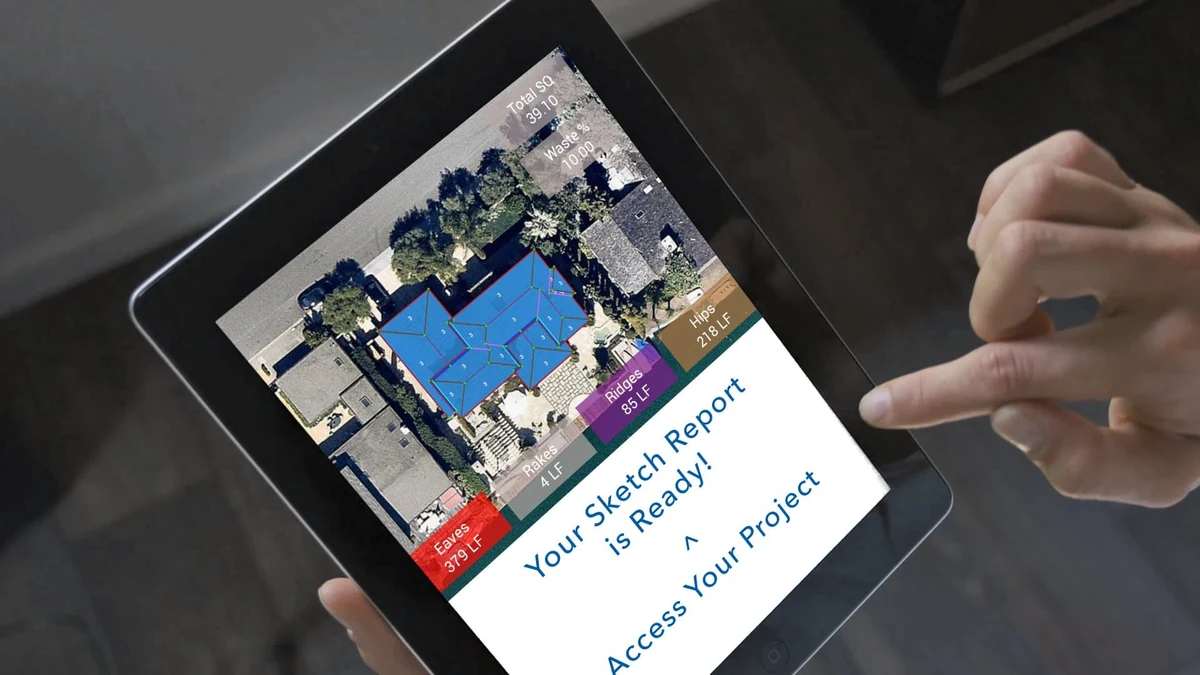
What’s actually in the report:
- Three diagrams: linear measurements color-coded by edge type (eaves, rakes, ridges, hips, valleys, step flashing), an area/facet diagram, and a pitch diagram per facet
- Aerial imagery source plus waste calculation table tuned to typical shingle cut-waste
- Summary page with totals
- Both a PDF deliverable AND a live editable RoofSnap project — you can continue editing pitch per facet, adding photos, notes, and secondary structures after delivery
The claimed accuracy sits in the 98-99% range on clean conditions, and independent corroboration from Roofing Software Guide’s review benchmarks it at “within 2%” for standard suburban residential. This is not EagleView-grade precision (EagleView published a 98.77% CompassData LiDAR-validated accuracy benchmark in the Denver metro in June 2025, the only independent benchmark in the category), but it’s legitimately accurate enough for retail residential estimating where you’ll verify on the roof anyway.
Report pricing (subscriber rates):
| Report Type | Pay-As-You-Go | Subscriber |
|---|---|---|
| Half Snap (perimeter, area, pitch) | $13 | $10 |
| Full Snap small residential (≤80 sq) | $35-$55 | $11-$37 |
| Gutter | $15 | $11 |
| Lighting | $18 | $15 |
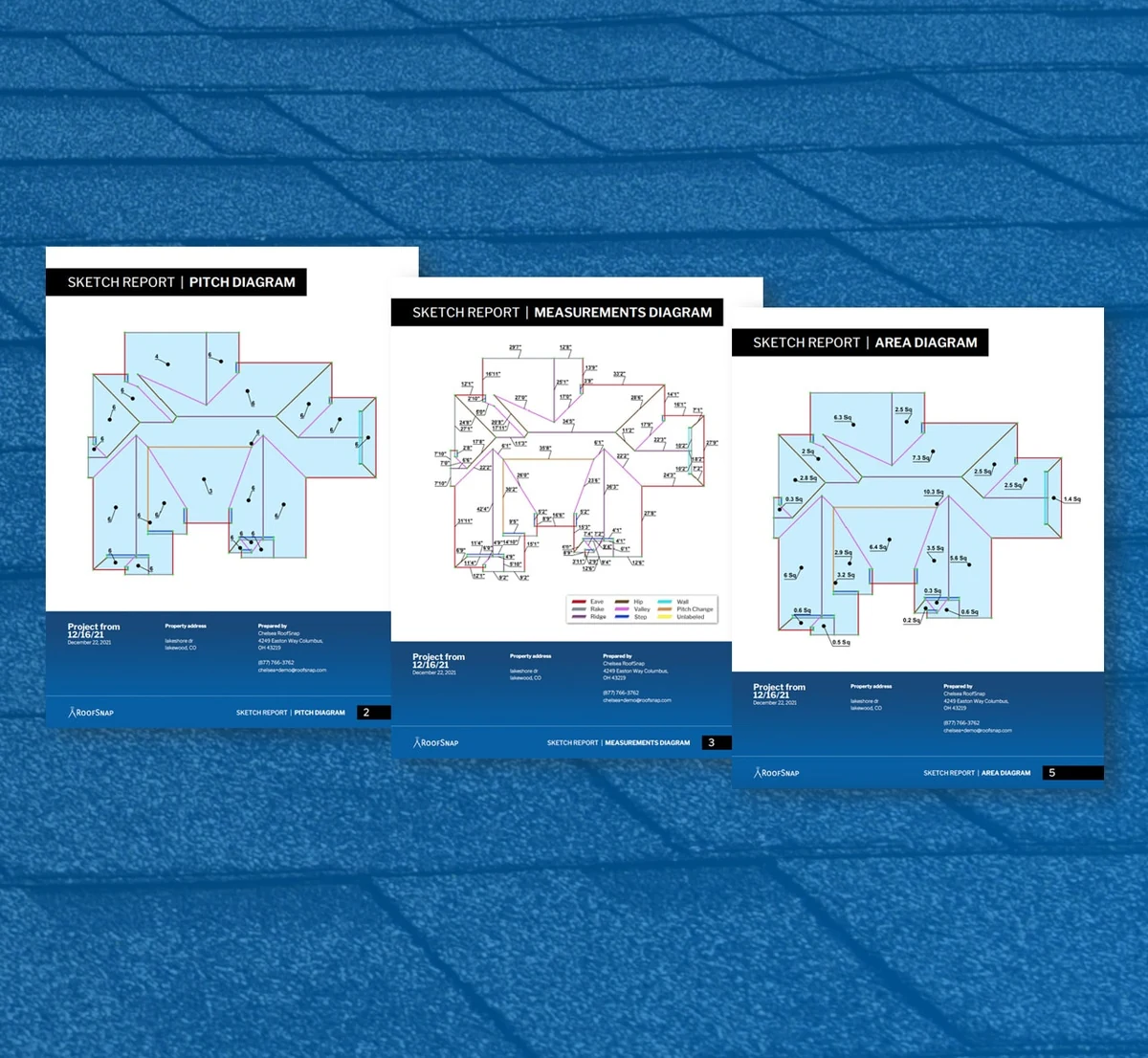
The reviewer-ID stamp on every report matters more than most buyers notice. When a measurement comes back questionable on a wing or a dormer, you know which human produced it and there’s a human to follow up with — this is a concrete accountability model competitors like EagleView (which has real customer service hold-time complaints cited in 30-60 minute ranges) don’t match on feel. Capterra reviewers cite RoofSnap support at 4.9/5 — the highest support sub-score in the estimating category across every competitor.
The Draw-It-Yourself Sketch Tool
Beyond SketchOS, RoofSnap ships a draw-it-yourself sketch tool that lets you trace roof edges directly on satellite imagery (or uploaded drone photos) inside the web app or on iPad. For roofers who’d rather not pay $11-$37 per SketchOS report, this is the alternative path — and unlike Roofr’s measurement service (which is a one-way request), RoofSnap’s DIY sketch is genuinely self-service.
How it works in practice:
- Enter the address or upload drone imagery (drone requires one known on-site scale measurement for accuracy calibration)
- Trace the roof outline edge by edge, labeling each line type (eave, rake, ridge, hip, valley)
- Input pitch per facet — the tool supports facet-level granularity
- Generate the report — measurements, waste calc, and diagrams auto-populate
Typical DIY time on a standard suburban residential roof runs 5 to 10 minutes once you’re trained on the tool. Complex cut-up profiles or heavy-dormer multi-section jobs take 15+ minutes. The upside: you pay nothing per-report beyond your subscription (or zero on Pay-As-You-Go beyond the $13 base if you only use SketchOS), and you retain full editing rights to every aspect of the measurement.
The downside is that drawing-accuracy depends on you. Rural properties with poor aerial coverage, tree-obstructed lots, and new construction where aerial imagery hasn’t been flown yet all reduce to drone photography — which you have to capture yourself and submit with the known-scale reference. Capterra reviewer Todd C. (project manager, 2+ years on the platform) captures this honestly: “Rural areas are hit and miss. Details on wings and bays are missed.”
For urban and suburban residential the DIY tool is fast and forgiving. For rural contractors or new-construction-heavy workloads, SketchOS (with a human technician actually looking at the imagery) is the better default, and you factor the $10-$37 into your job cost.
Estimates, Proposals, Payments, and Financing
This is where RoofSnap punches above its price class. Where iRoofing has a beautiful visualizer but no payment processing, where EagleView delivers measurements but doesn’t close the sale, RoofSnap’s proposal-to-paid workflow is integrated end-to-end.
Snap Estimates (instant Good/Better/Best):
Input the address, property size, and material selection. Output: three tiered estimates in under 10 seconds — good/better/best structured for iPad kitchen-table selling. The product UI labels these as “AI-generated” in a disclaimer, though the underlying logic is rule-based from your pricebook rather than true generative AI. Honest framing: this is template automation marketed as AI, the same pattern you’ll see across the category.

Detailed Estimate Builder:
For production estimates, you get a customizable line-item tool with labor rates, material costs, profit margins, markups, discounts, waste factor settings, and material-order generation. The pricebook is customizable per contractor — there’s no public pricebook marketplace, so you build your own libraries or import from your existing bids.
Proposals and contracts:
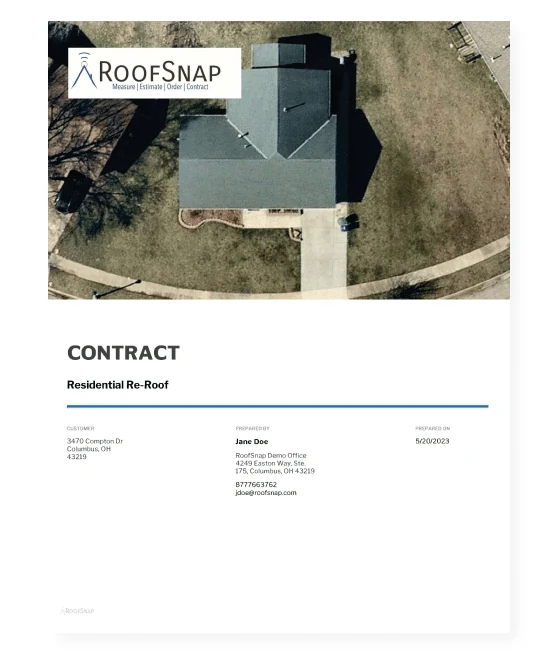
Convert any estimate to a branded contract in one click (same data auto-flows). Upload your company logo, customize terms & conditions, and include photos from the project file. Homeowners e-sign on any device — in-person on your iPad or remotely from their phone. Important honest note: RoofSnap explicitly recommends lawyer-review for jurisdiction-specific contract language. They don’t ship a generic legal-language library and they don’t use AI to draft clauses — your contract is yours to lawyer-proof.
Payments (Stripe):
2.9% + $0.30 on credit cards, 1% on ACH (capped is not publicly disclosed — confirm at signup). Over 40 payment methods supported, deposits, progress payments, and final invoicing from inside the proposal. PCI compliance is handled by Stripe. This is genuinely competitive with Roofr’s 2.8% + $0.30 and better than most contractor tools that charge 3.0%+ with opaque markup.
Homeowner financing (Acorn Finance):
The Acorn Finance integration is RoofSnap’s marketplace-style financing play. Instead of a single partner (like Roofr’s GoodLeap-only integration or AccuLynx’s multi-partner stack), Acorn routes the homeowner’s application across 30+ lenders including LightStream, SoFi, LendingPoint, and Best Egg. Loan range: $1,000 to $100,000, funding 1-2 business days. Illustrative rate example on the site: 8.94% APR on a $10K loan, 84-month term. The marketplace model typically produces better approval rates than single-partner financing because the homeowner’s credit profile can match against multiple underwriters simultaneously.
The gap in the proposal workflow: RoofSnap does not integrate with Wisetack, Hearth, or Financeit as alternative financing options — Acorn Finance is the sole partner. If your existing pipeline runs on Wisetack or Hearth, you’d need to pull those offers manually and attach to the RoofSnap proposal.
RoofSnap Has No AI — Let’s Be Direct About That
I’m going to be direct here because the 2026 roofing software market has a lot of AI washing going on and it helps no one.
As of April 2026, RoofSnap does not market any proprietary AI feature. The only AI-related content on their blog is a generic “Roofing Technology Trends 2025” post that positions RoofSnap as “a data integration platform” without claiming RoofSnap itself has AI. SketchOS reports are human technicians, not AI computer vision. The Good/Better/Best instant estimates are labeled “AI-generated” in a disclaimer but the underlying system is rule-based from your pricebook. The draw-it-yourself sketch tool uses no AI.
What RoofSnap does not have:
- AI damage detection — EagleView Assess has this and expanded September 10, 2025 to large/complex roofs
- AI takeoff — no automatic roof sketching; manual tracing is required
- AI copilot or chatbot
- Generative AI proposal writing
- AI-driven pricing optimization
- AI lead scoring or call answering
This is a deliberate positioning choice, not an oversight. EverPro’s broader portfolio strategy appears to be operational depth over AI velocity inside RoofSnap — there were no AI partnership announcements, no AI roadmap commitments, and no AI launches publicly disclosed in the 12 months through April 2026. If AI-native roofing estimating is a priority, the category alternatives are:
- AI damage detection: EagleView Assess
- AI material visualization: Hover Instant Design, iRoofing Color Visualizer
- Agentic AI / MCP architecture: EagleView Horizon (launched April 21, 2026, GA June 1)
- AI lead capture / call answering: Roofr Lead Capture Agents (roadmap late 2026), Rosie, Smith.ai, Upfirst
If you don’t need AI — and for small residential retail roofing crews, the honest answer is that you probably don’t need it yet — RoofSnap’s anti-AI positioning is actually a feature. The tool is simpler. The pricing is lower. The human QA is a legitimate accountability model. But calibrate your expectations against the category’s direction, not against RoofSnap’s older marketing that occasionally over-promises.
Integrations: The Biggest Gap You’ll Feel Daily
This is where RoofSnap’s budget positioning costs you the most in day-to-day workflow, and I’m going to lay it out plainly.
The complete list of native integrations on the RoofSnap platform:
- AccuLynx — measurements and photos sync between platforms without manual upload
- MarketSharp — native CRM integration with a flat $30 measurement report fee through the connection
That’s it. Two.
What RoofSnap does not integrate with:
- JobNimbus — the most popular CRM among roofing contractors
- Jobber — the multi-trade service CRM
- GoHighLevel — the marketing-first CRM many roofing lead-gen shops run
- HubSpot or Salesforce
- QuickBooks — third-party review sites explicitly confirm no QuickBooks integration
- Xero or Sage Construction
- CompanyCam — the photo documentation standard
- EagleView or Hover — RoofSnap competes with both
- Xactimate — no ESX export, no in-Xactimate integration
- Zapier — no general-purpose automation escape hatch
- No public API for custom integration — Roofing Software Guide explicitly calls this out
- DocuSign — e-sig is native inside RoofSnap instead, which partially offsets
What to pair RoofSnap with:
- If you’re already on AccuLynx: RoofSnap is genuinely the right measurement+estimate add-on. The native integration works, and AccuLynx’s in-house estimating is weaker than what RoofSnap produces.
- If you’re on JobNimbus: skip RoofSnap. Pair JobNimbus with EagleView (deep native integration via Smart Estimates auto-populate) or with Roofr for the Xactimate ESX bridge.
- If you’re running Jobber or GoHighLevel: RoofSnap doesn’t integrate with either — you’d live in manual PDF-email workflow. If you’re actively choosing between Jobber and GoHighLevel for your CRM layer, our GoHighLevel vs Jobber breakdown covers which fits which business model, and neither pairs cleanly with RoofSnap.
- For QuickBooks job costing: you’re in manual CSV import/export territory. If accounting integration is load-bearing for your operation, RoofSnap is the wrong pick.
The honest math: if you’re spending $78/user/mo on RoofSnap Annual + $200-$300/mo on JobNimbus + $80/mo on QuickBooks + $34/user/mo on CompanyCam, do the sum. Roofr’s $209-249/month Essentials plan gets you the measurement tool AND the CRM AND the integrated proposal workflow — and unlike RoofSnap, it has an actual Xactimate ESX path at $10 per report. For standalone-tool use inside an AccuLynx-centric operation, RoofSnap earns its keep. For anyone building a multi-tool stack, the integration poverty is a daily tax.
2026 Pricing (The Real Reason RoofSnap Exists)
Pricing is where RoofSnap’s positioning makes structural sense. The tiers are published publicly on roofsnap.com/pricing — no demo-gate, no “contact sales” wall, just real numbers.
| Tier | Price | Commitment | Includes |
|---|---|---|---|
| Pay-As-You-Go | $13/measurement order | None | Per-order only, no subscription |
| Monthly | $105/user/month | Month-to-month | 5 HD images/mo + unlimited DIY + full suite + 7-day free trial (no CC) |
| Annual — 2-4 users | $78/user/month | Annual billing | 240 HD images/user/year + full suite |
| Annual — 5-9 users | $61/user/month | Annual billing | Same + volume discount |
| Annual — 10+ users | $52/user/month | Annual billing | Same + largest volume discount |
What you actually get included on any subscription tier:
- Unlimited draw-it-yourself measurements
- HD imagery credit allotment (5/mo Monthly, 240/year Annual per user)
- Full estimate, material, and contract suite
- Native Stripe payments (2.9% + $0.30 CC, 1% ACH)
- Acorn Finance marketplace financing (30+ lenders, $1K-$100K loans)
- Custom pricebook, branded contracts, e-signatures
Additional costs (subscriber rates):
- Half Snap reports: $10
- Full Snap small residential: $11-$37
- Gutter reports: $11
- Lighting: $15
- Stripe processing on collected payments: 2.9% + $0.30 card / 1% ACH
Hidden costs check:
- No onboarding fee. No mandatory setup cost surfaced in reviews or the pricing page.
- No contract minimum beyond the annual plan’s yearly commitment.
- No meaningful pricing changes disclosed publicly in 2025-2026 — stable through April 2026.
The real-world math for a 3-person roofing crew:
At the Annual 2-4 user tier, $78/month × 3 users = $234/month, or $2,808/year. Add 10 SketchOS Full Snap reports at $25 average/month = $250/month, totaling ~$484/month or $5,808/year all-in. Compare to Roofr Essentials at $249/month flat (no per-seat limits) + 10 reports at $15 average = $399/month or $4,788/year. Roofr is cheaper for a 3-person crew if you’re using reports heavily. RoofSnap’s price advantage kicks in at 5+ users, where the $61/user Annual rate ($305/month for 5 users) or $52/user at 10+ ($520/month for 10 users with 2,400 HD images/year allotted) becomes the category-cheapest option.
The pricing strategy in one sentence: RoofSnap competes on per-user cost at multi-seat volume. If you’re 1-2 users, Pay-As-You-Go or competitors usually win. If you’re 5+ users and don’t need deep integrations, RoofSnap’s math works.
Who Should Use RoofSnap vs Who Shouldn’t
Who Should Use RoofSnap
- Owner-operator or 5-10 person residential retail roofing contractors running 10-50 measurements/month — this is the sweet spot where the per-user Annual pricing works and the feature set is sufficient
- AccuLynx customers who want stronger measurement and estimate tooling than AccuLynx’s in-house — the native integration is the one strategic bridge in the platform
- Price-sensitive crews that already closed the conversation that AI and deep integrations aren’t on this year’s priority list — RoofSnap’s anti-AI positioning is a genuine feature for this demographic
- Gutter specialists or roofing+gutter combined operations — the Gutter Measurement product line is a legit second trade in the platform
- Contractors who sell at the kitchen table on Good/Better/Best pricing — the instant three-tier estimate output is built for this workflow
- Shops that value human-accountability on measurements — the SketchOS reviewer-ID stamp is a real differentiator if you’ve been burned by a measurement service’s anonymous output
Who Shouldn’t Use RoofSnap
- Insurance-restoration roofers writing Xactimate estimates. No ESX path, no in-Xactimate integration — EagleView (native integration) or Roofr ($10 Verisk-certified ESX add-on) are the correct alternatives.
- Production roofers running 50+ jobs per month. RoofSnap isn’t a CRM — you’ll hit the ceiling fast on crew management, pipeline, dispatching, job costing. AccuLynx is the category leader for production roofing; JobNimbus is the tier-two choice at a lower price.
- Multi-trade contractors (roofing + HVAC + plumbing + electrical). RoofSnap is roofing+gutters+lighting only. Service businesses need Jobber or Housecall Pro as the platform layer.
- Any contractor whose QuickBooks integration is load-bearing. No native sync means manual CSV imports per job. The wrong tool if job costing accuracy depends on tight accounting flow.
- Siding contractors, painting contractors, solar installers, and landscapers. No siding support. No solar PV design. No painting visualization. Hover is the correct tool for siding and painting exterior work.
- AI-forward contractors who want damage detection, AI takeoff, or AI copilot features — RoofSnap’s no-AI positioning is explicit. Hover, EagleView Horizon, or Roofr’s roadmap are better aligned.
- Large crews needing CRM, dispatch, or pipeline management — use AccuLynx, JobNimbus, or ServiceTitan and pair with a measurement service.
- Contractors with heavy mobile-app field workflow requirements. The iOS app (3.3/5 stars, 39 ratings, last meaningful version 1.17.7 from May 31, 2023) is materially weaker than the web app. Field-heavy operations should check if the mobile experience actually works for their crews before committing.
- Rural and new-construction specialists. Capterra reviewers consistently flag measurement accuracy issues on rural properties and areas with weak aerial coverage. EagleView has better imagery network coverage; Hover’s photogrammetry sidesteps aerial entirely.
What Users Actually Say (and the Thin Sample Caveat)
RoofSnap’s public review footprint is statistically thin — smaller than any major competitor in the roofing estimating category. Current April 2026 aggregates:
- Capterra: 4.7/5 across 11 verified reviews (ease of use 4.7, customer service 4.9, features 4.6, value 4.6, likelihood to recommend 4.9)
- G2: ratings aggregated but review count not publicly confirmable (page access restricted during research)
- Apple App Store (iOS app): 3.3/5 across 39 ratings — much more critical than web-product reviews
- Roofing Software Guide 2026 review: 8.6/10 (RSG Silver) — “Hands-on aerial measurements on a budget”
- Kingcontractor: 4.5/5 — “one of the best affordable options for small-to-medium roofing businesses”
For comparison: AccuLynx has 800+ Capterra reviews; JobNimbus has thousands; Roofr has 101 Capterra reviews; even iRoofing at 23 reviews is a bigger sample. 11 Capterra reviews means directionally positive sentiment without the statistical confidence of a larger sample. Worth flagging to readers.
The positive consensus comes through clearly across the small sample:
“Best program for the money that a roofing contractor can have.” — Chris F., Operations Manager (2+ years on platform), Capterra review
“Saves me time and money and extremely easy to use.” — Larry E., Owner (1-2 years), Capterra
“I would highly recommend RoofSnap to anyone in the roofing business.” — Sue W., Accounting Clerk, Construction (6-12 months), Capterra
“RoofSnap has been great for our business. Their turnaround time is excellent on getting reports. I recommend RoofSnap to any roofing company needing fast and accurate measurements.” — Ken Cope, Roof Maxx (RoofSnap case study)
“Love the software. Very easy to use. The turnaround time on ordering a RoofSnap report is very good.” — Miguel Ortiz, Salt Roofing (RoofSnap case study)
Support consistency at 4.9/5 on Capterra is the single strongest individual sub-score across the roofing estimating category in 2026. The speed-of-turnaround and ease-of-use themes are consistent across named-contractor testimonials.
The critical review pattern is narrower but substantive:
“No true CRM management. Built for small companies.” — Lucas H., Owner (2+ years), Capterra
“Rural areas are hit and miss. Details on wings and bays are missed.” — Todd C., Project Manager (2+ years), Capterra
“Quantities of items go from the number I chose to say 25 randomly.” — Corbin B., Owner (1-2 years), Capterra
“Extremely buggy and slow to load.” — Anonymous iOS App Store review, August 2024
The consistent critical themes: no CRM depth (every reviewer mentions this), rural-area measurement issues, pitch rounding at the material-decision boundary, the occasional quantity-field bug, and iOS app reliability. None of these are dealbreakers individually — but stacked together they’re the voice-of-customer reason RoofSnap is a 3.5/5 rather than a 4.5/5 in this review.
Expert vouch: Roofing Software Guide’s 2026 review gave RoofSnap their RSG Silver award at 8.6/10, praising “integrated payments and financing reduce friction at close” and confirming measurement accuracy “within 2%” on suburban residential. The TAMKO Edge™ certification program includes RoofSnap as a discount partner for TAMKO-certified contractors — a shingle manufacturer’s willingness to bundle the tool is a meaningful third-party vouch.
Reddit sentiment: RoofSnap has minimal organic Reddit discussion compared to noisy peers like Roofr or EagleView. r/Roofing does not have prominent threads about RoofSnap. Interpret that neutrally — it could indicate a quietly satisfied customer base, or it could indicate low category awareness. Either way, don’t lean on Reddit consensus for RoofSnap the way you would for more discussed tools.
When This Beats the Alternatives
RoofSnap beats every competitor in exactly three scenarios:
Scenario 1: You’re a 5-10 person residential retail roofing crew on AccuLynx who wants stronger measurement workflow. At $61/user/month Annual with the native AccuLynx integration, RoofSnap is structurally the best add-on for this operation. EagleView would be more accurate but 3-5× more expensive at volume. Roofr doesn’t integrate natively with AccuLynx.
Scenario 2: You’re an owner-operator doing low-volume retail work (under 15 measurements/month) and subscription minimums matter. Pay-As-You-Go at $13/order is the lowest barrier to entry in the category. Cheaper than Roofr’s $19 Starter reports, and there’s no monthly floor. For the genuine solo-at-lowest-volume use case, RoofSnap wins on pure subscription economics.
Scenario 3: You’ve explicitly decided AI and integration depth aren’t 2026 priorities for you. If your stack is already stable, your close rate doesn’t depend on material visualization, and your workflow tolerates manual PDF-based data transfer between tools, RoofSnap’s anti-AI budget positioning is a genuine feature. You’ll pay less, get a cleaner tool, and the human-QA measurement layer is real accountability.
Outside those three scenarios, the alternatives are stronger:
- Insurance restoration, any adjuster-facing work: EagleView for accuracy and live Xactimate; Roofr for the $10 ESX bridge
- Full-exterior visualization and siding: Hover — the 3D model + Instant Design is the category’s sales close tool
- Kitchen-table color visualization on roofing: iRoofing at $107-149/mo — the AI Color Visualizer is the better feature for pure residential sales lift
- Multi-tool platform with integrated CRM and better mobile: Roofr — feature velocity is visibly stronger, mobile PWA launched January 2026, Xactimate bridge shipped April 2026
- Production roofing at 50+ jobs/month: AccuLynx as the CRM backbone, then RoofSnap or EagleView for measurement
The 3.5/5 rating reflects a real product with real value in a narrow lane, undercut by real weaknesses in a category that’s moving faster than RoofSnap is. For the crew RoofSnap is built for, it’s a solid pick. For anyone outside that demographic, the alternatives outrank it on features, velocity, and integration ecosystem — every time.
Updated April 2026 — pricing verified on roofsnap.com/pricing, not third-party aggregators. See also our Roofr review, EagleView review, Hover review, iRoofing review, and the full estimating software category for side-by-side context.