

Tradify charges by the seat, and that single decision explains most of what is good and bad about it. At one user it is a focused, well-built quoting and job-costing tool for an electrician or a plumber who is tired of writing quotes in Word. At five users it costs $255 to $305 a month, which is two to three times what Jobber or Housecall Pro charge for the same crew, and the product does not do enough more to justify the difference.
So this review is really about finding the line. Below it, Tradify is a good buy. Above it, it is an expensive way to avoid a dispatch board you would have been better off buying.
What Tradify Actually Is
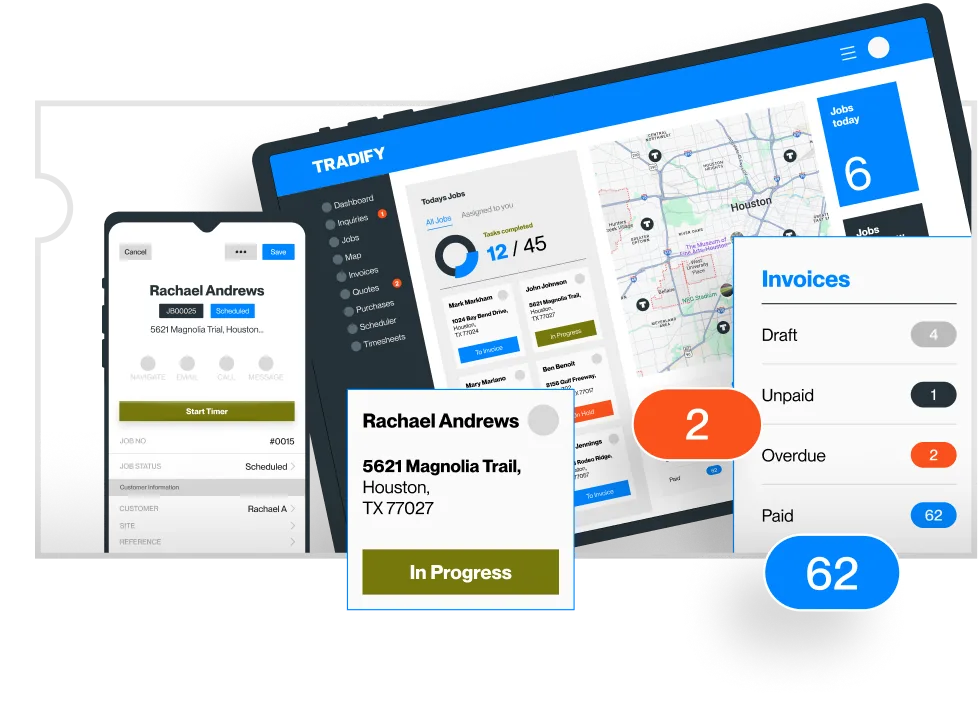
Tradify is job management software, which in this category is a specific thing: it manages the paperwork lifecycle of a job rather than the movement of trucks. An inquiry comes in through a form or a phone call, you build a quote, the customer accepts, the quote becomes a job, your people log time and materials against it, supplier bills get attached, and the invoice comes out the other end built from what the job actually consumed.
It was built in New Zealand for trades, and the four it names are electricians and AV installers, plumbers and gas engineers, HVAC technicians, and property maintenance companies. The company now carries an Access Group badge on its own site, so it sits inside a larger UK software group.
What it is not is a dispatch platform. There is a calendar, live staff and job locations on a map, route planning, and Google Calendar sync, and that is the extent of it. Nobody at Tradify is pretending otherwise, and the honest read is that for the shops it targets, a dispatch board would be a feature nobody opens.
What Tradify Costs, and Where the Math Turns
Three published tiers, priced per user per month in US dollars, verified against tradifyhq.com in September 2026.
| Plan | Per user / month | What it adds |
|---|---|---|
| Lite | $47 | Job management, scheduling, quoting, invoicing, online payments, email tracking, Xero and QuickBooks sync |
| Pro | $51 | Custom branding, inquiry forms, customer communication history, job photos and files, recurring jobs, templates, appointment reminders, quote options, progress invoicing, costing and bill tracking, timesheets, subcontractor scheduling |
| Plus | $61 | SmartRead and SmartWrite, service reminders, job tasks, purchase orders, bulk invoicing, kit bundles, staff activity history, job service reports, reporting |
| Custom | By quote | Everything in Plus, tailored for large teams |
Add-on: Instant Website at $12 a month on any plan. Free trial: 14 days with every feature unlocked, which is unusually generous and worth using on the Plus features specifically, since that is the tier decision you will actually agonize over.
Now the part the pricing page does not do for you.
| Crew | Tradify Pro | Tradify Plus | Jobber | Housecall Pro |
|---|---|---|---|---|
| 1 user | $51 | $61 | Core $29 | Basic $59 |
| 3 users | $153 | $183 | Connect $99 (5 seats) | Essentials $149 (5 seats) |
| 5 users | $255 | $305 | Connect $99 | Essentials $149 |
| 10 users | $510 | $610 | Grow $149 | MAX $299 + $75/user over 8 = $449 |
At one user, Tradify is mid-pack and the product quality carries it. At three, it is already $54 more than Jobber Connect and you are getting fewer seats than Connect includes. At five, the gap is $156 to $206 a month, or roughly $2,000 to $2,500 a year. At ten it is not a comparison anymore.
The line is four users. Below four, Tradify’s quoting and job costing are worth the premium for a shop that quotes constantly and wants to know its margin per job. At five and above, you are paying a dispatch-platform price for a product that does not dispatch, and the honest recommendation is Jobber or, if your trade is HVAC or plumbing with real dispatch pressure, Workiz.
One thing worth saying plainly: Tradify publishes all of this. Workiz pulled its prices behind a quote form this year, ServiceTitan has never published, and Podium still will not tell us what its FSM costs. A vendor that prints three numbers and an add-on fee is doing something the category mostly refuses to do, and it makes the comparison above possible at all.
The Quote-to-Invoice Loop
This is the reason to buy Tradify, so it is worth being specific about what it does.
Quotes are built from a price list you import, templated so the second bathroom rough-in does not start from a blank page, and branded on Pro and above. Quote options let you send the customer a good, better, and best version in one document rather than three quotes and a phone call. Tradify tracks whether the quote was opened, which is a small thing that changes how you follow up.
When a quote is accepted it becomes a job, and that is where the platform earns its keep. Time goes on it from the mobile app or a timesheet. Materials go on it. On Pro, supplier bills get tracked against it, and on Plus, purchase orders do. The profit snapshot then shows you what you quoted against what the job consumed.
That last number is the one most small shops cannot produce. Plenty of software tells an electrician what he invoiced last month. Very few tell him that the service-panel jobs are running 12 points under the quoted margin because the helper’s hours never make it onto the ticket. Tradify does that at $51 a user, and for a shop that quotes a lot of similar work, knowing it is worth more than the software costs.
Invoicing closes the loop: branded, generated from the job, progress-billed in stages on longer work, bulk-invoiced on Plus, paid by card through Stripe, and chased by automated overdue reminders. Invoice view tracking tells you whether the customer opened it, which kills the “I never got it” conversation.
Where it stops: payments are card through Stripe, and Tradify does not publish the processing rate on its pricing page. There is no advertised ACH tier and no consumer financing integration, so a $9,000 panel upgrade cannot be presented as $220 a month the way Housecall Pro’s Wisetack integration presents it. For a shop selling big-ticket replacements, that is a real gap, and our contractor financing tools guide covers what you would have to bolt on beside it.
SmartTools: Two AI Features, One of Them Useful
Tradify’s AI is branded SmartTools and it is two things, both on the Plus tier at $61 a user.
SmartRead captures costs from a photograph. Point your phone at a supplier invoice and it pulls the cost lines out and puts them against the job instead of you typing them at the kitchen table. For a shop running a trade account with daily counter pickups, this is the feature that pays for itself, because the alternative is either an hour a week of keying or, more commonly, costs that never make it onto the job at all and quietly eat the margin.
SmartWrite is the writing one. It corrects spelling and grammar, generates descriptions automatically from quote and invoice line items, and shifts the tone of a customer message between friendly and professional. It is a convenience. It will make your quotes read better if writing is not your strength, and it will not change your week.
Two honest caveats. First, neither is on Lite or Pro, so the AI decision is really a decision to pay $10 more per user per month, which at five users is $600 a year. Second, Tradify does not publish usage limits or per-use pricing for either tool. That is a strange gap in 2026, when nearly every vendor with an AI feature has had to put a cap on it somewhere, and it is worth asking about directly before you upgrade a crew.
Compared to the category, this is a modest AI surface. ServiceM8 shipped an AI Phone Agent that answers calls. Workiz has had Genius Answering booking jobs since December 2024. Jobber sells an AI Receptionist at $29 a month. Tradify’s AI reads bills and fixes grammar. That is a defensible choice for its customer, but if the phone ringing unanswered is your actual problem, Tradify does not solve it and you should read the AI call answering category instead.
Integrations: The Shortest List in the Category
QuickBooks. Xero. Stripe. Google Calendar.
That is the published list, and it is the single biggest structural weakness in the product. Here is what is not on it: CompanyCam for job photos, any aerial measurement tool, any consumer financing provider, any lead source like Angi or Thumbtack, any review platform, and no named Zapier connector on the product pages.
The accounting half of that short list is genuinely good. Xero in particular is deeper than most competitors manage, which follows from where the product was built: in New Zealand, Xero is the default, not the alternative. If your bookkeeper lives in Xero, Tradify is one of the few trade platforms that was designed around that assumption rather than retrofitted to it, and that is a legitimate reason to pick it over an American-built competitor.
But a four-name list means Tradify assumes it is your whole stack. For a solo electrician, that assumption holds. For a shop that already runs CompanyCam on every job and takes leads from three platforms, it means re-keying, and re-keying is what software was supposed to stop.
Scheduling and the Field
The calendar assigns jobs to people and syncs both ways with Google Calendar. A map shows where staff and jobs are in real time. Route planning orders the day. Appointment reminders go out to customers. Recurring jobs handle maintenance work on Pro, and service reminders on Plus chase the annual gas certificate or the six-month check.
What is absent: skill-based assignment, a nearest-qualified-tech suggestion when the emergency call lands, capacity enforcement that refuses the double-booking, and GPS-triggered on-the-way texts. Those are dispatch features, they belong to a different class of product, and Tradify does not claim them.
The mobile app is the part users rate highest, and Tradify’s own claim is 4.8 out of 5 across more than 9,000 ratings and reviews. That figure is vendor-reported and should be read as such, but the volume behind it is large, and the consistent theme in trade forums is that quoting and invoicing from the van works without a fight. Timesheets run from the same app, including for subcontractors on Pro, which closes the labor half of the job-costing loop.
Who Should Buy Tradify
Solo electricians, plumbers, and gas engineers who quote constantly. This is the core customer. Lite at $47 or Pro at $51 gets you templated quoting, job costing, and invoicing that beats the spreadsheet-and-Word setup you are probably running, and the Xero sync means your books close themselves.
Two-to-four person shops that bill by the job and want the margin number. Pro at $51 a user, so $102 to $204 a month. The profit snapshot per job is the feature you are paying for, and no tool in this bracket does it better.
Anyone whose accountant works in Xero. The strongest single argument for Tradify over an American-built competitor.
Property maintenance companies with recurring service obligations. Recurring jobs on Pro plus service reminders on Plus handle the annual-certificate rhythm well.
Who Should Not
Crews of five or more. The per-user math stops making sense. Jobber Connect at $99 covers five and Housecall Pro Essentials at $149 covers five with a payment stack Tradify cannot match. Our Jobber vs Housecall Pro comparison is the decision you should be making instead.
Anyone with a dispatcher. If a person spends the day moving job cards between trucks, buy a dispatch board. Workiz is the small-shop answer and ServiceTitan is the big-shop one; our Jobber vs Workiz page covers the split.
Roofing and restoration contractors. No Xactimate path, no ESX export, no supplement workflow, no aerial measurement integration. Read JobNimbus or AccuLynx instead.
Shops that need financing at the point of sale. Card through Stripe is the whole payment story. If you sell $8,000-plus replacements, you need Wisetack or Hearth in the quote, and Tradify does not put them there.
Anyone whose bottleneck is the phone, not the paperwork. Tradify’s AI reads supplier bills. It does not answer calls.
The Bottom Line
Tradify earns 3.9 out of 5 the way a focused product usually does: high marks where it concentrates and low ones where it declined to compete. The quoting and job-costing loop, the mobile app, and the Xero sync are genuinely strong. Dispatch, integrations, payment breadth, and cost at scale are where the score comes off, and each of those is a deliberate choice by the company rather than a bug.
The buying rule is simple enough to state in one line. Four users or fewer, quoting-heavy, on Xero: Tradify is a good buy and the 14-day trial costs you nothing to prove it. Five or more, or anyone with a dispatcher: you are paying a premium for a product that does not do the thing the premium usually buys.
If you are inside that line, start the trial on Pro rather than Lite. Costing and bill tracking are what you came for, and they are not on Lite.
Pricing verified September 2026 against tradifyhq.com/pricing. Review is research-based: built from Tradify’s published product, pricing, and feature documentation rather than hands-on time in the platform, and flagged as such. Tradify runs an affiliate program that Contractor ToolStack participates in; it has no effect on the rating, which comes from the weighted rubric described on how we review. See the full field service management category and invoicing and payments category for side-by-side context.