


Search Contractor ToolStack

Find reviews, head-to-head comparisons, category guides, and more.

jobnimbus ai call answering vs servicetitan roofing crm
DroneDeploy logo and branding
Research-Based Review

DroneDeploy Review 2026: The StructionSite Successor + AI Reality Capture

By Steven Risher | Updated 2026-05-08

Editorial Verdict SILVER · VERY GOODBest Reality-Capture Platform for Commercial GCs (Aerial + Ground Unified)
Editorial
4.2/5
By Editor
Community
No Votes Yet

DroneDeploy in 2026 is two products under one platform: Aerial — the drone-photogrammetry tool the company has shipped since 2013 — and Ground, which is what StructionSite became after DroneDeploy acquired it in October 2022 and migrated paid customers in November 2024. Same AI engine runs across both: Progress AI claims 95% accuracy across 80-plus trades and ships reports in 2 hours; Safety AI auto-flags risks with 90,000+ detections to date; Inspection AI handles predictive maintenance for energy and rail.

The Ground side is what most contractor readers came here for — the 360-degree-camera-on-a-hard-hat-monopod walk that auto-pins photos to floor plans, runs BIM Compare against the model, and ships an owner-facing report before the crew leaves the site. Hardware support spans Insta360 X5/X4/ONE RS 1-inch, Ricoh Theta X, plus Boston Dynamics Spot and OnSight ground robots for autonomous capture. The Aerial side is drone photogrammetry — orthomosaics, 3D models, volume calculations, site progress over time — and it's where DroneDeploy's enterprise depth sits at 40% of ENR Top 400, 3.18 million sites across 180 countries.

What to know going in. Pricing is custom-quote for Ground (no published tier) and starts around \$4,188 a year for the individual Aerial Flight & Analysis plan. There's a 14-day free trial with no credit card. The integration ecosystem is deeply commercial — Procore deep with embedded app, Autodesk Construction Cloud auto-sync added October 2025, BIM 360, Bluebeam — and it's deliberately not residential. Zero native bridges to Jobber, JobNimbus, Housecall Pro, ServiceTitan, AccuLynx, GoHighLevel, or Smith.ai. Capterra sample size is thin (single-digit reviews on the DroneDeploy listing through 2023; the StructionSite listing was absorbed into DroneDeploy at the brand merge).

It's the right pick for commercial general contractors at $1M-plus revenue scale, specialty subs working on commercial jobs that already require BIM coordination, owner-developers managing portfolios of large interiors (data centers, healthcare, multifamily), and heavy-civil contractors using drones for earthworks volumes. It's the wrong pick for residential remodelers (use Buildertrend), HVAC or plumbing service businesses (use Workiz, ServiceTitan, or Jobber), residential roofing with insurance work (use JobNimbus or AccuLynx), and any contractor who wanted CompanyCam's clean residential photo-with-job workflow at $13 a month.

Right pick for commercial GCs, specialty subs on Procore-managed jobs, and heavy-civil contractors using drone photogrammetry. Wrong pick for residential trades, service businesses, and anyone who wanted CompanyCam's residential photo-with-job UX at a residential price.

Sites Captured
3.18M+
180 countries · 46M 360 walks · 135M views
ENR Top 400
~40%
Including Turner, DPR, Skanska, McCarthy, Walsh, Clayco
Progress AI
95%
Claimed accuracy across 80+ trades · 2-hour reports
StructionSite
Migrated
Acquired Oct 2022 · sunset Nov 1, 2024 → Ground
From Custom quote (Ground) / $4,188/yr (Aerial)14-Day Free Trial AI-Powered Mobile App
Try DroneDeploy Free

Photo Documentation Scores

Capture Speed & Field Workflow
3.5
Organization & Tagging
4.7
Integrations with CRM, PM & Estimating
4.5
Pricing & Value
2.5
Sharing, Reports & Client/Insurance Portals
4.5
Mobile Reliability
4.0
AI & Auto-Categorization
4.7

Weighted by importance to contractors. How we score →

Trade Fit Report

How Well Does DroneDeploy Fit Your Trade?

Based on features, integrations, and real contractor feedback

Built For This Works Well Use With Limits Look Elsewhere
General Contractor
Built For This
Solar
Works Well
Roofing
Use With Limits
Restoration
Works Well
Electrical
Use With Limits
Painting
Works Well
HVAC
Use With Limits
Plumbing
Use With Limits
Landscaping
Use With Limits
Cleaning
Use With Limits
Live Contractor Poll · Updated Daily

Rate DroneDeploy — Voted by 0 Contractors

Real ratings from contractors using DroneDeploy daily. Annual rolling.

Overall Rating Your headline rating — how good is it, all things considered
Mobile App / Field Use Performance on phone, tablet, and in low-signal job sites
Ease of Use How quickly your crew picked it up; daily UX
Features That Matter Whether the things you need are actually there
Integrations How well it connects to QBO, CompanyCam, EagleView, etc.
Value for Price Whether the cost matches what you're getting
Want your quote featured publicly below? Quotes from verified contractors rotate as featured testimonials with your name, business, state, and trade — pulled from your verified profile. Anonymous quotes are stored privately for sentiment analysis.

Be the first contractor to rate DroneDeploy — your vote starts the leaderboard.

In November 2024, every commercial superintendent who’d been running StructionSite on their iPhone for the past five years woke up inside a different product. Their data, their projects, their floor plans, their 360-degree walk archives — all migrated overnight to DroneDeploy Ground. The company that bought StructionSite back in October 2022 finally folded the brand into its own platform, and the product that 5.0 stars across 152 iOS reviews had been calling “StructionSite Construction App” became “DroneDeploy Ground” on the same login.

That migration is the editorial story for May 2026 — but it’s not the whole product. DroneDeploy in 2026 is two products under one platform: Aerial (the drone-photogrammetry tool the company has shipped since 2013) and Ground (the ex-StructionSite 360-degree-walk product). Same login. Same project hierarchy. Same AI engine running across both — Progress AI claiming 95-percent accuracy across 80-plus trades, Safety AI auto-flagging hazards, Inspection AI handling predictive maintenance for energy and rail.

“If a picture is worth a thousand words; a 360 photo is worth a million.” — Albert Zulps, Director of Emerging Technology, DroneDeploy Ground product page

This review covers what the unified platform actually does, what it costs (Aerial pricing is published, Ground is sales-only), what the AI stack ships in 2026 versus what’s still on the roadmap, where DroneDeploy fits in the commercial-construction stack alongside Procore and Autodesk Construction Cloud, what carried over from StructionSite versus what changed, and which contractors should be running CompanyCam instead because they’re not the audience DroneDeploy is built for.


What DroneDeploy Actually Is (Two Products, One Platform)

The positioning question matters because most contractor readers come into a DroneDeploy review with one of two mental models: “the StructionSite successor” or “the drone software.” Both are right. Neither is complete.
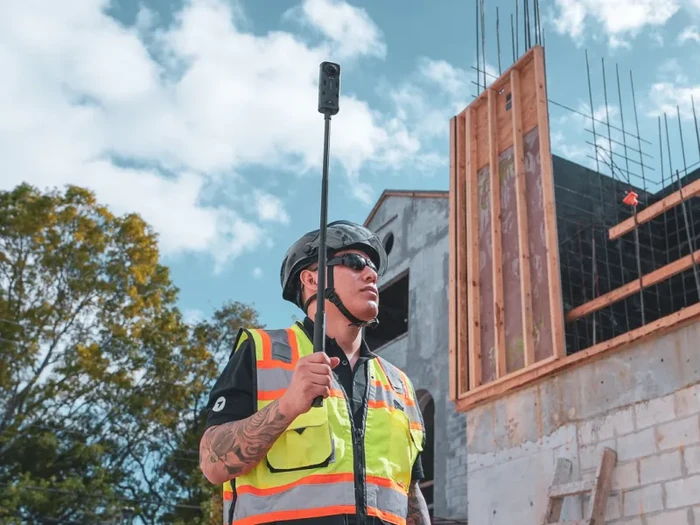
A construction worker in a high-visibility safety vest and dark hard hat holds an Insta360 360-degree camera mounted on a tall monopod above his head, with concrete forms, scaffolding and a partially-framed commercial building visible in the background, illustrating the DroneDeploy Ground capture workflow
DroneDeploy Ground capture in the field — Insta360 X5 on a monopod, real commercial site.

DroneDeploy Aerial is the original product. Founded 2013 in San Francisco, the company built its category around drone photogrammetry — a contractor flies a DJI Mavic, Mini, or M30-series drone over an outdoor site; the platform processes the imagery into orthomosaics, 3D models, point clouds, and volumetric measurements. Use cases: earthworks volumes for heavy-civil contractors, site progress flyovers for commercial GCs, agricultural field analysis, mining stockpile measurement, and inspection workflows for utilities, rail, and renewables.

DroneDeploy Ground is what StructionSite became. Acquired October 2022, sunset November 1, 2024, migrated under the DroneDeploy login. The capture workflow is hard-hat-mount: a superintendent walks the building with an Insta360 X5 (or X4, ONE RS 1-inch, or Ricoh Theta X) on a monopod, AI auto-pins each 360-degree photo to its location on the floor plan, and the captured walk gets compared against the BIM model in the office for design-vs-reality verification.

The unified play is what DroneDeploy markets in 2026. A commercial GC running both Aerial flyovers and Ground interior walks on the same project doesn’t coordinate two vendors and two data lakes — it’s one platform, one project, one Procore-integrated reality-capture record. That’s the editorial difference between DroneDeploy and a focused competitor like OpenSpace (Ground-only) or DJI Terra (Aerial-only).


How DroneDeploy Ground Works in Practice

This is the half most contractor readers came here for, so it gets the most space.

The capture workflow goes like this. A superintendent or foreman opens the DroneDeploy app on their iPhone or iPad, selects the project, and either picks a path to walk (linear capture) or marks specific zones to cover. They mount the 360-degree camera on the monopod or hard-hat mount, hit record, and walk the building. The mobile app syncs the camera’s video or photo stream over Bluetooth, captures GPS where signal permits, and queues the upload. Back in the office or over WiFi, the platform processes the walk: AI auto-aligns each frame against the floor plan (the original “Vision Engine” that StructionSite shipped, now native to DroneDeploy Ground), tags photos by spatial location, and makes the captured walk searchable from the web app.
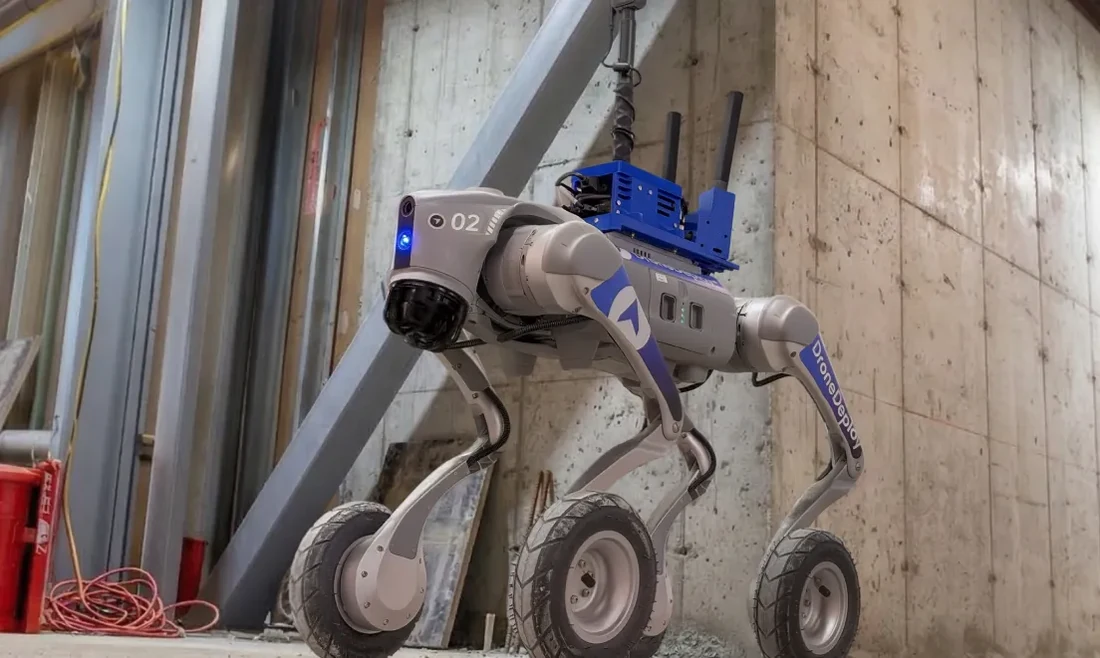
A DroneDeploy-branded autonomous ground robot with wheeled legs and a blue and white body labeled DroneDeploy stands inside a commercial construction site between concrete walls, with framing materials, electrical conduit and an exposed structural beam visible in the surroundings — representing the agentic-AI ground-robot product DroneDeploy announced for 2026 beta deployments
DroneDeploy's branded ground robot — autonomous capture for the 2026 beta deployments announced at Horizons 2025.

Hardware support as of May 2026: Insta360 X5 (newest, dual 1-inch sensors, added October 2025), Insta360 X4, Insta360 ONE RS 1-inch, Ricoh Theta X. The platform accepts both .INSV and .MP4 formats. For autonomous capture, Boston Dynamics Spot and the OnSight ground robot can both walk a site without a human operator — Turner Construction reports 95-percent-plus inspection-time reduction running Spot for autonomous walks.

Plan ingestion happens via PDF drawings, BIM models in Revit or IFC format, or auto-sync from Autodesk Construction Cloud (added October 2025) or Procore Drawings. The April 2025 release added level-by-level BIM calibration — important for legacy StructionSite migrated projects that didn’t have aligned levels.

BIM Compare is the flagship verification feature. The October 2025 release added side-by-side BIM-vs-360-panorama comparison and a “Replace BIM” button that preserves spatial alignments when the design model gets revised — the company claims a 75-percent rework reduction on alignment workflow. For a commercial GC running BIM coordination meetings, this is the layer that makes the platform sticky.

Reports ship as branded PDFs covering progress, safety findings, defects, and BIM-compare exports. The October 2025 release added auto-sync to Autodesk Construction Cloud for BIM, bidirectional model updates, and DJI Mini 4 Pro support on the Aerial side.


How DroneDeploy Aerial Works (And Why Most Residential Contractors Don’t Need It)
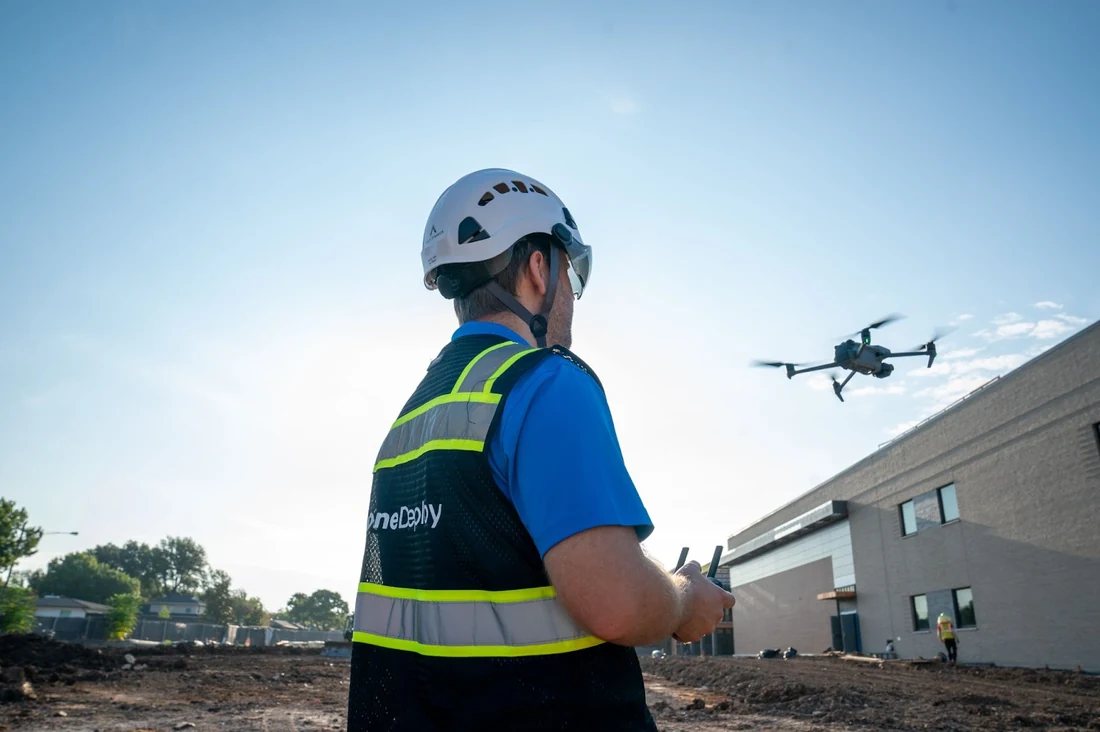
A construction contractor wearing a DroneDeploy-branded high-visibility vest and white hard hat operates a DJI drone over an active commercial construction site, with the drone visible in the upper right corner of the frame against a clear sky and a partially-completed building visible in the background
DroneDeploy Aerial in production — DJI flight over a commercial site, captured imagery flows into Procore via the native integration.

The Aerial side is what built DroneDeploy. A contractor flies a drone over an outdoor site (DJI Mavic/Mini/M30 series are the most-used; DJI Mini 4 Pro support added October 2025). The platform processes the imagery into:

  • Orthomosaics — high-resolution top-down composites that cover the whole site
  • 3D models — photogrammetric reconstructions usable for measurement and BIM coordination
  • Point clouds — exportable for downstream surveying workflows
  • Volume calculations — stockpile, cut/fill, earthworks volumes from the same imagery
  • Site progress — week-over-week and month-over-month comparison views

Use cases that fit:

  • Heavy-civil and earthworks contractors measuring stockpile and cut/fill volumes weekly
  • Commercial GCs documenting site progress for owners on large outdoor projects (data centers, healthcare campuses, multifamily complexes)
  • Mining and energy operations for stockpile management and inspection
  • Agricultural operations using DroneDeploy Ag (the entry-level $1,908/year tier)
  • Utility, rail, and renewables inspection via Inspection AI’s predictive-maintenance workflow

Use cases that don’t fit:

  • Residential roofing contractors measuring individual roofs — EagleView and Hover serve them with pre-flown imagery; you don’t need to fly your own drone
  • Residential remodelers doing additions and kitchens — drone flyovers add nothing to a single-family workflow
  • Service-trade businesses (HVAC, plumbing, electrical) — there’s no Aerial use case at all

For contractors who don’t already own and operate drones, the Aerial side is editorial color, not a buying reason. The Ground product is what most contractor readers should evaluate.


What DroneDeploy Costs in 2026

Pricing transparency on the Aerial side is unusually good for a commercial-construction platform; pricing transparency on the Ground side is genuinely opaque.

2026 Pricing · Verified May 4 2026
Published Aerial Tiers · Custom-Quote Ground

Aerial pricing is on the public pricing page. Ground tier pricing is sales-only — plan for two-to-three discovery calls.

Ag Lite · Aerial
\$1,908 /year individual
Agricultural drone analysis
Entry tier for ag operators; not relevant for contractor audience but anchors the price floor
Flight & Analysis · Aerial
\$4,188 /year individual
Drone flights · orthomosaics · 3D · volumes
The realistic individual-pilot Aerial entry tier for heavy-civil contractors
Advanced · Aerial
Custom quote
Multi-user · enterprise · API
Sales-quoted from here up — most commercial GCs land here
Ground · 360 Walks
Custom quote
Ex-StructionSite · 360 walks + AI
Ground Pro Beta (LiDAR/RTK/8K) coming 2026, pricing TBD

14-day free trial, no credit card. Annual billing saves ~30% versus monthly on individual Aerial plans. Demand renewal pricing in writing before signing — enterprise SaaS in this category routinely escalates 15-30% at year-two.

The honest read on pricing: for a 25-person commercial GC running Ground across 4-6 active projects, expect annual contracts in the high four-figures to low five-figures based on aggregator-sourced ranges. Implementation and training fees aren’t publicly disclosed; ask. The Ground Pro Beta tier (announced for 2026, adds mobile LiDAR, RTK, and 8K imagery) doesn’t have published pricing yet either.

If your operation can’t tolerate two-to-three discovery calls before you see a real number, this isn’t the product for you, and that’s a structural fit issue more than a complaint.


The AI Stack: Three Products, One Engine

This is where DroneDeploy has pulled clear daylight on most photo-documentation competitors in 2025-2026.
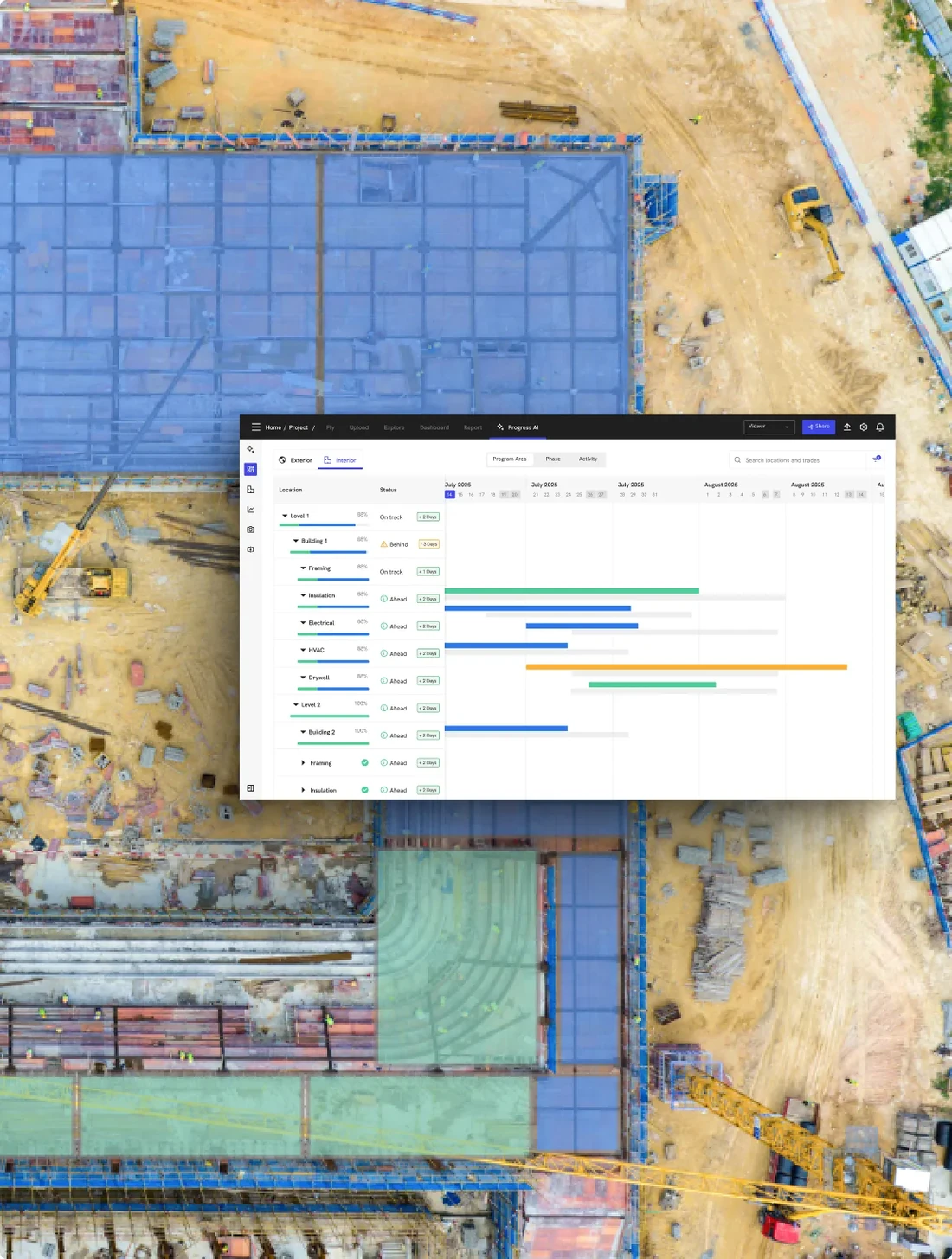
DroneDeploy Progress AI dashboard view showing an aerial photograph of a commercial construction site with semi-transparent blue BIM overlay covering the building footprint to indicate planned versus actual construction state, with a darker grid pattern visible underneath showing the building structure being tracked
Progress AI overlays BIM data on aerial site imagery to track work-in-place by trade and percent-complete.

Progress AI launched July 2025 and is the headline. Tracks 80-plus trade types with claimed 95-percent accuracy. Delivers reports within 2 hours of upload. Requires no BIM model or schedule prerequisite — the AI infers progress from imagery alone. Used on 3-million-plus sites in 180 countries. The contractor-relevant claim: percent-complete by trade across the project, derived from imagery rather than a manually-maintained schedule.

Safety AI got a unified dashboard in April 2025 after several years of incremental hazard-detection features. Auto-detects fall protection, PPE compliance, and hazardous conditions across captured imagery with 90,000-plus detections to date. Customer-enabled with project-level enable/disable controls — useful for operations where safety-AI alerts could create labor-relations friction if turned on without crew briefing.

Inspection AI handles predictive maintenance for oil and gas, rail, renewables, and utilities. Visual review with severity ranking. Exports to asset-management systems. Most contractor readers won’t use Inspection AI; it’s relevant for energy-side and infrastructure operators.

DroneDeploy LiDAR point-cloud scan output of a commercial construction site interior, showing dense scan data with materials and equipment visible, overlaid with red circular pin markers indicating annotated locations or detected items along the scan path
DroneDeploy LiDAR point-cloud output with location pins — the kind of data downstream AI workflows operate on.

The 2026 roadmap announced at Horizons 2025 added embodied-AI ground robots in beta deployments (Boston Dynamics Spot is already in production with Turner Construction; OnSight ground robots add autonomous UGV capture with thermal imaging), Gaussian Splats for 3D capture, mobile RTK for surveying-grade positioning, and automated earthworks calculation. The “zero robotics knowledge required” framing matters — DroneDeploy is explicitly trying to remove the human from routine inspection-walk capture.

Versus Procore Copilot specifically: different shape entirely. Procore Copilot is conversational AI across the broader project-management platform (“show me all RFIs from last month with cost-impact”); DroneDeploy AI is reality-capture-domain-specific (“what percent-complete is the framing on level 4?”). Most enterprise commercial GCs run both — they’re complementary, not competing. Versus Raken AI: Raken’s three features (Photo Tagging, Photo ID, Daily Report Summaries) are utility-narrow; DroneDeploy AI is broader and deeper, especially on percent-complete-by-trade quantification. Versus CompanyCam AI: roughly even on photo tagging maturity but DroneDeploy’s plan-pinning automation goes deeper because the underlying capture model (360-degree spatial walks with BIM alignment) gives the AI more spatial context to work with.


Integrations: Commercial-Construction-Native, Residential-Trade-Absent
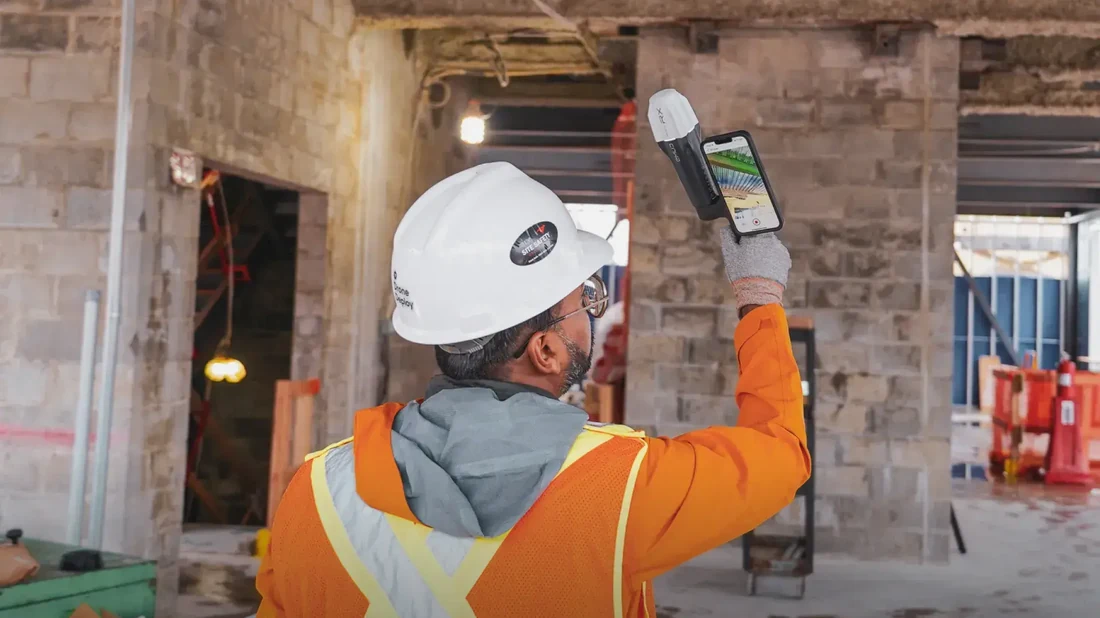
A construction contractor wearing a white DroneDeploy-branded hard hat and orange high-visibility safety jacket holds up a phone-mounted 360-degree camera capture device while standing inside a commercial concrete-block building under construction, illustrating the DroneDeploy Ground interior 360-walk capture workflow with native Procore data sync
DroneDeploy Ground interior capture — a contractor in a DroneDeploy-branded hard hat documenting a concrete-block interior; data flows into Procore via the native integration.

The integration story is the cleanest single fit signal in DroneDeploy’s value proposition.

What DroneDeploy IS natively integrated with:

  • Procore — DEEP. First reality-capture platform to integrate Procore BIM in 2021. Embedded App lives inside Procore’s UI. Photos sync to Procore Albums twice daily. RFI creation directly on 360-degree photos. Drawings auto-sync. Procore credentials handle SSO. The October 2025 release deepened the integration further with bidirectional model updates.
  • Autodesk Construction Cloud + Autodesk Build — auto-sync for BIM added October 2025, bidirectional model updates, “Replace BIM” preserving alignment.
  • BIM 360 — yes, the legacy Autodesk integration.
  • Bluebeam — listed in DroneDeploy’s app marketplace, depth on Ground specifically unverified during research.
  • Cloud storage — Box, Google Drive, OneDrive, SharePoint, Egnyte, Dropbox, ShareFile, Amazon S3.
  • GIS — ArcGIS Online, Esri.

What DroneDeploy is NOT integrated with — verified May 4, 2026:

ToolNative?Why it matters
JobNimbusNoRoofing CRM — different market
JobberNoResidential service FSM
Housecall ProNoResidential service FSM
ServiceTitanNoService-trade FSM
AccuLynxNoRoofing/insurance CRM
GoHighLevelNoMarketing automation
Smith.aiNoAI receptionist (different category)
CompanyCamNoCompeting photo-doc product
RakenNoAdjacent commercial daily-reports
BuildertrendNoResidential GC platform
FieldwireNoAdjacent field-PM product

Practical implication: if your operation runs the residential-trade FSM stack, DroneDeploy is structurally the wrong product. It’s built for commercial GCs running Procore and Autodesk, and its integration roster reflects that by design — not by oversight. If you came in expecting DroneDeploy to slot into a Jobber + JobNimbus + AccuLynx workflow, CompanyCam is what you actually want. CompanyCam ships those native integrations, has cleaner photo organization for the residential photo-with-job model, and costs an order of magnitude less per seat.

For the marketing-automation-plus-FSM case that comes up often in residential service trades — running Jobber + GoHighLevel as a paired stack under $400 a month combined — DroneDeploy doesn’t slot in there either. That’s a different stack for a different audience entirely.


What Real Contractors Say (And Why the Sample Is Thin)

The customer-sentiment data on DroneDeploy in 2026 is harder to source than for most products on this hub, and that’s worth being honest about.

The pre-acquisition StructionSite Capterra listing went inactive after the November 2024 sunset. The current DroneDeploy Capterra listing has only 9 reviews dated 2020-2023 with a 4.1/5 average — and those reviews predate Progress AI, Safety AI, the Ground rebrand, and the 2026 product. G2 is similarly thin and absorbed StructionSite reviews into the DroneDeploy listing during the brand merge. Real customer-sentiment data has to come from named case studies and the customer-logo wall, which DroneDeploy publishes prominently — Turner, Rio Tinto, DPR Construction, Bayer, Skanska, BP, McCarthy Building Companies, Ryan Companies, Walsh Group, Clayco, AECOM, Layton Construction, Weitz, PCL.

A few verifiable named quotes worth pulling forward:

“If a picture is worth a thousand words; a 360 photo is worth a million.” — Albert Zulps, Director of Emerging Technology, DroneDeploy Ground product page

“They have made this software incredibly easy to use.” — Steven K., Pilot, Airlines/Aviation, Capterra 5/5 stars · September 19, 2023

“Everything has been seamless.” — Eric C., Safety Officer, Construction industry, Capterra 5/5 stars · December 13, 2021

“Software has fail twice causing the lost of 2 drones.” — Fernando G., CEO, Security & Investigations industry, Capterra 1/5 stars · September 10, 2020

The Fernando G. quote is the worth-taking-seriously critical one — drone-loss events on the Aerial side are a real risk pattern even if rare, and contractors flying $5,000-$20,000 DJI drones over their own jobsites should price the insurance and the hardware-loss math into the buying decision. The most-quoted production case study is Turner Construction’s deployment of Boston Dynamics Spot for autonomous walks, which the company cites as 95-percent-plus inspection-time reduction — a bigger ROI claim than the Capterra sample can validate, but verifiable through Turner’s own published case study.

For contractors who weight Capterra heavily, the data is genuinely thinner than CompanyCam (4.7 across 1,800-plus reviews) or Raken (4.6 across 248). The named-customer evidence is strong; the aggregated review evidence is weak. Both are real signals.


What Changed in 2025-2026

Three updates from the last twelve months are worth flagging.

StructionSite sunset (November 1, 2024). Paid customers migrated to DroneDeploy Ground. Founder Matt Daly is now General Manager of AEC and Integration at DroneDeploy. Co-founders Phillip Lorenzo and Dan Zito remain referenced. The legacy structionsite.com domain returns 403; logins now run through app.dronedeploy.com. Customer data, projects, and 360-degree walk archives migrated automatically.

April 2025 release. Insta360 X5 support announcement preview, customer-enabled Safety AI, high-performance minimap, offline deliverable filtering by date and level, BIM alignment by level (important for ex-StructionSite migrated projects), simplified project creation.

July 2025 — Progress AI launch. 95-percent accuracy claim across 80-plus trade types, 2-hour reports, no BIM-model or schedule prerequisite required.

Horizons 2025 (October). Three AI agents (Progress, Safety, Inspection), 2026 beta of embodied-AI ground robots, Gaussian Splats for 3D capture, mobile RTK, automated earthworks. Docked drones operating on 100-plus projects.

October 2025 release. Insta360 X5 fully supported, Autodesk Construction Cloud auto-sync for BIM, “Replace BIM” preserving alignment, BIM-vs-360-panorama compare side-by-side, DJI Mini 4 Pro support, geofences, manual flight override for docks.

2026 roadmap. Embodied-AI ground robot beta deployments (Spot already in production at Turner Construction). DroneDeploy Ground Pro tier with mobile LiDAR, RTK, and 8K imagery — pricing not yet announced.


Who Should Use DroneDeploy

Six contractor archetypes where DroneDeploy is editorially the right pick.

Commercial general contractors at $1M-plus revenue scale running Procore-coordinated jobs with BIM coordination requirements. The platform was built for you.

Specialty trade subcontractors on commercial jobs — concrete, framing, mechanical, electrical, drywall, glazing — required to submit progress documentation to a GC who runs Procore. You can run DroneDeploy without buying Procore yourself; data still flows into the GC’s Procore via the native integration.

Owner-developers managing portfolios of large interiors — data centers, healthcare campuses, multifamily complexes, industrial buildings — where the executive-level reporting layer is load-bearing.

Heavy-civil and earthworks contractors using drones for stockpile measurement, cut-fill volumes, and weekly site progress flyovers. The Aerial side is where DroneDeploy’s enterprise depth lives, and this is the audience that uses it most.

Industrial operations in oil and gas, rail, renewables, utilities, mining — Inspection AI handles the predictive-maintenance workflow at scale.

Compliance-heavy commercial operations running OSHA-driven safety programs where Safety AI’s auto-detection of PPE compliance and fall hazards is meaningful documentation.


Who Should NOT Use DroneDeploy

Six wrong-fit contractor archetypes with explicit redirects.

Residential remodelers and custom home buildersBuildertrend is purpose-built with native scheduling, customer portal, sales pipeline, selections, and proposal workflow that DroneDeploy doesn’t ship and isn’t trying to. Use Buildertrend.

HVAC, plumbing, and electrical service businessesWorkiz, ServiceTitan, Jobber, or Housecall Pro are the right tools. Multi-tech dispatch, recurring service plans, customer-facing booking, GPS routing — none of which DroneDeploy does, all of which you need. If you also want marketing automation and AI call answering on top, the Jobber + GoHighLevel paired stack under $400 a month combined is the right pairing — neither half integrates with DroneDeploy and that’s by design.

Roofing contractors with insurance workJobNimbus or AccuLynx handle Xactimate scope, supplements, EagleView measurements, and the production-board workflow DroneDeploy doesn’t model. For roof-only measurement, EagleView and Hover serve pre-flown imagery without the contractor needing to fly drones at all.

Solo contractors and 1-5-person residential shops — DroneDeploy’s enterprise pricing structure plus commercial feature density is overkill. CompanyCam at $13/user/month for the residential photo-with-job model, or Contractor Foreman at $332/month flat for unlimited users, is the right cost-to-value fit.

Photo-doc-first residential operations where photos are 80-plus percent of the buying reason — CompanyCam has cleaner photo organization UX, deeper photo AI search, lower per-seat cost, and native integrations to JobNimbus, Jobber, AccuLynx, Buildertrend that DroneDeploy doesn’t ship. If you want CompanyCam’s clean residential workflow at residential pricing, get CompanyCam.

Operations needing transparent published pricing — DroneDeploy’s Ground tier is sales-quoted only. If you can’t tolerate two-to-three discovery calls before you see a number, the product isn’t going to fit and that’s a structural mismatch, not a vendor failing.


The Verdict

DroneDeploy in 2026 is the most defensible reality-capture platform for commercial construction, and the editorial moat is the unified Aerial-plus-Ground-plus-AI architecture. Two products under one platform, sharing one AI engine, integrating natively with the enterprise commercial-construction stack (Procore, Autodesk Construction Cloud, BIM 360, Bluebeam) and explicitly not integrating with the residential-trade FSM stack. Progress AI’s 95-percent-accuracy claim across 80-plus trades is the strongest AI claim in photo-documentation, and the 2026 ground-robot roadmap moves the platform toward autonomous capture in a way no competitor has matched.

The honest catches matter. Pricing on the Ground side is custom-quote, with two-to-three discovery calls before you see a real number. The Capterra sample is thin because the StructionSite-to-DroneDeploy brand merge wiped review history. Mobile workflow has known sharp edges that residential photo apps don’t share. Zero native integrations with the residential-trade FSM stack — by design, but disqualifying for that audience.

Buy DroneDeploy if you’re a commercial GC running Procore-coordinated jobs, a specialty sub on commercial work required to submit BIM-aligned documentation, an owner-developer with a portfolio of large interiors, a heavy-civil contractor measuring earthworks volumes, an industrial operator running predictive-maintenance inspection workflows, or a compliance-heavy commercial operation where Safety AI’s documentation layer is load-bearing.

Skip DroneDeploy entirely if you’re residential remodeling (use Buildertrend), HVAC/plumbing/electrical service (use Workiz, ServiceTitan, Jobber, or HCP), roofing insurance work (use JobNimbus or AccuLynx), solo or 1-5 employees (use CompanyCam or Contractor Foreman), photo-doc-first at the residential price point (use CompanyCam), or sales-pipeline-driven (use the Jobber + GoHighLevel paired stack).

The editorial honest read: DroneDeploy is a 4.2 in our methodology, not a 4.7, because the contractor-stack-fit-broadly dimensions where it doesn’t compete (residential FSM integrations, transparent pricing, residential-photo-with-job UX) are weighted into the score. The platform-depth signals are real; they just don’t translate to the residential audience that makes up the larger share of contractor readers. Match the audience to your operation, and DroneDeploy is the editorial winner. Match the wrong audience to it, and you’ll have an expensive sales call with no follow-up.

Match the workflow to the tool, not the other way around.

Our Verdict

DroneDeploy in 2026 is two products under one platform: Aerial — the drone-photogrammetry tool the company has shipped since 2013 — and Ground, which is what StructionSite became after DroneDeploy acquired it in October 2022 and migrated paid customers in November 2024. Same AI engine runs across both: Progress AI claims 95% accuracy across 80-plus trades and ships reports in 2 hours; Safety AI auto-flags risks with 90,000+ detections to date; Inspection AI handles predictive maintenance for energy and rail. The Ground side is what most contractor readers came here for — the 360-degree-camera-on-a-hard-hat-monopod walk that auto-pins photos to floor plans, runs BIM Compare against the model, and ships an owner-facing report before the crew leaves the site. Hardware support spans Insta360 X5/X4/ONE RS 1-inch, Ricoh Theta X, plus Boston Dynamics Spot and OnSight ground robots for autonomous capture. The Aerial side is drone photogrammetry — orthomosaics, 3D models, volume calculations, site progress over time — and it's where DroneDeploy's enterprise depth sits at 40% of ENR Top 400, 3.18 million sites across 180 countries. What to know going in. Pricing is custom-quote for Ground (no published tier) and starts around \$4,188 a year for the individual Aerial Flight & Analysis plan. There's a 14-day free trial with no credit card. The integration ecosystem is deeply commercial — Procore deep with embedded app, Autodesk Construction Cloud auto-sync added October 2025, BIM 360, Bluebeam — and it's deliberately not residential. Zero native bridges to Jobber, JobNimbus, Housecall Pro, ServiceTitan, AccuLynx, GoHighLevel, or Smith.ai. Capterra sample size is thin (single-digit reviews on the DroneDeploy listing through 2023; the StructionSite listing was absorbed into DroneDeploy at the brand merge). It's the right pick for commercial general contractors at $1M-plus revenue scale, specialty subs working on commercial jobs that already require BIM coordination, owner-developers managing portfolios of large interiors (data centers, healthcare, multifamily), and heavy-civil contractors using drones for earthworks volumes. It's the wrong pick for residential remodelers (use Buildertrend), HVAC or plumbing service businesses (use Workiz, ServiceTitan, or Jobber), residential roofing with insurance work (use JobNimbus or AccuLynx), and any contractor who wanted CompanyCam's clean residential photo-with-job workflow at $13 a month.

★ 4.2/5

What Works

7 pros
  • Ground (formerly StructionSite) is the strongest 360-degree walk product on the market.
    Hard-hat-mount Insta360 X5 walk, AI auto-pins photos to floor plans during upload, BIM Compare ships side-by-side reality-vs-design view added October 2025, level-by-level BIM alignment for ex-StructionSite migrated projects. Captures sync over WiFi (cellular supported), offline capture with queued upload, video walks in addition to discrete 360 photos. The category-leading customer base — Turner, DPR, Skanska, McCarthy, Ryan Companies, Walsh Group, Clayco — runs production deployments, not pilots.
  • Progress AI shipped July 2025 with claimed 95% accuracy across 80-plus trade types
    and delivers reports within 2 hours of upload, with no BIM model or schedule prerequisite required. Safety AI auto-detects safety risks (90,000-plus detections to date) with the unified Safety AI dashboard added April 2025. Inspection AI handles predictive maintenance for oil & gas, rail, renewables, and utilities. The AI claim that matters most for contractor readers: Progress AI tracks percent-complete by trade across the project, and it does it on imagery, not from a manually-maintained schedule.
  • Procore integration is the deepest in the photo-documentation category.
    DroneDeploy was the first reality-capture platform to integrate Procore BIM in 2021. Embedded App lives inside Procore's UI. Photos sync to Procore Albums twice daily. RFI creation directly on 360 photos. Drawings auto-sync. Procore credentials handle SSO. The October 2025 release added Autodesk Construction Cloud auto-sync for BIM with bidirectional model updates — both flagship commercial PM platforms now connect natively.
  • Boston Dynamics Spot integration moves DroneDeploy toward autonomous capture.
    Turner Construction reports 95-percent-plus inspection-time reduction using Spot for site walks. OnSight ground robots add autonomous UGV capture with thermal imaging. The 2026 roadmap announced at Horizons 2025 added embodied-AI ground robots in beta deployments. Most photo-documentation tools assume a human walks the site; DroneDeploy's roadmap explicitly removes the human.
  • Aerial side is the original product and still the deepest drone-photogrammetry platform on the market.
    Drone-flown orthomosaics, 3D models, point clouds, volumetric measurements (stockpile and earthworks calculations), site progress over time. October 2025 release added DJI Mini 4 Pro support, geofences, manual flight override for docks. Heavy-civil contractors, mining operators, and ag operations make up the majority of Aerial-only customers; commercial GCs use Aerial for site flyovers paired with Ground for interior documentation.
  • Compliance posture matches enterprise procurement requirements.
    SOC 2 Type 2 certified, ISO 27001 certified. Customer logos include Turner, Rio Tinto, DPR, Bayer, Skanska, BP, Corteva, Scotts, Laing, Woodside, ConocoPhillips, AECOM, Skender, Monrovia, Layton Construction, Weitz, PCL. For a $50M-plus commercial GC where vendor security review is a 6-week process, DroneDeploy clears it; smaller residential platforms typically don't.
  • The combined platform — Aerial + Ground + AI — is genuinely unified.
    Same login. Same project hierarchy. Same AI engine running across both halves. Reports ship in the same format. Mobile and web apps cover the full surface. For a commercial GC running both drone flyovers and 360 interior walks on the same project, you're not coordinating two vendors and two data lakes — it's one platform doing both jobs.

What to Watch

7 cons
  • Pricing is custom-quote on the Ground side and there's no published tier table.
    dronedeploy.com/pricing shows individual Aerial plans starting at \$4,188/year (Flight & Analysis) and \$1,908/year (Ag Lite), but Ground tier pricing is sales-only. Aggregator sources don't cleanly separate Ground from Aerial pricing. Plan for two-to-three discovery calls before you see a real number for the Ground product, and ask for renewal pricing in writing — enterprise SaaS quotes in this category routinely escalate 15-30 percent at year-two.
  • Zero native integrations with the residential-trade FSM stack.
    No Jobber, no Housecall Pro, no ServiceTitan, no JobNimbus, no AccuLynx, no GoHighLevel, no Smith.ai. No published Zapier path either. DroneDeploy is built for commercial construction running Procore and Autodesk Construction Cloud — if your stack is residential FSM, this is structurally the wrong product and CompanyCam is what you actually want.
  • Capterra and G2 review sample size is thin for the rebranded platform.
    The pre-acquisition StructionSite Capterra listing went inactive after the November 2024 sunset; the DroneDeploy Capterra listing has only 9 reviews dated 2020-2023 (4.1/5 average) — those reviews predate Progress AI, Safety AI, the Ground rebrand, and the 2026 product. Real customer-sentiment data has to come from named case studies (Turner, McCarthy, Ryan Companies are documented) rather than aggregated review platforms. For contractors who weight Capterra heavily, the data is thinner than CompanyCam's 4.7 across 1,800-plus reviews or Raken's 4.6 across 248.
  • Mobile app friction is real and persistent.
    The legacy StructionSite Construction App (still floating in app stores) showed 5.0 across 152 reviews — but the recurring complaint pattern (video uploads over 6 minutes failing, "drawings out of date" errors requiring restart, app needing restart on large drawing files) carried into DroneDeploy Ground. For superintendents documenting 30-story commercial projects with multi-hundred-page drawing sets, the mobile workflow has known sharp edges that smaller residential photo apps don't share.
  • StructionSite brand confusion lingers in 2026.
    Customers who Google "StructionSite" still find legacy help docs, the original mobile app listing, and stale reviews — but pay for DroneDeploy Ground and log in at app.dronedeploy.com. Nobody at DroneDeploy is hiding the migration, but the brand transition is messy enough that you'll occasionally see a sales rep say "StructionSite" mid-call out of habit. Worth knowing if you're inheriting a legacy contract or trying to onboard a new team that remembers the old brand.
  • OpenSpace beats DroneDeploy on standalone 360-walk processing speed and the recent Disperse acquisition.
    OpenSpace's Vision Engine processes 360 walks in roughly 15 minutes versus DroneDeploy's 2-hour Progress AI cycle (different products solving different problems, but the speed gap matters for tight bid windows). OpenSpace acquired Disperse in October 2025, adding human-verified computer-vision verification — a layer DroneDeploy doesn't directly match. G2's head-to-head shows reviewers favor OpenSpace for ongoing product support and the standalone 360-walk use case.
  • Ground integrations are not yet at parity with Aerial integrations
    per DroneDeploy's own help docs ("This article refers to Aerial integrations only. Ground integrations are not yet available" appears across multiple integration-specific articles). Procore is the obvious exception — it works for both — but if your workflow needs ACC auto-sync for Ground specifically, Bluebeam Ground depth, or Microsoft Teams Ground integration, verify the depth during your demo because the public documentation is uneven.

Frequently Asked Questions

They're two halves of the same platform, solving different capture problems. DroneDeploy Aerial is the original 2013 product — a contractor flies a drone (DJI Mavic, Mini, M30 series) over an outdoor site, the platform processes the imagery into orthomosaics, 3D models, point clouds, and volumetric measurements. Use cases: earthworks volumes for heavy-civil, site progress flyovers for commercial GCs, agricultural field analysis, mining stockpile measurement, utility/rail/renewables inspection. DroneDeploy Ground is what StructionSite became after DroneDeploy acquired it in October 2022 and sunset the brand on November 1, 2024 — a hard-hat-mount Insta360 X5 (or Ricoh Theta X) 360-degree camera walk through interior spaces, with AI that auto-pins photos to floor plans and runs BIM Compare against the design model. Use cases: commercial interior documentation, BIM verification, owner-facing progress reports, defect tracking. Same login, same project hierarchy, same AI engine running across both. Most commercial GCs use them paired — Aerial for site flyovers, Ground for interior walks, both feeding the same Procore-integrated reality-capture record.
Pricing splits across published individual Aerial plans and custom-quote Ground tiers. Aerial individual plans (published at dronedeploy.com/pricing as of May 4 2026): Flight & Analysis at \$4,188/year, Ag Lite at \$1,908/year, Advanced Flight & Analysis at custom-quote. Ground tiers (commercial 360-walk product): custom-quote only — there is no published tier table. Sales-led conversation required. Free trial: 14 days, no credit card required. Annual discount: Approximately 30 percent versus monthly billing on individual Aerial plans. Implementation/training fees: Not publicly disclosed; plan to ask. Ground Pro Beta (announced 2026, mobile LiDAR/RTK and 8K imagery): coming soon, pricing TBD. Practical implication for contractors: budget two-to-three discovery calls into the timeline before you see a real Ground number. Demand renewal pricing in writing before signing — enterprise SaaS in this category routinely escalates 15-30 percent at year-two. For a 25-person commercial GC running Ground across 4-6 active projects, expect annual contracts in the high four-figures to low five-figures based on aggregator-sourced ranges, but verify against your own quote.
No — none of them, and there is no published Zapier path either. Verified May 4 2026 against DroneDeploy's app marketplace. DroneDeploy's integration ecosystem is deeply commercial-construction-flavored, which is why none of the residential-trade CRMs and FSMs are on the list. What DroneDeploy IS natively integrated with: Procore (DEEP, embedded app, BIM Compare integration, RFI creation on 360 photos, drawings auto-sync, photos sync to Procore Albums twice daily — first reality-capture platform to integrate Procore BIM in 2021), Autodesk Construction Cloud + Autodesk Build (auto-sync for BIM added October 2025, bidirectional model updates), BIM 360 (legacy Autodesk integration), Bluebeam (depth on Ground unverified — published listing exists), cloud storage (Box, Google Drive, OneDrive, SharePoint, Egnyte, Dropbox, ShareFile, Amazon S3), GIS (ArcGIS Online, Esri). Practical implication for trades: if your operation runs Jobber, JobNimbus, AccuLynx, Housecall Pro, ServiceTitan, or GoHighLevel — those tools all ship their own job-attached photo workflow, and DroneDeploy is structurally the wrong layer to add. The right pick depends on your trade: roofing/storm-restoration on JobNimbus, residential remodelers on Buildertrend, HVAC service on Workiz or ServiceTitan, photo-doc-first on CompanyCam. DroneDeploy's market is commercial GCs running Procore — that's the integration story, by design.
Three production-shipped AI products plus 2026 agentic-AI roadmap. (1) Progress AI (launched July 2025): tracks 80-plus trade types with claimed 95-percent accuracy, delivers reports within 2 hours of upload, requires no BIM model or schedule prerequisite. Used on 3M-plus sites in 180 countries. (2) Safety AI (April 2025 unified dashboard): auto-detects safety risks (fall protection, PPE compliance, hazardous conditions) with 90,000-plus detections to date, customer-enabled with project-level enable/disable controls. (3) Inspection AI: predictive maintenance for oil & gas, rail, renewables, utilities — visual review, severity ranking, export to asset-management systems. 2026 roadmap announced at Horizons 2025: embodied-AI ground robots in beta deployments (Boston Dynamics Spot already in production at Turner Construction with 95-percent-plus inspection-time reduction), Gaussian Splats for 3D capture, mobile RTK, automated earthworks calculation. Versus Procore Copilot: different shape — Procore Copilot is conversational AI across the broader PM platform ("show me all RFIs from last month with cost-impact"); DroneDeploy AI is reality-capture-domain-specific ("what percent-complete is the framing on level 4?"). They're complementary, not competing — most enterprise commercial GCs run both. Versus CompanyCam AI: roughly even on photo tagging maturity but DroneDeploy's plan-pinning automation is deeper. Versus Raken AI: Raken's three features (Photo Tagging, Photo ID, Daily Report Summaries) are utility-narrow; DroneDeploy AI is broader and deeper, especially Progress AI's percent-complete-by-trade quantification.
StructionSite was acquired by DroneDeploy on October 12, 2022 (announcement) with the deal closing November 4, 2022. Paid customers were migrated to DroneDeploy Ground on November 1, 2024, and StructionSite ceased operating as a standalone product. Founder Matt Daly (StructionSite co-founder + CEO) is now General Manager of AEC & Integration at DroneDeploy. Co-founders Phillip Lorenzo and Dan Zito remain referenced. What this means for legacy customers: your data, projects, floor plans, and 360-degree walk archives migrated automatically to DroneDeploy Ground at the November 2024 cutover. Login is now at app.dronedeploy.com (not the legacy structionsite.com domain — that returns 403). The legacy StructionSite Construction App in Apple's App Store still appears in search results but redirects to DroneDeploy Ground. What carried over: all photos, plans, projects, integrations to Procore (which deepened post-merger), team accounts. What changed: the brand name on every UI surface, the marketing positioning (DroneDeploy frames Ground as half of a unified Aerial + Ground reality-capture platform rather than a standalone 360-walk product), and the AI layer (legacy SmartTrack functionality from 2020 is now Progress AI, with broader trade coverage and the 95-percent accuracy claim). If you're evaluating now and remember StructionSite: the product capability is intact and arguably stronger than at acquisition; the contract terms and pricing structure changed; verify renewal pricing in writing.
Residential remodelers and custom home buildersBuildertrend is purpose-built with native scheduling, customer portal, sales pipeline, selections, and proposal workflow that DroneDeploy doesn't ship and isn't trying to. HVAC, plumbing, and electrical service businessesWorkiz, ServiceTitan, Jobber, or Housecall Pro are the right tools for multi-tech dispatch, recurring service plans, GPS routing, and customer-facing booking. None of which DroneDeploy does. Roofing contractors with insurance workJobNimbus or AccuLynx handle Xactimate scope, supplements, EagleView measurements, and the production-board workflow DroneDeploy doesn't model. Solo contractors and 1-5-person shops — DroneDeploy's enterprise pricing structure plus commercial feature density is overkill; CompanyCam at \$13/user/month or Contractor Foreman at \$332/month flat is the right cost-to-value fit. Photo-doc-first residential operationsCompanyCam has cleaner photo organization UX, deeper photo AI search, lower per-seat cost, and native JobNimbus + Jobber + AccuLynx integrations that DroneDeploy doesn't ship. Operations needing transparent published pricing — DroneDeploy's Ground tier is sales-quoted only; if you can't tolerate two-to-three discovery calls before you see a number, the product isn't going to fit. Marketing-first contractors who want AI call answering plus FSM — that's a different stack entirely; the Jobber + GoHighLevel paired stack at under \$400/month combined is what most residential service operations should run, and neither half integrates with DroneDeploy.
Get The Next Review

Independent contractor software reviews — in your inbox.

One email when we publish a new product review, head-to-head comparison, or AI tool deep-dive. Field-tested by a tradesman, not recycled vendor copy.

No spam · ~1 email/month · Unsubscribe in 1 click