


Most construction project management software has the same origin story: a SaaS team in San Francisco or New York reads about the construction industry’s tech-adoption gap, raises a Series A, and ships a product that looks like Asana with a hard hat sticker. Projul reads differently. It was built in Saint George, Utah by a working general contractor who needed a system to run his own jobs, then opened it up to other builders when the tooling outgrew the original use case. Whether that origin story changes how the software works in your hands is the question this review is built around.
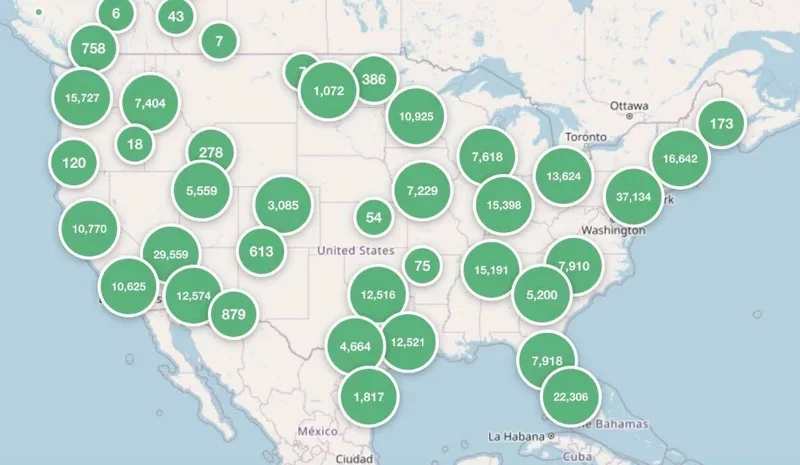
The numbers say the answer is yes — at least for the customers Projul has. The platform carries a 4.7/5 Capterra rating across 21 reviews and a 4.9/5 G2 rating with 9.8 sub-scores on ease of use and quality of support, both rare results for any PM, let alone a construction-specific one. 5,000+ active contractors across all 50 states manage 301,185+ projects on the platform. Capterra reviewer Jon S., a construction owner, summarizes it as “a Construction-based CRM and job/crew management together like no other software.” Ryan A., another construction owner, writes “Projul allowed me to get a better handle on my costs and improve profit margin.” Oliver F., a construction manager, says “their support staff is amazing and patient. I am always able to speak to someone.” That kind of consistent, named-operator review sentiment is not common in this category.
The catches are real and worth naming up front. Annual billing only, no monthly tier. No published free trial. No native AI inside the platform. An integration list that’s narrower than the marketing implies. A review sample of about 30 public reviews — high quality but small. None of those are dealbreakers for the right contractor, but they’re load-bearing decisions, and the rest of this review walks through where Projul earns the rate and where the alternatives win.
What “Built by a Contractor” Actually Means in the Product
The phrase “built by contractors” gets used loosely in this category. Almost every PM platform claims it. What’s worth checking is whether the workflow choices in the product reflect that origin or just the marketing copy.
Projul’s defaults read like the answer. The job-costing module assumes you’ll reset your costs after each job and save that cost data forward to inform the next estimate — which is the way a real contractor learns from job-to-job profitability rather than the way an MBA-designed dashboard surfaces it. Ryan A. (Capterra) calls this out specifically: “the job costing feature allows you to reset costs post-job and saves that cost for next job.” That’s a tiny implementation detail, but it’s the kind of detail that comes from someone who has lost margin three quarters in a row before realizing they were miscoding the same labor line.
The selections module on the Pro tier handles homeowner material decisions before trades start — a workflow that exists because residential remodelers and custom home builders bleed coordination time when finishes get picked late. The geofenced time tracking on Pro enforces job-site clock-in by location, which only matters if you’ve actually had a sub call in from the parking lot of the wrong site. The 1build cost-data integration delivers regional pricing freshness that’s hard to maintain by hand and that’s specifically painful when material costs move 8 to 15 percent quarter-over-quarter, as they have during the 2024-2026 supply-chain cycle.
None of this is unique to Projul in isolation — Buildertrend has Selections, Contractor Foreman has time tracking, several PMs integrate with QuickBooks. What’s distinctive is that Projul ships these as a coherent set rather than as separate add-on modules, and the workflow assumptions across them feel internally consistent. That coherence is what most reviewers point to when they call the platform easy to use despite the construction depth.
Pricing Reality: Annual-Only, Tier-Gated, No Free Trial
This is the part of Projul that requires the clearest-eyed look, because the pricing model is meaningfully different from peers and the surprises tend to come on tier feature-gating.
Published on projul.com/pricing. Annual-only — no monthly tier, no published free trial, no money-back guarantee. $4,500 of Premium Support included on annual signup.
- ✓CRM + estimating + payments
- ✓Mobile + scheduling + reporting
- ✓eSignatures + templates + leads
- ✗No change orders, no portal
- ✗No job costing, no Gantt
- ✓Everything in Core, plus:
- ✓Change orders + client portal
- ✓Job costing + Gantt + timelines
- ✓Time tracking + messaging
- ✓QuickBooks Online sync
- ✓Everything in Core+, plus:
- ✓QuickBooks Desktop sync
- ✓Geolocation + geofencing
- ✓Selections + photo reports
- ✓Assemblies + Spanish translation
Three things to notice. First, there is no monthly billing — the smallest commitment Projul will accept is one year, $4,788 minimum, paid up front or financed over twelve months. Second, the entry-level Core tier is missing most of what contractors associate with construction PM (no change orders, no client portal, no job costing, no Gantt) — for most operations, Core+ is the actual starting tier, not Core. Third, the features that matter for larger crews (geofencing, QB Desktop, selections) all live on Pro at $14,388/year, which is closer to mid-tier Buildertrend or low-end Procore territory.
There’s no published free trial and no money-back guarantee on projul.com. The $4,500 of Premium Support included with annual signup is meant to absorb the implementation-risk premium, and it’s a real value if you use it — but it does not eliminate the year-long commitment if the product turns out not to fit.
For comparison: Contractor Foreman ships transparent monthly tiers ($49 to $332/month) plus a 30-day money-back guarantee. Buildertrend is demo-gated but offers month-to-month billing at a higher rate. ClickUp has a generous free tier and 30-day trial. Projul’s commitment-first model is the outlier in this competitive set, and you should walk into demos knowing that.
The Estimating Engine and the 1build Cost-Data Edge
Projul’s estimating module ships across all three tiers, which is unusual — most peers gate estimating to a higher tier. The line-item estimating, branded proposal PDFs, eSignature capture, and deposit collection are all on Core. Where the depth lives is the 1build integration.
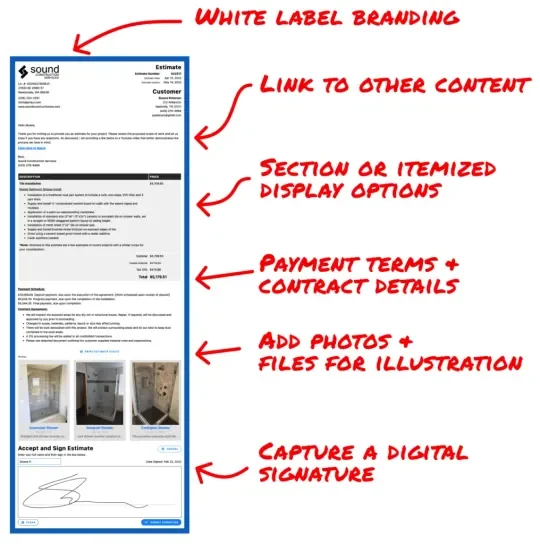
1build is a separate company that maintains a live database of regional construction cost data — labor rates, material costs, equipment pricing — keyed to specific markets and updated continuously. The Projul partnership pulls that data into the estimating engine so when you add a line item like “Install standing-seam metal roof, 1,800 sf, North Texas,” the underlying labor and material rates reflect current Dallas-area pricing rather than a static price book you maintained two years ago.
For contractors who keep their own price books current, that’s a nice-to-have. For contractors who don’t (which is most of them, honestly), it’s a real edge — material price volatility from 2024 forward has been the kind of thing that quietly destroys margin if your estimating data is even six months stale. The 1build integration gives you a defensive floor against that.
The estimating workflow itself is conventional but clean: build line items, organize into sections, attach photos and notes, generate a branded PDF proposal, send for signature, collect deposit through JustiFi-powered payment processing. eSignatures are native. Change orders flow back into the active job from Core+ upward, with budget impact attached.
What it doesn’t do: native aerial measurement (no EagleView or Hover integration), native trade-specific assembly libraries beyond what 1build provides, AI photo-to-estimate workflows like Beam AI or photo-driven roof takeoffs like Roofr ship. If you’re a roofer specifically, you’ll likely pair Projul with EagleView for aerial reports and run them externally. If you’re a remodeler or GC, the 1build feed plus your own templates is generally enough.
Construction-Native Project Management
The PM core kicks in at Core+ with change orders, client portal, job costing, Gantt charts, linear timelines, in-platform messaging, and progress billing. This is the construction PM bundle most reviewers are reacting to when they describe the platform as “construction software done right.”
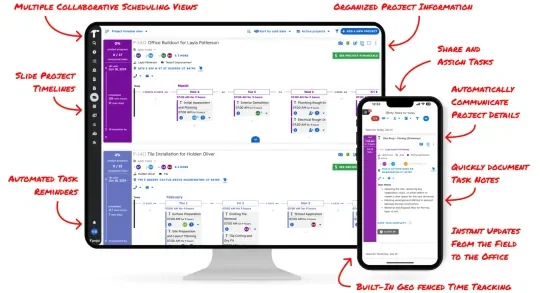
The schedule supports both Gantt and a linear timeline view that’s easier to read on a tablet in the field. Tasks have dependencies, assigned trades, and status indicators. Schedule slip propagates downstream automatically — if you push the framing out three days, the rough-in and inspection tasks shift with it instead of requiring you to drag every dependent line manually. The Build Notes 2.1.240 release on March 24, 2026 added file attachments inside conversations and faster task updates, which sounds incremental but is the kind of polish that compounds over a year of daily use.
Job costing is where customer reviews concentrate the warmest language. Committed costs versus actuals, retainage tracking, and the post-job reset workflow that Ryan A. cited mean the platform is genuinely usable as the source of truth for job-level profitability — which is the bar most PMs miss. The QuickBooks integration on Core+ (Online) and Pro (Desktop) handles the accounting hand-off cleanly, with cost codes, vendor bills, and customer invoices syncing in both directions.
Change orders flow through the client portal for homeowner approval with budget impact attached. Progress billing on Core+ supports AIA-style draws if you’re running larger residential or light commercial work. None of this is breakthrough functionality in 2026 — Buildertrend, Procore, and Contractor Foreman all ship comparable feature sets — but Projul’s implementation lands cleanly and the customer reviews are unusually consistent on this point.
Mobile, Geofencing, and the Field Experience
The mobile app is full-featured rather than a stripped companion to the desktop, which matters because most field crews live on phones rather than at desktops. Job lists, schedule views, daily logs, photo capture, and time tracking all work natively on iOS and Android.
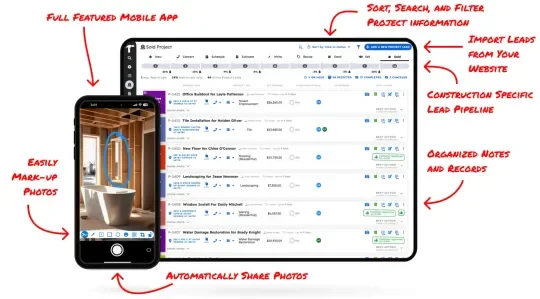
Geofenced time tracking on the Pro tier is the differentiator most contractors with sub crews care about. The app uses GPS to verify clock-in is happening at the actual job-site location rather than from the parking lot of a previous job or from somebody’s couch. For operators who’ve had the conversation about whether a sub really arrived at 7 AM, this isn’t a nice-to-have — it removes a recurring management overhead.
Photo reports on Pro auto-bundle job photos into branded summaries you can send to homeowners or insurance carriers. The CompanyCam integration on all tiers means if you’re already running CompanyCam for photo documentation, the photos sync into Projul jobs automatically rather than living in a separate silo. That’s a smaller integration than most contractors realize matters until they’ve spent six months toggling between CompanyCam and a PM that doesn’t talk to it.
What’s missing from mobile: full-featured offline support is limited (clock in/out works offline, but most other actions require connection), and the app doesn’t ship Spanish-language UI outside the Pro tier — a real gap for crews running in Texas, California, Florida, or the Southwest where bilingual field communication is daily reality.
Integrations: The Real Native List
This is the section where Projul’s coverage runs thinner than the marketing suggests. The native integration list, verified on projul.com as of April 2026:
Projul ships native QuickBooks (both editions), CompanyCam, JustiFi, and 1build — but the daily-use integrations contractors expect (Jobber, JobNimbus, ServiceTitan, EagleView, Hover) are missing. Zapier glue fills some gaps.
- QuickBooks OnlineCore+
- QuickBooks DesktopPro
Rare native QB Desktop sync after Contractor Foreman sunset Jan 2026.
- 1buildAI takeoffs
- CompanyCamall tiers
1build feeds live regional pricing into estimates — closest thing to embedded AI.
- JustiFiwhite-label
- Zapier5,000+ apps
Payment processing native; Zapier fills gaps but breaks under field pressure.
- SRS Distribution
- Beacon
- ABC Supply
Not native: Jobber, JobNimbus, ServiceTitan, Smith.ai, AccuLynx, GoHighLevel, EagleView, Hover, Buildertrend, Xero, HubSpot, Salesforce, DocuSign.
What’s not native: Jobber, JobNimbus, ServiceTitan, Smith.ai, AccuLynx, GoHighLevel, EagleView, Hover, Buildertrend, Xero, HubSpot, Salesforce, DocuSign. Some of these absences make competitive sense (Buildertrend is a competitor; ServiceTitan is FSM-not-PM territory). Others are real gaps — no native EagleView is an issue for roofers; no native HubSpot or Salesforce closes off contractors with marketing-heavy CRM stacks.
The Zapier coverage fills some of this in for low-volume workflows. For high-volume daily integrations, Zapier glue is fragile under real field pressure and tends to break in ways that show up as missed sync events rather than loud errors. If a critical integration is on your shortlist, verify it during demo before signing.
The AI Question: What’s Native, What’s Partner, What’s Missing
Projul does not currently ship native AI features inside the platform. The AI surface is 1build’s cost-data and takeoff partnership, which is real but limited to estimating. Specifically:
- No native AI scheduling — no auto-generated schedule from scope, no AI conflict detection
- No native AI summarization — daily logs don’t auto-summarize into homeowner updates the way Buildertrend’s AI Client Updates does
- No native AI document generation — no AI-drafted change orders, RFIs, or progress reports
- No native AI meeting transcription — no equivalent to ClickUp Brain’s meeting summarization
- No native chatbot or AI assistant — no Brain/Copilot/Wave equivalent inside Projul
What Projul has via 1build:
- AI takeoffs from drawings or photos (separate 1build product, integrated)
- Live regional cost data feeding line-item pricing
- Material cost updates without manual price-book maintenance
For most residential GCs and remodelers in 2026, this is acceptable but not aspirational. The leading construction-PM AI surfaces (Buildertrend’s AI Client Updates and AI Bill Pay; ClickUp Brain across PM workflows) are genuinely useful and Projul has not yet matched them. If AI inside your PM is a top-three buying criterion, Projul currently lags. If your AI priority is keeping estimating cost data fresh without manual upkeep, the 1build integration delivers.
This is the most likely area for Projul to evolve in 2026-2027. The 1build partnership creates a foundation for further AI integration, and the company’s small-team, contractor-led culture suggests they’re more likely to ship AI that actually solves construction problems than to bolt on a generic ChatGPT wrapper for press release purposes. But “future direction” is not a feature you can buy today.
What 5,000+ Customers Say
The named-reviewer testimonials on Capterra and G2 are unusually consistent and worth surfacing in their own voice rather than paraphrased.
Ryan A., Construction Owner (Capterra, 5/5): “Projul allowed me to get a better handle on my costs and improve profit margin. The job costing feature allows you to reset costs post-job and saves that cost for next job!”
Jon S., Construction Owner (Capterra, 5/5): “Projul ties a Construction-based CRM and job/crew management together like no other software. Rescheduling when a customer calls is super easy, I can do it on my phone while on the job.”
Oliver F., Construction Management (Capterra, 5/5): “Their support staff is amazing and patient. I am always able to speak to someone.”
Kasha D., Office Manager (Capterra, 5/5): “With Projul we’ve organized a huge amount of projects helping us grow our business.”
The pattern across these reviews: cost control, ease of mobile use, support quality, and organizational scalability. None of them mention AI. None of them mention integration breadth. The Capterra customer-service sub-score of 4.7/5 and the G2 quality-of-support score of 9.8/10 reinforce the support theme — for a company at Projul’s size (small-team relative to Buildertrend or Procore), that level of support consistency is a real competitive position.
The 4.7/5 Capterra score across 21 reviews and the 4.9/5 G2 score across 9 reviews are exceptionally high but the sample size means they should be read as “very strong signal from a small population” rather than as statistically robust. The marketing claim of “32% average profit increase” and “two-plus hours saved daily per employee” is unverified by independent audit and should be treated as testimonial-derived rather than measured.
Best-Fit Contractor Profiles
Projul earns the rate for specific contractor profiles. It does not earn the rate universally, and being honest about which is which is the right way to read this section.
Projul is the right fit if you are:
- A 5-30 person residential GC, remodeler, or custom home builder running design-build or design-coordinated work where job costing and selections drive margin
- A contractor still running QuickBooks Desktop who needs native PM sync (one of the only options left in 2026)
- A roofer or restoration GC who values the SRS, Beacon, GAF, and ABC Supply native material integrations
- A multi-state operation where geofenced time tracking matters for sub accountability
- A contractor whose top buying criterion is “construction-purpose-built workflows” rather than “AI features” or “broadest possible integration list”
- A team that can absorb a one-year commitment of $7,188 (Core+) or $14,388 (Pro) without trial-period validation
Projul is not the right fit if you are:
- A solo operator or 1-2 person shop where $399-$599/month is heavy relative to monthly revenue — Contractor Foreman at $49/month for 1 user is the right starting point
- A field service operation (HVAC, plumbing, electrical service work) — ServiceTitan or Housecall Pro are FSM-purpose-built where Projul is PM-purpose-built; the workflow shapes are different
- A roofing-only contractor where pure-play estimating with deep aerial integration is the primary need — Roofr, AccuLynx, or JobNimbus lead in roofing-specific workflows
- A custom home builder where the Selections module is the kitchen-table close tool — Buildertrend ships category-leading Selections depth and is worth the renewal-hike risk
- A contractor who needs AI summarization, AI scheduling, or AI document generation natively inside the PM — ClickUp ships ClickUp Brain across the platform; Buildertrend ships AI Client Updates and AI Bill Pay; Projul does not yet
- An operator who wants to validate the platform on a free trial or month-to-month before committing — Projul’s annual-only model rules this workflow out
How Projul Scored Against PM Dimensions
We score project management software on eight dimensions weighted by what actually drives outcomes for residential and small commercial GCs. The table below shows where Projul lands.
Eight dimensions weighted by what drives outcomes for residential and small commercial GCs. Schedule, mobile, and financials are the real strengths; AI capabilities is the real ceiling.
Gantt + linear timeline + auto-cascade dependency shifts. Build Notes 2.1.240 polish.
Change orders, daily reports, file attachments. Lighter on RFI/submittal depth than Procore.
Post-job cost reset, committed-vs-actual, AIA progress billing, native QB sync both editions.
QB both, CompanyCam, 1build, JustiFi, roofing materials. Gaps in CRM, FSM, aerial.
Solid portal with selections + change-order approval. Not Buildertrend-tier.
Flat annual rate, no per-seat creep, $4,500 support included. Annual-only is the cost.
1build cost-data partner only. No native AI inside the platform.
Full-featured mobile, geofenced time tracking on Pro, smooth in customer reviews.
The 70/30 primary-weighted formula multiplies the PM score by 0.70, the Estimating score by 0.30, and adds a 0.20 site calibration constant — landing the top-line rating at 4.0/5. The Estimating score sits lower primarily because Projul has no native aerial measurement (EagleView, Hover) and no AI estimating workflow beyond the 1build cost-data feed.
Where to Look Instead
If Projul isn’t the fit, the alternatives by use case:
- Need transparent monthly billing or a free trial: Contractor Foreman — $49-332/month, 30-day money-back, broad module bundle
- Need category-leading Selections for custom home builds: Buildertrend — $339-829/month, demo-gated, AI Client Updates + AI Bill Pay shipping, 2,483 reviews
- Need full-platform AI assistance: ClickUp — full ClickUp Brain across PM workflows, free tier, $7-19/month per user paid
- Need field service management instead of project management: ServiceTitan for HVAC/plumbing/electrical, Housecall Pro for smaller service operations
- Need a roofing-first CRM with PM features: JobNimbus — roofing-tuned, native EagleView, broader integration ecosystem
- Need lightweight estimating without full PM weight: Roofr for roofing-only, Beam AI for AI-driven photo-to-estimate workflows
The Verdict for Contractors
Projul is the most quietly competitive PM in this category and one of the few that genuinely earns the “built by contractors” claim. The 4.7/5 Capterra and 4.9/5 G2 scores reflect a small but consistently happy customer base, the QuickBooks Desktop sync is increasingly rare and increasingly valuable, the 1build cost-data integration delivers real estimating freshness, and the construction-purpose-built workflows feel internally coherent rather than bolted together.
The catches are real and shouldn’t be glossed: annual-only billing with no trial is a real friction point that costs Projul deals against Contractor Foreman’s transparent monthly model and Buildertrend’s flexibility; the integration list is narrower than the marketing copy implies; native AI inside the platform is currently absent; and the public review sample is small enough that customer reference calls during your evaluation matter more than usual.
For 5-30 person residential GCs, remodelers, and custom home builders who want construction-authored workflows without per-seat pricing inflation — and who can absorb a one-year commitment in exchange for the $4,500 of Premium Support that comes with it — Projul earns a serious slot on the shortlist. For solo operators, FSM workflows, AI-first buyers, or contractors who need to validate before committing, the alternatives win and that’s not a knock on Projul; it’s a recognition that no PM is right for every contractor.
The right way to evaluate Projul is the way you’d evaluate any annual-commitment software: book the demo, ask for a sandbox you can configure with two of your real jobs, get three customer references at your size and trade, and confirm the integrations you depend on daily are on the native list rather than glued together with Zapier. If those checks pass, Projul is one of the cleanest construction-PM picks in the $599-$1,199/month range. If they don’t, walk.